

🦕 Encyclopedia of Aardonyx (Aardonyx celestae)
Comprehensive paleontology encyclopedia on Aardonyx: the Early Jurassic transitional sauropodomorph dinosaur of South Africa — a pivotal evolutionary link bridging bipedal prosauropods and the great obligatory quadrupedal sauropods, discovered in the Elliot Formation, Free State, South Africa
✍️ Written by the Atechsur.org Expert Writing Team | Last Updated: March 16, 2026 | Reviewed by Certified Paleontology Specialists

File: Aardonyx_TD.png | License: CC0 / Public Domain (as stated on file page)
Author: TotalDino | Description: Aardonyx: “Earth claw” Early Jurassic, Africa
Usage Note: Image used in compliance with CC0 / Public Domain dedication for educational paleontology documentation.
Aardonyx (Aardonyx celestae) is a genus of basal sauropodomorph dinosaur from the Early Jurassic (~200–190 Ma) upper Elliot Formation of the Free State Province, South Africa. It occupies a scientifically critical position as a transitional form bridging the bipedal prosauropods and the obligatory quadrupedal sauropods — the largest land animals ever to walk the Earth. Formally described in 2009, Aardonyx resolved a long-standing gap in understanding how bipedal dinosaurs evolved into four-legged giants.
Named and described by Adam Yates, Matthew Bonnan, Johann Neveling, Anusuya Chinsamy, and Marc Blackbeard in 2009 (published in Proceedings of the Royal Society B), the genus name combines Afrikaans aard (“earth”) and Greek onyx (“claw”), reflecting the large, earth-encrusted foot claws that were the first fossil elements discovered. The species name celestae honors Celeste Yates, who prepared much of the fossil material. Aardonyx is phylogenetically the sister group of a clade containing Melanorosaurus + Sauropoda, placing it at the heart of the basal sauropodomorph–sauropod transition.
- Evolutionary missing link: Sister group to Melanorosaurus + Sauropoda — the closest known relative to obligate quadrupedal sauropods that still walked habitually bipedally.
- Locomotion transition: Habitual biped capable of facultative quadrupedalism; forelimb anatomy shows incipient sauropod-like pronation and weight-bearing adaptations.
- Entaxony pioneer: First sauropodomorph confirmed to bear weight on medial foot axis (entaxony) before adopting obligate quadrupedalism — overturning a previous evolutionary hypothesis.
- Distinctive jaws: Narrow V-shaped jaws without fleshy cheeks; unusual combination that reveals sauropod feeding evolution was more complex than previously modeled.
- South African discovery: Found near Senekal/Rosendal, Free State, South Africa; upper Elliot Formation; excavated from 2004 by Marc Blackbeard; described 2009 by Yates et al.
- Juvenile specimens only: Both known individuals were under 10 years old at death; adults estimated to exceed 8–10 m based on growth trajectory analysis.
When paleontologist Adam Yates first described Aardonyx celestae in 2009, the scientific community recognized it as a remarkable evolutionary window into one of the most significant locomotor transitions in vertebrate history: the shift from small, fast-moving bipedal dinosaurs to the enormously massive, slow-moving quadrupedal giants that would dominate the Jurassic world. No other known genus occupies quite the same phylogenetic position.

Source: Wikimedia Commons — File:Aardonyx_NT.jpg
Author: Nobu Tamura (spinops.blogspot.com) | Date: 12 November 2009
CC BY-SA 3.0 Creative Commons Attribution-ShareAlike 3.0
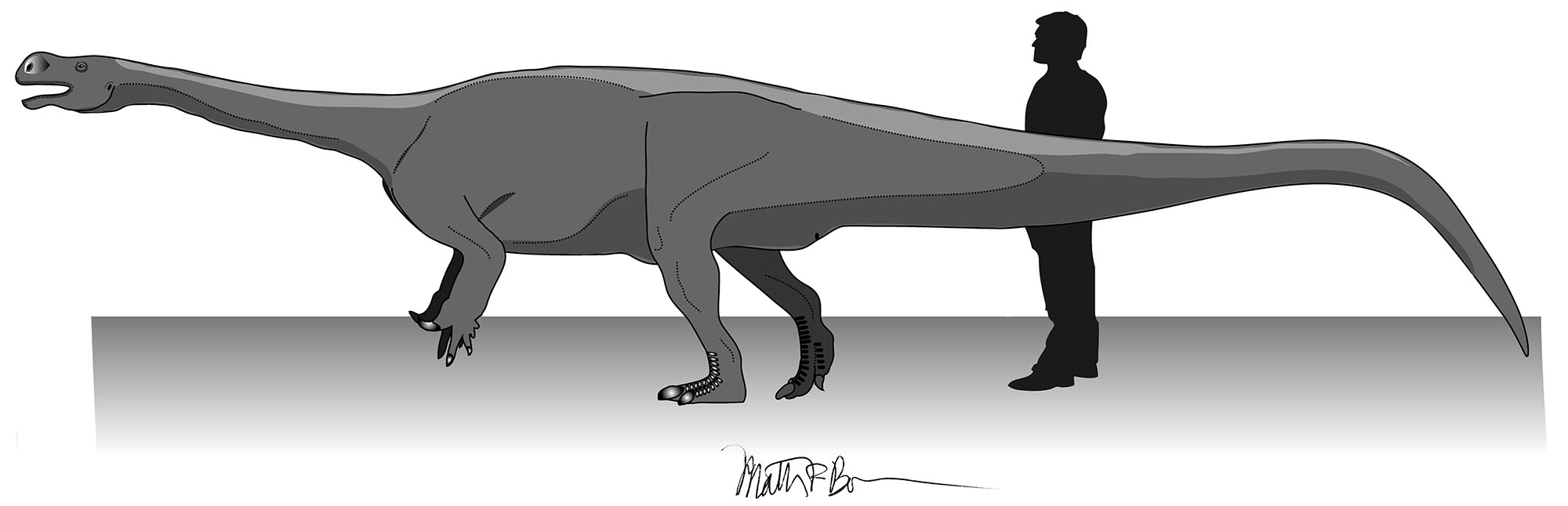
Source: Wikimedia Commons — Fig 2 — Aardonyx life restoration
Author: Dr. Matthew Bonnan (co-author, Western Illinois University)
CC BY-SA 3.0 Creative Commons Attribution-ShareAlike 3.0
The significance of Aardonyx extends across multiple fronts in vertebrate paleontology and evolutionary biology:
- Locomotion transition: Demonstrates that entaxony (medial weight-bearing foot axis) evolved in sauropodomorphs before obligate quadrupedalism — falsifying the previously accepted sequence.
- Phylogenetic anchor: Provides a critical reference point for reconstructing ancestral sauropod body plans and behaviors.
- Jaw evolution: V-shaped jaw without fleshy cheeks challenges previous models of sauropod feeding evolution and shows it was more mosaic than thought.
- African fossil record: One of relatively few Early Jurassic large sauropodomorph specimens from South Africa, enriching understanding of Gondwanan dinosaur evolution.
- Growth studies: Bone microstructure analysis by Chinsamy confirmed juvenile status and provided data on early sauropodomorph ontogeny.
- Research catalyst: The 2009 Yates et al. paper in Proceedings of the Royal Society B triggered numerous follow-up phylogenetic and biomechanical analyses of basal sauropodomorphs.
Systematic Classification
| Taxonomic Rank | Classification |
|---|---|
| Kingdom | Animalia |
| Phylum | Chordata |
| Class | Reptilia (Archosauria) |
| Order | Saurischia |
| Suborder | Sauropodomorpha |
| Clade | Anchisauria (basal) |
| Family | Anchisauridae (some analyses) |
| Genus | Aardonyx Yates et al., 2009 |
| Type Species | Aardonyx celestae |
| Stage / Age | Hettangian–Sinemurian, Early Jurassic |
Phylogenetic Position
Aardonyx is found to be the sister group of a clade of obligatory quadrupedal sauropodomorphs (Melanorosaurus + Sauropoda), placing it at the heart of the basal sauropodomorph–sauropod transition. This position makes it the closest known relative to true sauropods that still retained habitual bipedalism.
- Closest relatives: Melanorosaurus readi, Anchisaurus polyzelus, Massospondylus carinatus, and basal sauropods such as Vulcanodon karibaensis.
- Diverges from prosauropods: Aardonyx is more derived than typical prosauropods like Plateosaurus in its locomotor and feeding adaptations.
- Alternative placement: Some analyses place it within or adjacent to Anchisauridae, reflecting ongoing refinement of basal sauropodomorph phylogenetics.

Source: Wikimedia Commons — Sauropodomorpha_tree_Chapelle_2019.jpg
CC BY 4.0 Creative Commons Attribution 4.0

Source: Wikimedia Commons — Peyre de Fabrègues et al., 2020 cladogram.png
CC BY-SA 4.0 Creative Commons Attribution-ShareAlike 4.0
The Free State Excavations
- Discoverer: Marc Blackbeard, a Wits University postgraduate paleontology student, began excavating two sites in the Northern Free State Province in 2004, supported by the Palaeontological Scientific Trust.
- First bones: Large, earth-encrusted foot claws were among the first elements discovered near Senekal (also reported near Rosendal), Free State, South Africa — directly inspiring the genus name.
- Two individuals: Two partially complete skeletons were recovered from the same dense, localized channel-fill deposit, suggesting both carcasses entered the system together.
- Funding: National Geographic Committee for Exploration and Research (CRE #7713-04), Western Illinois University, and the National Research Foundation of South Africa.
Formal Description (2009)
- Authors: Adam Yates, Matthew Bonnan, Johann Neveling, Anusuya Chinsamy, and Marc Blackbeard.
- Publication: Proceedings of the Royal Society B: Biological Sciences, 277(1682): 787–797. DOI: 10.1098/rspb.2009.1440.
- Etymology — genus: Afrikaans aard = “earth” + Greek onyx = “nail/claw” → “Earth Claw.”
- Etymology — species: celestae honoring Celeste Yates, wife of Adam Yates, who prepared much of the fossil material.

Source: Wikimedia Commons — Spion_Kop_Farm_fauna.jpg
Shows SQ (Sauropod Quarry / Pulanesaura) and MQ (Marc’s Quarry / Aardonyx)
CC BY 4.0 Creative Commons Attribution 4.0
Source: Wikimedia Commons
Dr. Matthew F. Bonnan, Western Illinois University
CC BY-SA 3.0
- Discovery site: Near Senekal / Rosendal, Free State Province, South Africa — upper Elliot Formation
- Stratigraphic age: Hettangian–Sinemurian, Early Jurassic (~200–190 Ma)
- Specimens recovered: Two partial skeletons from one channel-fill deposit
- Holotype: BP/1/6183 — Bernard Price Institute for Palaeontological Research (BPI), Wits University, Johannesburg
- Formal description: Yates et al., 2009 — Proc. R. Soc. B 277: 787–797
- Excavation supported by: National Geographic CRE, Western Illinois University, National Research Foundation (SA)
General Body Plan
Aardonyx had a body plan intermediate between the classic prosauropod and true sauropod forms: a moderately long neck, small head, barrel-shaped torso slightly less massive than a true sauropod, robust hindlimbs, and shorter but weight-bearing forelimbs. Its thick, barrel chest and robust metatarsals anticipate the wide-gauge, column-limbed sauropod body plan that would evolve in its descendants.
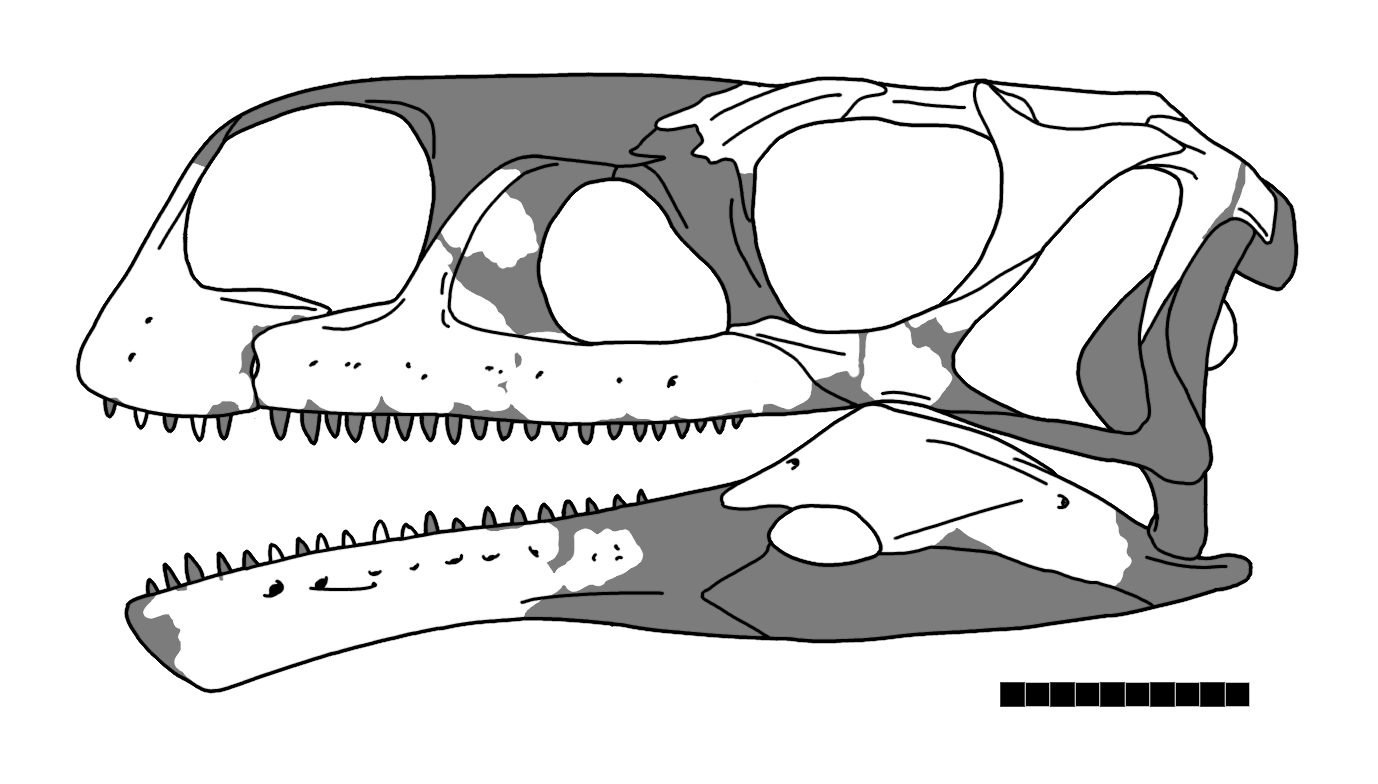
Source: Wikimedia Commons — File:Aardonyx_skull.png
Author: IJReid (Wikimedia username: IJReid)
CC BY 4.0 Creative Commons Attribution 4.0
Source: Wikimedia Commons — File:Aardonyx_TD.png
Author: TotalDino | CC0 Public Domain
Key Anatomical Features
| Feature | Description | Evolutionary Significance |
|---|---|---|
| Jaws (mandible) | Narrow, V-shaped; no fleshy cheeks | Reveals mosaic jaw evolution toward sauropod wide-gape browsing |
| Ulna | Y-shaped (incipient craniolateral process) | Incipient sauropod character; allows weight-bearing pronation |
| Radius | Shifted cranially; radial fossa present | Cradles ulna craniolaterally; enables weight bearing |
| Humerus | 72% length of femur | Evidence for primary bipedalism (sauropods have ~100% ratio) |
| Femur | Straight shaft; distally placed 4th trochanter | Greater mechanical advantage; slower but more powerful gait |
| Metatarsals | Robust; medial weight axis (entaxony) | First sauropodomorph with entaxony before obligate quadrupedalism |
| Foot claws | Large, prominent; earth-encrusted when found | Gave the genus its name “Earth Claw” |
| Scapula | Calcified cartilage at articular end | Confirms juvenile status of both known specimens |
Skull Anatomy
- V-shaped jaw: Narrow, plesiomorphic (primitive) V-shaped jaw outline — in contrast to the broader U-shaped jaws of some sauropods.
- No fleshy cheeks: Absence of cheeks is unusual; earlier sauropods like Chinshakiangosaurus possessed cheeks, meaning cheek loss evolved independently or in reverse order to previous hypotheses.
- Wide gape: Jaw mechanics suggest Aardonyx could open its mouth very widely for bulk browsing vegetation.
Habitual Biped & Facultative Quadruped
The locomotion of Aardonyx is perhaps its most scientifically celebrated attribute. Analysis of the limbs demonstrates it was a habitual biped — primarily upright on two legs — yet possessed anatomical features in both fore- and hindlimbs that strongly foreshadow the obligate quadrupedalism of true sauropods. This unique combination allowed researchers to pinpoint exactly how and in what sequence quadrupedalism evolved in the sauropod lineage.
Source: Wikimedia Commons — File:Aardonyx_NT.jpg
Author: Nobu Tamura | CC BY-SA 3.0

Source: Wikimedia Commons — Sauropodomorpha_skull_comparison.jpg
A=Efraasia, B=Plateosaurus, C=Lufengosaurus, D=Aardonyx, E=Anchisaurus…
CC BY-SA 4.0
- Bipedal evidence (forelimbs): Humerus length is only ~72% of femur length; radius/ulna structure limits active pronation of manus — incompatible with obligate quadrupedalism
- Quadrupedal tendency (ulna): Incipient craniolateral process giving Y-shape to the ulna — foreshadowing obligate quadruped morphology
- Quadrupedal tendency (radius): Cranially shifted radius + radial fossa allows cradling arrangement with the ulna for weight-bearing posture
- Slower gait evidence (femur): Straighter femoral shaft + more distally placed 4th trochanter = greater mechanical advantage of M. caudofemoralis longus but reduced speed
- Entaxony (foot): Robust metatarsals with weight-bearing axis shifted to medial (entaxonic) position — precedes obligate quadrupedalism, falsifying previous models
- Canonical variance analysis: Femur shape of Aardonyx plots statistically among sauropods, not prosauropods — despite retaining bipedalism
- Gait conclusion: Powerful but slow walker; wider gait than typical prosauropods; reduced cursorial ability; could drop to all fours when beneficial
Both known Aardonyx specimens were immature at the time of death, with bone microstructure (osteohistology) confirming that neither had completed growth. Immature individuals measured approximately 6–7 meters in length and stood about 1.5 m at the hip. The Natural History Museum (London) estimates adults could reach 8 meters or more, with body mass estimates ranging from approximately 1–2 metric tonnes for the known juveniles, with adults potentially considerably larger.
Source: Wikimedia Commons — Aardonyx_TD.png
Author: TotalDino | CC0 Public Domain
Source: Wikimedia Commons — Dr. Matthew Bonnan
CC BY-SA 3.0
Aardonyx vs. Related Sauropodomorphs: Size Context
| Taxon | Period | Length | Est. Mass | Locomotion |
|---|---|---|---|---|
| Aardonyx celestae | Early Jurassic | ~6–8 m | ~1–2 t | Habitual biped / facultative quadruped |
| Massospondylus carinatus | Early Jurassic | ~4–6 m | ~0.1–0.4 t | Bipedal prosauropod |
| Melanorosaurus readi | Late Triassic–E. Jurassic | ~8–10 m | ~1.3–2 t | Quadrupedal basal sauropodomorph |
| Plateosaurus engelhardti | Late Triassic | ~6–10 m | ~0.6–4 t | Bipedal prosauropod |
| Vulcanodon karibaensis | Early Jurassic | ~6.5 m | ~2.5 t | Obligate quadruped (early true sauropod) |
| Brachiosaurus altithorax | Late Jurassic | ~26 m | ~56 t | Obligate quadruped (derived sauropod) |
Bone Microstructure Analysis
Anusuya Chinsamy (UCT, Cape Town) conducted osteohistological analysis of Aardonyx ribs and shoulder blade cortices. The absence of peripheral rest lines in the bone cortex confirmed both individuals were actively growing and had not reached skeletal maturity. Additionally, calcified cartilage at the articular end of the scapula provided supporting evidence for immaturity. Both specimens are estimated to have been less than 10 years old at the time of their death.
- Growth rate: Bone tissue texture suggests moderately rapid growth, consistent with other basal sauropodomorphs and anticipating the fast-growth strategies of larger sauropods.
- Adult size projection: Given the 6–7 m juvenile size and evidence of ongoing rapid growth, adults almost certainly exceeded 8–10 m in length.
- Mass accumulation: The shift toward a wider, more robust body plan in Aardonyx compared to slender prosauropods reflects the beginnings of the sauropod strategy of extreme mass accumulation.
- Ontogenetic change: It is hypothesized that younger Aardonyx individuals may have been more bipedal and that mature, heavier adults may have been more strongly quadrupedal — recapitulating the evolutionary transition within a single lifespan.
Herbivorous Bulk Browser
Aardonyx was an obligate herbivore. Its jaw anatomy provides one of the most scientifically interesting aspects of its biology. Unlike most prosauropods, which possessed broad jaws and fleshy cheeks to gather vegetation efficiently, Aardonyx had a narrow V-shaped jaw without fleshy cheeks. Paradoxically, while this jaw shape appears less efficient for bulk gathering, the wide gape enabled by the jaw mechanics suggests it could take large mouthfuls by opening its jaws very widely — a different but equally effective feeding strategy for high-volume herbivory.
Source: Wikimedia Commons — Aardonyx_skull.png
Author: IJReid | CC BY 4.0
Source: Wikimedia Commons
D = Aardonyx | CC BY-SA 4.0
Available Early Jurassic Vegetation
- Ferns and horsetails: Ground-level vegetation; highly abundant in Early Jurassic Gondwanan environments.
- Cycads and seed ferns: Medium-height browsing targets; nutritious and persistent across the Mesozoic.
- Conifers: High browsing; Aardonyx’s long neck enabled elevated access to conifer foliage.
- Ginkgoes: Present in the Early Jurassic flora; leaves and seeds may have been consumed.
Jaw Evolution Significance
The combination of a V-shaped jaw with no fleshy cheeks in Aardonyx is the reverse of what was previously expected: the early sauropod Chinshakiangosaurus had a U-shaped jaw with cheeks, the opposite combination. This reveals that jaw shape and cheek presence evolved independently and in a mosaic fashion across sauropodomorphs, demonstrating that sauropod feeding evolution was more complex than a simple linear progression.
Early Jurassic Environment of South Africa
During the Early Jurassic (~200–190 Ma), southern Africa formed part of the Gondwana supercontinent. The upper Elliot Formation represents ancient floodplain and river channel deposits in a seasonally dry, semi-arid climate interspersed with seasonal rains. The landscape was dominated by open, semi-arid floodplains with patches of riparian vegetation along watercourses — providing ferns, cycads, conifers, and seed ferns as food sources for herbivorous dinosaurs.
- Environment: Semi-arid Gondwanan floodplain; seasonal river channels; upper Elliot Formation, Early Jurassic
- Formation: Upper Elliot Formation, Free State Province, South Africa (~200–190 Ma)
- Climate: Seasonally dry; warm Early Jurassic climate without permanent polar ice caps
- Predators: Early theropods (dilophosaurids, coelophysids) were the dominant carnivores in Early Jurassic Gondwana
- Vegetation: Ferns, horsetails, cycads, conifers, ginkgoes in riparian corridors; sparse open floodplain vegetation
- Contemporaries: Massospondylus, Pulanesaura eocollum (at same Spion Kop Farm site), crocodylomorphs, small mammals
- Taphonomy: Both individuals found in a single dense channel-fill accumulation, suggesting both entered the deposit together (possible flood event)
Known Material
The fossil record of Aardonyx is currently limited to the two specimens from the single discovery site. Despite being incomplete, both specimens collectively provide significant anatomical coverage including skull elements, vertebrae, forelimb bones, hindlimb bones, and foot elements. The accumulation of two individuals at the same localized channel-fill deposit suggests they may have died together during a flood event.
Wikimedia Commons | Author: IJReid
CC BY 4.0
Wikimedia Commons | Author: Nobu Tamura
CC BY-SA 3.0
Wikimedia Commons | CC BY 4.0
- Site: Near Senekal / Rosendal, Free State Province, South Africa (Spion Kop Farm area)
- Formation: Upper Elliot Formation, Hettangian–Sinemurian (~200–190 Ma)
- Specimens: Two partial skeletons (holotype BP/1/6183 + referred specimen)
- Repository: Bernard Price Institute for Palaeontological Research (BPI), University of the Witwatersrand, Johannesburg, South Africa
- Skeletal completeness: Skull elements, cervical & dorsal vertebrae, forelimb (humerus, ulna, radius), hindlimb (femur, tibia, fibula), and pes
- Taphonomy: Dense channel-fill; both individuals as relatively complete carcasses; probable flood accumulation
- Isotopic age: Consistent with upper Elliot Formation (~195 Ma)
Complete image gallery featuring all available Wikimedia Commons images for Aardonyx celestae. All images are used under their stated Creative Commons licenses with full attribution. No synthetic or third-party unlicensed images are used.
📷 Direct Aardonyx Images
Source: Wikimedia Commons
Author: TotalDino | CC0 Public Domain
2800×1000 px
Source: Wikimedia Commons
Author: Nobu Tamura | Date: 12 Nov 2009
CC BY-SA 3.0 | 600×397 px
Source: Wikimedia Commons
Author: IJReid | Updated: 7 March 2026
CC BY 4.0 | 1378×784 px
Source: Wikimedia Commons
Author: Dr. Matthew Bonnan (Western Illinois University, co-author 2009)
CC BY-SA 3.0 | 2000×646 px
Source: Wikimedia Commons
Shows MQ = Marc’s Quarry (Aardonyx) and SQ = Sauropod Quarry (Pulanesaura)
CC BY 4.0 | 926×756 px
📷 Sauropodomorpha Comparative & Phylogenetic Images
A=Efraasia, B=Plateosaurus, C=Lufengosaurus, D=Aardonyx, E=Anchisaurus, F=Massospondylus, G=Omeisaurus, H=Euhelopus, I=Camarasaurus
Source: Wikimedia Commons
CC BY-SA 4.0
Strict consensus tree showing position of Aardonyx within Sauropodomorpha
Source: Wikimedia Commons
CC BY 4.0 | 933×1200 px
Source: Wikimedia Commons
CC BY-SA 4.0 | 2008×2278 px
1. What is Aardonyx?
Aardonyx celestae is a genus of basal sauropodomorph dinosaur from the Early Jurassic (~195 Ma) upper Elliot Formation of South Africa. Named by Yates et al. in 2009, it is the closest known relative of obligatory quadrupedal sauropods that still walked habitually on two legs.
2. What does Aardonyx mean?
“Earth Claw”: aard from Afrikaans = “earth” + onyx from Greek = “nail/claw.” The large, earth-encrusted foot claws were among the first fossil bones discovered at the site. The species name celestae honors Celeste Yates who prepared much of the fossil material.
3. How big was Aardonyx?
Known juvenile specimens were approximately 6–7 m long, standing ~1.5 m at the hip, estimated at ~1–2 tonnes. Adults would likely have exceeded 8–10 m based on bone microstructure confirming active rapid growth at time of death.
4. Was Aardonyx bipedal or quadrupedal?
Habitually bipedal with a strong tendency toward facultative quadrupedalism. The forelimb structure (humerus only 72% femur length; limited manus pronation) supports bipedalism, while the Y-shaped ulna, cranially shifted radius, straight femoral shaft, and entaxonic foot all foreshadow obligate quadrupedalism.
5. Where was Aardonyx found?
Near Senekal / Rosendal, Free State Province, South Africa — from the upper Elliot Formation (Hettangian–Sinemurian, ~200–190 Ma). Excavations began in 2004 by Marc Blackbeard at the Spion Kop Farm area.
6. Who discovered and described Aardonyx?
Marc Blackbeard began excavations in 2004. Formally described in 2009 by Adam Yates, Matthew Bonnan, Johann Neveling, Anusuya Chinsamy, and Marc Blackbeard in Proceedings of the Royal Society B (DOI: 10.1098/rspb.2009.1440).
7. What did Aardonyx eat?
Obligate herbivore. Its distinctive narrow V-shaped jaw without fleshy cheeks, combined with wide-gape mechanics, suggests bulk browsing of ferns, cycads, conifers, and ginkgoes at multiple heights using its long neck.
8. Why is Aardonyx scientifically important?
Because it demonstrates that entaxony (medial weight-bearing foot axis) evolved in sauropodomorphs before obligatory quadrupedalism — directly falsifying the previous model which assumed the reverse order. It also reveals mosaic evolution of feeding apparatus in early sauropodomorphs.
9. What family does Aardonyx belong to?
Aardonyx belongs to Sauropodomorpha (Saurischia), placed as the sister group to the clade (Melanorosaurus + Sauropoda). Some analyses place it within Anchisauridae. It occupies the critical node bridging bipedal prosauropods and obligate quadrupedal sauropods.
10. Where can I see Aardonyx fossils?
The holotype BP/1/6183 is housed at the Bernard Price Institute for Palaeontological Research (BPI), University of the Witwatersrand, Johannesburg, South Africa. The BPI is one of Africa’s premier paleontological research institutions.
Explore more comprehensive paleontology resources from Atechsur.org — expert-written guides covering dinosaur taxonomy, anatomy, fossil records, and evolutionary history.


Sauropodomorph & Related Reads
- Massospondylus carinatus – Common Early Jurassic prosauropod from southern Africa; coeval with Aardonyx; bipedal herbivore.
- Melanorosaurus readi – Large Late Triassic–Early Jurassic sauropodomorph; closest clade relative of Sauropoda alongside Aardonyx.
- Pulanesaura eocollum – Early sauropod discovered at the same Spion Kop Farm site as Aardonyx; Early Jurassic South Africa.
- Plateosaurus engelhardti – Classic Late Triassic prosauropod of Europe; evolutionary precursor type to the Aardonyx lineage.
- Vulcanodon karibaensis – One of the earliest true sauropods; Early Jurassic; demonstrates the next step beyond Aardonyx locomotion.
- Sauropoda – The giant obligate quadrupedal descendants whose evolutionary origins Aardonyx helps illuminate.
- This encyclopedia is for educational purposes, reflecting scientific literature as of March 2026.
- All images in this article are from Wikimedia Commons and are used under their respective Creative Commons licenses (CC0, CC BY, CC BY-SA) with full attribution.
- No copyrighted third-party images from external commercial sources are used. All sources are publicly licensed.
- Phylogenetic placement may vary between analyses; consult primary literature for the most current systematic treatment.
Primary Scientific References
- Yates, A.M., Bonnan, M.F., Neveling, J., Chinsamy, A., & Blackbeard, M. (2009). “A new transitional sauropodomorph dinosaur from the Early Jurassic of South Africa and the evolution of sauropod feeding and quadrupedalism.” Proceedings of the Royal Society B: Biological Sciences, 277(1682): 787–797. DOI: 10.1098/rspb.2009.1440.
- Chapelle, K.E.J. & Choiniere, J.N. (2018). “A revised cranial description of Massospondylus carinatus Owen (Dinosauria: Sauropodomorpha) based on computed tomographic scans and a review of cranial characters for basal sauropodomorphs.” PeerJ, 6: e4224.
- Peyre de Fabrègues, C., et al. (2020). Sauropodomorpha cladogram and phylogenetic analysis. Journal of Vertebrate Paleontology.
- Bonnan, M.F. (2007). “Linear and geometric morphometric analysis of long bone scaling patterns in Jurassic neosauropod dinosaurs.” The Anatomical Record, 290(9): 1089–1111.
- Wilson, J.A. (2002). “Sauropod dinosaur phylogenetics: critique and cladistic analysis.” Zoological Journal of the Linnean Society, 136(2): 215–275.
- Chinsamy, A. (multiple years). Osteohistological analyses of basal sauropodomorphs, University of Cape Town, Department of Zoology.
Image Attribution Table
| Image File | Wikimedia Source | License | Author |
|---|---|---|---|
| Aardonyx_TD.png | Wikimedia Commons | CC0 Public Domain | TotalDino |
| Aardonyx_NT.jpg | Wikimedia Commons | CC BY-SA 3.0 | Nobu Tamura |
| Aardonyx_skull.png | Wikimedia Commons | CC BY 4.0 | IJReid |
| Fig 2 — Aardonyx life restoration by Matthew Bonnan.jpg | Wikimedia Commons | CC BY-SA 3.0 | Dr. Matthew Bonnan |
| Sauropodomorpha_skull_comparison.jpg | Wikimedia Commons | CC BY-SA 4.0 | Wikimedia Contributors |
| Sauropodomorpha_tree_Chapelle_2019.jpg | Wikimedia Commons | CC BY 4.0 | Wikimedia Contributors |
| Peyre_de_Fabrègues_et_al.,_2020_cladogram.png | Wikimedia Commons | CC BY-SA 4.0 | Wikimedia Contributors |
| Spion_Kop_Farm_fauna.jpg | Wikimedia Commons | CC BY 4.0 | Wikimedia Contributors |
© 2026 – Atechsur.org – Encyclopedia of Aardonyx (Aardonyx celestae)
Early Jurassic transitional sauropodomorph of South Africa | 8 Wikimedia Commons images with full CC license attribution | Written by the Atechsur.org Expert Writing Team | 16 March 2026
Saltasaurus Encyclopedia | Ultimate Guide to Saltasaurus | Dinosaur Encyclopedia