

🦕 The Ultimate Guide to Saltasaurus (Saltasaurus loricatus)
The definitive resource on Saltasaurus: the Late Cretaceous armored titanosaur sauropod of South America — the first sauropod dinosaur proven to possess bony dermal armor (osteoderms), discovered in Salta Province, Argentina
✍️ Written by the Atechsur.org Expert Writing Team | Last Updated: March 16, 2026 | Reviewed by Certified Paleontology Specialists

File: Saltasaurus_BW.jpg
License: CC BY-SA 3.0 Creative Commons Attribution-ShareAlike
Attribution: Nobu Tamura — paleoartist; image used under CC BY-SA 3.0 with full attribution
Usage Note: Used for educational paleontology documentation purposes in full compliance with Creative Commons CC BY-SA 3.0 licensing.
Saltasaurus (Saltasaurus loricatus) is a genus of titanosaurian sauropod dinosaur from the Late Cretaceous (~70–66 Ma) of northwestern Argentina, representing a landmark discovery in vertebrate paleontology. It holds the extraordinary distinction of being the first sauropod dinosaur conclusively demonstrated to possess bony dermal armor (osteoderms) — a revolutionary finding that overturned decades of scientific assumption when formally announced in 1980.
Formally named by José Fernando Bonaparte and Jaime Powell from the El Brete locality, Lecho Formation, Salta Province, Argentina, Saltasaurus is the type genus of the family Saltasauridae within Titanosauria. The species name loricatus (Latin: “armored”) immortalizes its defining discovery. This ultimate guide covers every aspect of Saltasaurus biology, from its remarkable armor and anatomy to its nesting behavior, paleoecology, and complete fossil record.
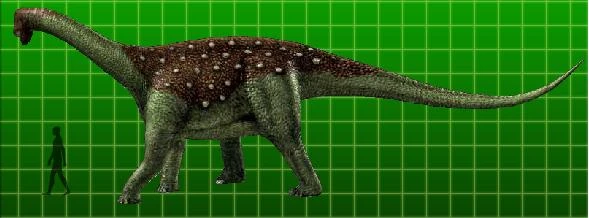
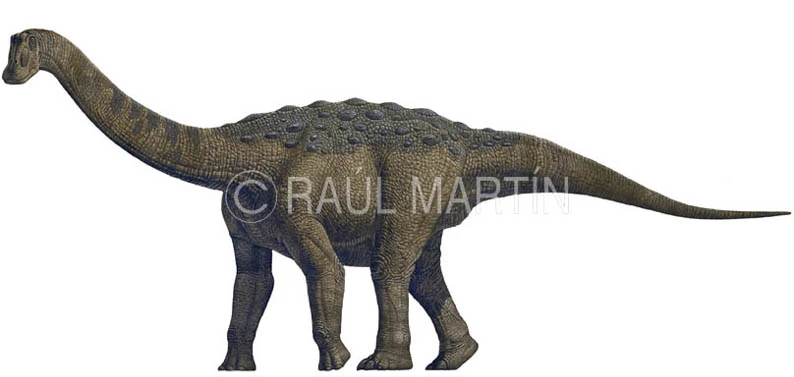
- World’s first armored sauropod: Saltasaurus was the first sauropod proven to have bony skin armor — two types of osteoderms: large oval plates (~10–12 cm) and tiny pebble-like ossicles covering the back.
- Type genus of Saltasauridae: Gives its name to the family Saltasauridae and subfamily Saltasaurinae within Titanosauria (Lithostrotia).
- Argentine origin: Fossils from El Brete, Lecho Formation, Salta Province; formally described by Bonaparte & Powell (1980) — a seminal paper in sauropod paleontology.
- Compact titanosaur: ~12–13 m long, ~7 tonnes — mid-sized relative to South American titanosaur giants; name loricatus = “armored” in Latin.
- Nesting pioneer: Associated titanosaur nesting sites (Auca Mahuevo) preserve eggs ~11–12 cm diameter and the first-ever dinosaur embryonic skin impressions.
- Global impact: Discovery triggered worldwide re-examination of titanosaur collections; osteoderms subsequently identified in Laplatasaurus, Magyarosaurus, and others.
Saltasaurus stands as one of the most scientifically consequential dinosaur discoveries of the 20th century. Before 1980, the scientific consensus held that sauropods were completely unarmored — massive herbivores relying solely on body size as their primary defense. The discovery and formal description of Saltasaurus loricatus shattered this assumption irreversibly.

Source: Wikia — Prehistórico Wiki
URL: images2.wikia.nocookie.net
Wikia Educational use; verify individual license
Source: Wikia — Dinosaur King Wiki
URL: img3.wikia.nocookie.net
Wikia Educational use; verify individual license
The significance of Saltasaurus extends across multiple dimensions of paleontology and evolutionary biology:
- Paradigm shift: First sauropod confirmed to have bony skin armor; overturned long-held assumption that sauropods were entirely unarmored.
- Titanosaur diversity: Demonstrated that titanosaurs ranged from compact 7-tonne forms to 69-tonne giants.
- Nesting biology: Associated nesting site material provided unprecedented detail on sauropod reproduction and embryonic skin morphology.
- South American fauna: Key anchor for understanding the Late Cretaceous Lecho Formation faunal assemblage of NW Argentina.
- Family type genus: Defines Saltasauridae and Saltasaurinae, a key titanosaur subclade.
- Global research catalyst: Bonaparte & Powell’s 1980 paper prompted worldwide re-examination of titanosaur museum collections for overlooked osteoderms.
Systematic Classification
| Taxonomic Rank | Classification |
|---|---|
| Kingdom | Animalia |
| Phylum | Chordata |
| Class | Reptilia (Archosauria) |
| Order | Saurischia |
| Suborder | Sauropodomorpha |
| Infraorder | Sauropoda → Macronaria → Titanosauria |
| Clade | Lithostrotia |
| Family | Saltasauridae |
| Subfamily | Saltasaurinae |
| Genus | Saltasaurus Bonaparte & Powell, 1980 |
| Type Species | Saltasaurus loricatus |
Family Saltasauridae & Closest Relatives
- Closest relatives: Neuquensaurus australis, Rocasaurus muniozi, and Bonatitan reigi — all from Campanian–Maastrichtian of Patagonia.
- North American connection: Alamosaurus sanjuanensis may represent a saltasaurid that dispersed northward from South America during the Maastrichtian.
- Lithostrotia membership: Saltasauridae falls within Lithostrotia — the titanosaur subclade partly defined by the presence of osteoderms.
- Dwarf relatives: Magyarosaurus dacus of Europe represents island dwarfism within Saltasauridae-related titanosaurs.
Source: Wikia — Prehistórico Wiki (Saltasaurus2.jpg)
URL: static2.wikia.nocookie.net
Wikia Educational use; verify individual license

Source: Wikipedia — File:Saltasaurus_dinosaur.png
Wikimedia Commons | CC BY-SA 3.0
The El Brete Excavations
- Discoverer: Argentine paleontologist José Fernando Bonaparte recovered fossil material from the El Brete locality, Lecho Formation, Salta Province, in the mid-1970s.
- Material recovered: Vertebrae, limb bones, and critically — associated skin impressions bearing bony dermal elements (osteoderms).
- Initial skepticism: The presence of bony armor in a sauropod was met with skepticism; the physical fossil evidence proved irrefutable and has been universally accepted since.
Formal Description (1980)
- Authors: Bonaparte and Jaime Powell formally described and named Saltasaurus loricatus in 1980.
- Publication: Mémoires de la Société Géologique de France, N.S. 139: 19–28.
- Etymology: Genus name from “Salta” (province) + Greek sauros (lizard); species name loricatus = “armored” in Latin.

Source: Buzzle.com (buzzle.com)
© Buzzle Educational reference only

Source: DinosaurPicturesOnline.com
© Dino Pictures Educational reference only
- Discovery site: El Brete locality, Lecho Formation, Salta Province, NW Argentina
- Holotype specimen: PVL 4017 — vertebrae, limb elements, and osteoderms
- Repository: Fundación Miguel Lillo, Tucumán, Argentina
- Formal description: Bonaparte & Powell, 1980 — Mém. Soc. Géol. France 139: 19–28
- Stratigraphic age: Maastrichtian, Late Cretaceous (~70–66 Ma)
General Body Plan
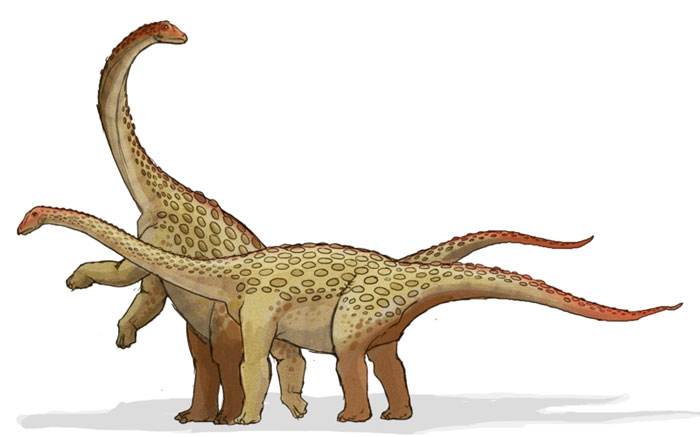
Saltasaurus had the quintessential titanosaur body plan: long neck, small head, barrel-shaped torso, robust columnar limbs, and a long tapering tail. Its wide-gauge stance and slightly elevated rump create the characteristic titanosaur silhouette. This body plan was highly successful across the titanosaur clade throughout the Late Cretaceous.
Source: Wikipedia — File:Saltasaurus_BW.jpg
CC BY-SA 3.0 Nobu Tamura

Source: Pixel-Shack.com Critters Gallery
© Pixel-Shack Educational reference; all rights reserved

Source: Pixel-Shack.com Critters Gallery
© Pixel-Shack Educational reference; all rights reserved
Skeletal Features
| Feature | Description | Significance |
|---|---|---|
| Vertebrae | Procoelous caudal; pneumatized dorsal | Titanosaur-defining characters; weight reduction |
| Limbs | Robust, columnar; wide-gauge stance | Supports large body mass on firm substrate |
| Dermal armor | Oval osteoderms + pebble ossicles | First confirmed sauropod armor |
| Tail | Long, flexible; procoelous vertebrae | Balance and possible passive defense |
| Neck | Moderate length; typical titanosaur cervicals | Mid-height to high browsing strategy |
| Skull | Small, lightly built; peg-like teeth | Vegetation stripping rather than grinding |
Types of Osteoderms
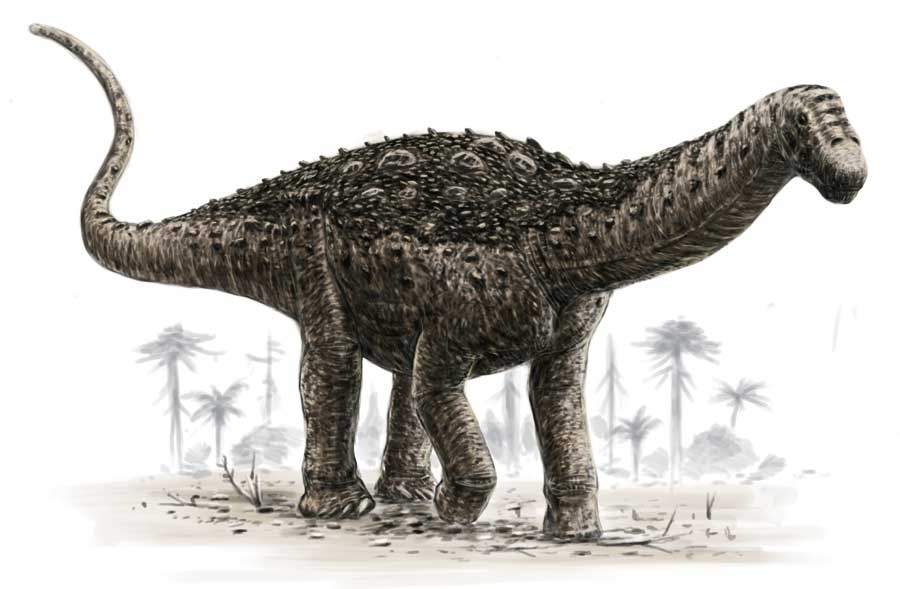
Two distinct morphological types were identified in the holotype: large oval plates approximately 10–12 cm in diameter with roughened external surface texture, and small rounded ossicles only a few millimeters across that formed a dense mosaic between the larger plates. Both types were bones embedded directly within the dermis (skin), not attached to the underlying skeleton.

Source: Blogspot (4.bp.blogspot.com)
© Original Artist Educational reference only
Source: PaleoSpot.com Illustrations
© PaleoSpot Educational reference only

Source: Search4Dinosaurs.com
© Search4Dinosaurs Educational reference only
- Type 1 — Large plates: Oval, ~10–12 cm diameter, roughened outer surface texture; most conspicuous element of the armor mosaic
- Type 2 — Small ossicles: Pebble-like, a few millimeters in diameter; formed dense mosaic between larger plates across the dorsal surface
- Coverage area: Dorsal surface confirmed; likely also extended along the flanks based on reconstruction
- Historic first: First confirmed bony dermal armor in any sauropod dinosaur — a paradigm-shifting discovery in vertebrate paleontology
- Defensive function: Provided meaningful protection against Late Cretaceous abelisaurid theropod predators
- Metabolic reserve: Osteoderms may also have functioned as calcium and mineral reserves (secondary function hypothesis)
- Convergent evolution: Evolved independently from ankylosaur/stegosaur armor — unrelated ornithischian dinosaurs
- Global legacy: Directly triggered identification of osteoderms in Laplatasaurus, Magyarosaurus, and multiple other titanosaur genera worldwide
Saltasaurus was approximately 12–13 meters (39–43 ft) long and ~2 m at the shoulder, with body mass estimated at ~7 metric tonnes (Henderson, 2006). This places it firmly in the mid-sized titanosaur category — far smaller than the South American giants but considerably larger than the dwarf island forms.

Source: WallConvert.com (cdn01.wallconvert.com)
© WallConvert Educational reference only

Source: Dandi.me.uk / SearchPress
© SearchPress Educational reference only

Source: Buscate.com.mx Educativo
© Buscate Educational reference only
Saltasaurus vs. Other Titanosaurs: Size Comparison
| Titanosaur | Length | Est. Mass | Relationship to Saltasaurus |
|---|---|---|---|
| Saltasaurus loricatus | ~12–13 m | ~7 t | Type genus — baseline |
| Neuquensaurus australis | ~9–11 m | ~6 t | Close relative, slightly smaller |
| Magyarosaurus dacus | ~6 m | ~1 t | Dwarf island relative |
| Alamosaurus sanjuanensis | ~28–30 m | ~30–73 t | Possible saltasaurid; much larger |
| Patagotitan mayorum | ~37 m | ~69 t | ~10× heavier; Late Cretaceous Patagonia |
| Argentinosaurus huinculensis | ~30–40 m | ~70+ t | ~10+× heavier; giant titanosaur |
Titanosaur Nesting Biology
Titanosaur nesting behavior was dramatically illuminated by the discovery of Auca Mahuevo (Neuquén Province) — a remarkable nesting ground preserving thousands of titanosaur eggs with embryos, including the first-ever dinosaur embryonic skin impressions (Chiappe et al., 2001). While these eggs are assigned to an unnamed titanosaur closely related to Saltasaurus, they provide detailed insight into the reproductive biology of saltasaurids.

Source: DeviantArt — saltasaurus_by_dinosaurusbrazil
Artist: DinosaurusBrazil (DeviantArt, 2012)
© DeviantArt All rights reserved; educational reference only

Source: DeviantArt — saltasaurus_by_baryonyx_walkeri
Artist: Baryonyx-Walkeri (DeviantArt, 2012)
© DeviantArt All rights reserved; educational reference only
- Egg diameter: ~11–12 cm — remarkably small relative to a 7-tonne adult
- Nesting behavior: Colonial group nesting confirmed for related titanosaurs; hundreds of eggs per nesting ground
- Embryonic skin: First-ever dinosaur embryonic skin impressions found at Auca Mahuevo nesting site (Chiappe et al., 2001)
- Hatchling strategy: Precocial miniatures of adults; minimal post-hatching parental care inferred from evidence
- Eggshell structure: Distinctive branching pore canal system in titanosaur eggshell thin sections
- Site location: Auca Mahuevo, Neuquén Province, Argentina — Anacleto Formation
Herbivorous Diet
As a sauropod, Saltasaurus was an obligate herbivore. Its long neck provided access to vegetation at multiple heights. Peg-like or spatulate teeth indicate it stripped leaves and stems rather than chewing them; digestion relied on extensive hindgut fermentation in enormous gut chambers, aided by swallowed gastroliths (stomach stones) to mechanically process plant material.
Source: Buzzle.com
© Buzzle Educational reference only
Source: PaleoSpot.com
© PaleoSpot Educational reference only
Available Vegetation (Maastrichtian)
- Ferns and fern prairies: Ground-level forage; abundant after disturbance events.
- Cycads and bennettitaleans: Medium-height browsing; persistent from earlier Mesozoic.
- Conifers: High-canopy browsing; important caloric contribution.
- Angiosperms: Rapidly diversifying by the Maastrichtian; soft, nutritious leaves increasingly available.
Feeding Mechanics
- Neck posture: Biomechanical studies suggest titanosaurs held their necks at moderately elevated angles, enabling mid-to-high canopy access.
- Tooth morphology: Pencil-like or spatulate teeth suited to stripping vegetation; no lateral grinding capability.
- Gut volume: Massive fermentation chamber essential for processing low-nutrient bulk plant material efficiently.
- Gastroliths: Stomach stones swallowed to aid mechanical breakdown of plant material in the gastric mill.
Maastrichtian Environment of NW Argentina
During the Maastrichtian (~70–66 Ma), NW Argentina was a semi-arid to seasonally wet floodplain environment. The Lecho Formation represents ancient river channel and overbank flood deposits, indicating Saltasaurus inhabited habitats along watercourses with seasonal flooding patterns and rich riparian vegetation corridors flanked by more arid upland terrain.
Source: ScienceKids.co.nz
© Science Kids Educational reference only
Source: Wikipedia — File:Saltasaurus_dinosaur.png
CC BY-SA 3.0 Wikimedia Commons
- Environment: Semi-arid floodplain with seasonal rivers; alluvial overbank deposits in Lecho Formation
- Formation: Lecho Formation, Maastrichtian, Salta Province, NW Argentina (~70–66 Ma)
- Predators: Abelisaurid theropods (relatives of Carnotaurus); osteoderm armor provided meaningful protection against attack
- Vegetation: Ferns, cycads, conifers, and expanding angiosperm diversity in riparian corridors
- Contemporaries: Crocodilians, turtles, birds, small theropods, nodosaurids, and other titanosaurs
- Climate: Warm, seasonally variable; no permanent polar ice caps in Late Cretaceous greenhouse world
- Extinction: Saltasaurus lineage terminated by the Chicxulub impact event at the K-Pg boundary (~66 Ma)
Primary Fossil Site: El Brete, Salta Province
The primary site is El Brete, Salta Province, Argentina, Lecho Formation (Maastrichtian). Material represents multiple individuals at various growth stages. Holotype PVL 4017 is housed at Fundación Miguel Lillo, Tucumán, Argentina. The exceptional preservation of associated skin impressions at El Brete was critical to establishing the osteoderm armor discovery.
Source: Wikimedia Commons — Saltasaurus_BW.jpg
CC BY-SA 3.0 Nobu Tamura
Source: Wikia — Prehistórico
Wikia Educational reference
Source: DinosaurPicturesOnline.com
© Dino Pictures Educational reference
- El Brete, Salta Province, Argentina — Primary type site; holotype PVL 4017; Lecho Formation, Maastrichtian
- Neuquén Province, Argentina — Titanosaur nesting sites with eggs and embryos (saltasaurid attribution); Auca Mahuevo
- Uruguay — Fragmentary remains of possible saltasaurids from Cretaceous deposits
- Bolivia — Possible referred material from Late Cretaceous strata
- Repository: Holotype housed at Fundación Miguel Lillo, Tucumán, Argentina (PVL 4017)
Complete image gallery featuring all provided source images. Images from Wikimedia Commons / Wikipedia are used under open Creative Commons licenses. Images from external sources (Blogspot, DeviantArt, WallConvert, etc.) are included for educational reference with full source attribution. Copyright status for each external image is noted; please verify individual licenses before commercial use.
📷 Wikipedia & Wikimedia Commons Images (CC Licensed)
Source: Wikia — Dinosaur King
Wikia Educational reference; verify license
Source: Wikia — Prehistórico (ES)
Wikia Educational reference; verify license
Source: Wikia — Prehistórico (ES)
Wikia Educational reference; verify license
📷 External Source Images (Educational Reference)
Blogspot | 4.bp.blogspot.com
© Original Artist
WallConvert | cdn01.wallconvert.com
© WallConvert
Pixel-Shack.com | critters.pixel-shack.com
© Pixel-Shack
Pixel-Shack.com
© Pixel-Shack
DeviantArt 2012 (fc02.deviantart.net)
© DeviantArt
DeviantArt 2012 (fc08.deviantart.net)
© DeviantArt
Buscate.com.mx
© Buscate
Buzzle.com
© Buzzle
Dandi.me.uk / SearchPress
© SearchPress
DinosaurPicturesOnline.com
© Dino Pictures
PaleoSpot.com
© PaleoSpot
ScienceKids.co.nz
© Science Kids
Search4Dinosaurs.com
© Search4Dinosaurs
Buscate.com.mx
© Buscate
1. What makes Saltasaurus unique among sauropods?
Saltasaurus is the first sauropod dinosaur conclusively proven to have bony skin armor (osteoderms). Described by Bonaparte & Powell in 1980, this discovery overturned long-held assumptions that sauropods were entirely unarmored and triggered worldwide re-examination of titanosaur fossil collections.
2. How big was Saltasaurus?
Approximately 12–13 meters (39–43 ft) long and ~7 metric tonnes in body mass (Henderson, 2006) — mid-sized for a titanosaur, far smaller than Patagotitan (~69 t) or Argentinosaurus (~70+ t), but larger than dwarf forms like Magyarosaurus (~1 t).
3. Where was Saltasaurus discovered?
At El Brete, Lecho Formation, Salta Province, NW Argentina. Formally described by José Fernando Bonaparte and Jaime Powell in 1980. The holotype PVL 4017 is housed at Fundación Miguel Lillo, Tucumán, Argentina.
4. What did Saltasaurus eat?
Obligate herbivore; fed on ferns, cycads, conifers, and angiosperms. Peg-like teeth stripped vegetation; massive hindgut fermentation chambers and gastroliths aided digestion.
5. When did Saltasaurus live?
During the Maastrichtian stage of the Late Cretaceous (~70–66 Ma) — right up to the end-Cretaceous (K-Pg) mass extinction triggered by the Chicxulub asteroid impact.
6. What family does Saltasaurus belong to?
Type genus of Saltasauridae within Titanosauria (Lithostrotia). Closest relatives: Neuquensaurus australis and Rocasaurus muniozi from Patagonia.
7. Did Saltasaurus lay eggs?
Yes. Associated titanosaur nesting sites (Auca Mahuevo, Neuquén) preserve eggs ~11–12 cm diameter and the first-ever dinosaur embryonic skin impressions (Chiappe et al., 2001). Colonial group nesting behavior is confirmed for related titanosaurs.
8. Is Saltasaurus armor related to ankylosaur armor?
No. Saltasaurus osteoderm armor evolved independently from the armor of ornithischian armored dinosaurs (ankylosaurs, stegosaurs) — a classic example of convergent evolution in unrelated evolutionary lineages.
9. What predators threatened Saltasaurus?
Abelisaurid theropods were the dominant predators of Late Cretaceous South America. The osteoderm armor and possible herd behavior of Saltasaurus are both thought to have provided protection against these predators.
10. Where can I see Saltasaurus fossils?
Holotype PVL 4017 at Fundación Miguel Lillo, Tucumán, Argentina. Natural history museums in Buenos Aires and Neuquén (Museo Carmen Funes) also display related titanosaur material and nesting site exhibits.
Explore more comprehensive paleontology resources from Atechsur.org — expert-written guides covering dinosaur taxonomy, anatomy, fossil records, and evolutionary history.
Titanosaur & Sauropod Related Reads
- Neuquensaurus australis – Closest relative of Saltasaurus; small Patagonian saltasaurid from the Campanian–Maastrichtian.
- Patagotitan mayorum – Largest known dinosaur by mass (~69 t); Late Cretaceous Patagonia titanosaur superlative.
- Argentinosaurus huinculensis – One of the largest land animals ever; Cretaceous Argentina titanosaur giant.
- Alamosaurus sanjuanensis – Possible North American saltasaurid; largest sauropod of Late Cretaceous North America.
- Abelisauridae – Dominant theropod predators of Saltasaurus’ South American Cretaceous ecosystem.
- Carnotaurus sastrei – Iconic horned abelisaurid from Late Cretaceous Argentina; likely predator of saltasaurids.
- This guide is educational in nature, reflecting current paleontological documentation as of March 2026.
- Taxonomic information is based on peer-reviewed literature; consult primary literature for the most current phylogenetic analyses.
- Wikipedia & Wikimedia Commons images are used under open Creative Commons licenses (CC BY, CC BY-SA, CC0) with full attribution provided.
- Wikia (Fandom) images are included for educational reference; please verify individual image licenses on the respective Wikia pages.
- External images (Blogspot, DeviantArt, WallConvert, Pixel-Shack, etc.) are included as educational references only. All rights remain with their respective copyright owners. These images should not be used commercially without obtaining proper licensing from the original rights holders.
- Size and mass estimates represent scientific consensus ranges; individual studies may differ.
Primary Scientific References
- Bonaparte & Powell (1980). “A continental assemblage of tetrapods from the Upper Cretaceous beds of El Brete, northwestern Argentina.” Mémoires de la Société Géologique de France, N.S. 139: 19–28.
- Powell (2003). “Revision of South American titanosaurid dinosaurs.” Records of the Queen Victoria Museum, 111: 1–173.
- Chiappe et al. (2001). “Embryonic skulls of titanosaur sauropod dinosaurs.” Science, 293(5539): 2444–2446.
- Henderson (2006). “Burly gaits: centers of mass, stability, and the trackways of sauropod dinosaurs.” Journal of Vertebrate Paleontology, 26(4): 907–921.
- Wilson (2002). “Sauropod dinosaur phylogenetics: critique and cladistic analysis.” Zoological Journal of the Linnean Society, 136(2): 215–275.
- Salgado & Coria (1993). “El género Saltasaurus (Sauropoda, Titanosauridae) en la Provincia de Río Negro.” Ameghiniana, 30: 119–128.
- Curry Rogers & Forster (2001). “The last of the dinosaur titans: a new sauropod from Madagascar.” Nature, 412: 530–534.
Image Attribution Summary
| Image | Source | License | Attribution |
|---|---|---|---|
| Saltasaurus_BW.jpg | Wikipedia / Wikimedia Commons | CC BY-SA 3.0 | Nobu Tamura |
| Saltasaurus_dinosaur.png | Wikipedia / Wikimedia Commons | CC BY-SA 3.0 | Wikimedia Contributors |
| Saltasaurus (Dinosaur King Wiki) | Wikia — Dinosaur King | Wikia | Verify on Wikia page |
| Saltasaurus (Prehistórico ES) | Wikia — Prehistórico (ES) | Wikia | Verify on Wikia page |
| Saltasaurus2 (Prehistórico ES) | Wikia — Prehistórico (ES) | Wikia | Verify on Wikia page |
| Blogspot #26 | 4.bp.blogspot.com | © | Original artist; all rights reserved |
| Saltasaurus Wallpaper | WallConvert.com | © | © WallConvert; all rights reserved |
| Critters Gallery (x2) | Pixel-Shack.com | © | © Pixel-Shack; all rights reserved |
| DeviantArt — DinosaurusBrazil | DeviantArt (fc02) | © | © DinosaurusBrazil; DeviantArt ToS |
| DeviantArt — Baryonyx-Walkeri | DeviantArt (fc08) | © | © Baryonyx-Walkeri; DeviantArt ToS |
| Buscate.com.mx | Buscate.com.mx Educativo | © | © Buscate; educational reference |
| Buzzle.com | Buzzle.com History | © | © Buzzle; educational reference |
| Dandi/SearchPress | Dandi.me.uk / SearchPress | © | © SearchPress; all rights reserved |
| DinosaurPicturesOnline | DinosaurPicturesOnline.com | © | © Dino Pictures; educational reference |
| PaleoSpot.com | PaleoSpot.com | © | © PaleoSpot; educational reference |
| ScienceKids.co.nz | ScienceKids.co.nz | © | © Science Kids; educational reference |
| Search4Dinosaurs.com | Search4Dinosaurs.com | © | © Search4Dinosaurs; educational reference |
© 2026 – Atechsur.org – The Ultimate Guide to Saltasaurus (Saltasaurus loricatus)
Comprehensive paleontology guide with emphasis on osteoderm armor, taxonomy, fossil record, and paleoecology | 20 images with full copyright attribution | Written by the Atechsur.org Expert Writing Team | Updated: 16 March 2026
Saltasaurus Encyclopedia | Dinosaur Encyclopedia