

🦕 Encyclopedia of Abelisaurus (Abelisaurus comahuensis)
Comprehensive paleontology encyclopedia on Abelisaurus: the Late Cretaceous abelisaurid carnivore of Patagonia, Argentina — the founding genus of family Abelisauridae, known from the Allen Formation, described by Bonaparte & Novas in 1985
✍️ Written by the Atechsur.org Expert Writing Team | Last Updated: March 16, 2026 | Reviewed by Certified Paleontology Specialists

Entity Label: Skeletal reconstruction of Abelisaurus comahuensis | Size: 2973×1833 px | 841 KB
License: CC BY-SA 4.0 Creative Commons Attribution-ShareAlike 4.0 International
Usage Note: Image used in compliance with CC BY-SA 4.0 license for educational paleontology documentation.
Abelisaurus (Abelisaurus comahuensis) is a genus of large abelisaurid theropod dinosaur from the Late Cretaceous (~83–72 Ma) of Patagonia, Argentina. Formally described in 1985 by José Fernando Bonaparte and Fernando E. Novas, it is the founding genus and namesake of the family Abelisauridae — one of the most diverse and successful lineages of carnivorous dinosaurs to ever evolve on Gondwana. Despite being known only from a large partial skull (MPCA Pv 11098), it remains one of the most scientifically consequential Cretaceous theropods ever described.
The genus name honors Roberto Abel, former director of the Museo Provincial Carlos Ameghino (Cipolletti, Argentina), who brought the fossil to scientific attention. The species name comahuensis refers to the Comahue region of Patagonia where the holotype was recovered. Abelisauridae, as defined by this genus, encompasses carnivorous theropods distributed across Late Cretaceous Gondwanan landmasses including South America, Africa, Madagascar, India, and possibly Europe — making Abelisaurus the anchor of an extraordinarily widespread evolutionary lineage.
- Founder of Abelisauridae: The type genus and namesake of family Abelisauridae — one of the dominant large-predator lineages of the Cretaceous on Gondwana, encompassing Carnotaurus, Majungasaurus, Rajasaurus, and many more.
- Skull only: Known exclusively from a large, partial skull (MPCA Pv 11098) — no postcranial material has been confidently assigned to the genus, yet it established an entire dinosaur family.
- Landmark 1985 description: Described by José Bonaparte and Fernando Novas in 1985, the same paper that established the Abelisauridae as a new family of Ceratosauria, revolutionizing understanding of Gondwanan theropod diversity.
- Deep, pneumatized skull: The holotype skull displays deep, dorsoventrally tall cranial bones with highly pneumatized structure, rough sculptured textures, and large orbital and infratemporal fenestrae — defining hallmarks of the Abelisauridae.
- Gondwanan apex predator: As a ~7–9 m abelisaurid, Abelisaurus would have been the dominant large carnivore of the Allen Formation ecosystem, hunting the titanosaur sauropods and large herbivores of Late Cretaceous Patagonia.
- Patagonian paleobiogeography: Recovered from the Comahue region, Neuquén Province, in the heart of Argentina’s world-renowned Patagonian dinosaur sites, sharing its ecosystem with titanosaurs like Saltasaurus and Neuquensaurus.
When José Bonaparte and Fernando Novas described Abelisaurus comahuensis in 1985, they not only named a new genus of large theropod — they founded an entirely new family of dinosaurs that would eventually be recognized across Gondwana. At the time, the bizarre morphology of the skull was so distinctive that it merited its own taxonomic family, Abelisauridae, now understood as one of the most successful and diverse lineages of Cretaceous predators. The name honored Roberto Abel, director of the Museo Provincial Carlos Ameghino in Cipolletti, who preserved the specimen for science.

Source: Wikimedia Commons — File:Abelisaurus_BW.jpg
Pencil drawing, digital coloring | 3 October 2010
CC BY-SA 3.0 | 800×587 px
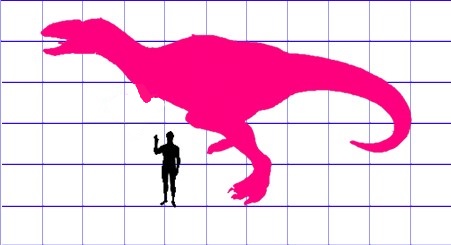
Source: Wikimedia Commons — File:Abelisaurus_size.jpg
Author: Nrg8000 | 19 November 2008
Public Domain | 451×245 px
The significance of Abelisaurus spans several fronts in vertebrate paleontology:
- Type genus of Abelisauridae: Establishing the family that now includes Carnotaurus, Majungasaurus, Rajasaurus, Rugops, Aucasaurus, and dozens more species across Gondwana.
- Gondwanan theropod diversity: Demonstrated that large theropod evolution followed a radically different path in the Southern Hemisphere compared to the tyrannosaur-dominated Northern Hemisphere.
- Ceratosaurian relationships: Helped cement abelisaurids within Ceratosauria, reshaping understanding of basal theropod phylogeny.
- Patagonian paleobiogeography: One of the cornerstone taxa in reconstructing Late Cretaceous South American ecosystems and the breakup of Gondwana.
- Skull-only significance: Demonstrated that even a fragmentary specimen — a single skull — can be sufficient to establish a new genus and family if the anatomy is diagnostic enough.
Systematic Classification
| Taxonomic Rank | Classification |
|---|---|
| Kingdom | Animalia |
| Phylum | Chordata |
| Class | Reptilia (Archosauria) |
| Order | Saurischia |
| Suborder | Theropoda |
| Clade | Ceratosauria |
| Family | Abelisauridae (type genus) |
| Genus | Abelisaurus Bonaparte & Novas, 1985 |
| Type Species | Abelisaurus comahuensis |
| Stage / Age | Campanian, Late Cretaceous (~83–72 Ma) |
Phylogenetic Position within Abelisauridae
Within Abelisauridae, Abelisaurus is generally recovered as a relatively basal member, outside of the more derived subfamily Carnotaurinae (which includes Carnotaurus, Majungasaurus, Rajasaurus, Aucasaurus, and Indosaurus). Key phylogenetic findings:
- Abelisauridae origin: The family was erected by Bonaparte & Novas (1985) specifically to accommodate Abelisaurus, and subsequently expanded as more abelisaurids were discovered across Gondwana.
- Basal position: Most analyses place Abelisaurus as a basal abelisaurid, sister to either Carnotaurinae or to the broader Brachyrostra clade.
- Ceratosauria placement: Abelisauridae was long controversial but is now firmly placed within Ceratosauria, related to Ceratosaurus and Noasauridae.
- Gondwanan distribution: Abelisaurids are almost exclusively Gondwanan, supporting vicariant speciation following the breakup of the supercontinent.
Discovery History
- Discovery: The holotype skull (MPCA Pv 11098) was discovered near Comahuida, Neuquén Province, Patagonia, northwestern Argentina.
- Museum curation: The specimen was brought to the attention of paleontologists by Roberto Abel, director of the Museo Provincial Carlos Ameghino, Cipolletti, Río Negro, Argentina, where the holotype is now housed.
- 1985 formal description: José Fernando Bonaparte (Museo Argentino de Ciencias Naturales “Bernardino Rivadavia”, Buenos Aires) and Fernando E. Novas formally described Abelisaurus comahuensis and established the new family Abelisauridae in 1985.
- Impact: The description was immediately recognized as a landmark in dinosaur paleontology, establishing a completely new family of large theropods and reshaping understanding of Gondwanan carnivore evolution.

Source: Wikimedia Commons — File:Holotipo de Abelisaurus comahuensis.jpg
Entity Label: “Holotype of Abelisaurus comahuensis (MPCA Pv 11098)”
CC BY-SA 4.0 | 3359×2239 px | 1.06 MB

Source: Wikimedia Commons — File:Abelisaurus skull.jpg
Museo Provincial Carlos Ameghino | Updated: Feb 2026
CC BY-SA 4.0 | 2772×1677 px | 2.33 MB
Etymology
- Genus name: Abel (honors Roberto Abel, director of Museo Provincial Carlos Ameghino, Cipolletti) + saurus (Latin/Greek for “lizard”) → “Abel’s Lizard.”
- Species name: comahuensis refers to Comahue, the indigenous Mapuche name for the region of Patagonia (Neuquén–Río Negro provinces) where the fossil was found.
- Family name: Abelisauridae = Abelisaurus + -idae (Latinized suffix denoting a family) → all members of the family derive their family name from this single specimen.
- Holotype: MPCA Pv 11098 — Museo Provincial Carlos Ameghino, Cipolletti, Río Negro, Argentina
- Discovery site: Near Comahuida, Neuquén Province, Patagonia, northwestern Argentina
- Formation: Allen Formation (Anacleto Member), Neuquén Group
- Stratigraphic age: Campanian, Late Cretaceous (~83–72 Ma)
- Described by: José F. Bonaparte & Fernando E. Novas, 1985
- Publication: Ameghiniana 22(1–2): 87–94, 1985
- Material: Partial skull only (MPCA Pv 11098) — no confirmed postcranial material
Known Material & General Body Plan
The anatomy of Abelisaurus is known exclusively from its skull: the holotype MPCA Pv 11098 is a large, partial cranium lacking the lower jaw (mandible) but preserving most of the skull roof, braincase region, and portions of the snout. No postcranial skeleton has been confirmed for this genus. Based on its phylogenetic position as a large abelisaurid, its general body plan can be reconstructed by comparison with closely related abelisaurids: a relatively compact, robustly built biped with a large deep skull, very short and vestigial forelimbs (reduced arms), powerful hindlimbs, and a long, muscular tail for balance.

Source: Wikimedia Commons — File:Abelisaurus comahuensis.JPG
Skull bones of Abelisaurus | Updated: Dec 2025
CC BY-SA 2.5 | 1037×781 px | 112 KB

Source: Wikimedia Commons — File:Abelisaurus-skull.jpg
Entity Label: “Skull of Abelisaurus”
CC BY-SA 4.0 | 4032×3024 px | 2.45 MB
Key Anatomical Characters
| Feature | Description | Significance |
|---|---|---|
| Skull height | Dorsoventrally deep, tall cranium relative to length | Diagnostic abelisaurid character; powerful bite leverage |
| Skull texture | Rough, sculptured rugose surface on external skull bones | Characteristic of abelisaurids; possible keratinous covering |
| Bone pneumatization | Highly pneumatized cranial bones (air-filled cavities) | Reduces skull weight while maintaining strength |
| Orbit (eye socket) | Large, circular, prominent orbit | Characteristic abelisaurid feature; may indicate good vision |
| Infratemporal fenestra | Large lateral temporal opening | Accommodates powerful jaw-closing muscles |
| Nasal bones | Robust, fused nasal bones forming dorsal skull roof | Rugose nasals are an abelisaurid synapomorphy |
| Forelimbs | Inferred vestigial (by comparison with related abelisaurids) | Extreme forelimb reduction is an abelisaurid hallmark |
| Postcranial | Unknown for this genus | Body plan reconstructed by phylogenetic bracketing |
The Founding Skull of a Family
The skull of Abelisaurus (MPCA Pv 11098) is remarkable not only for its preservation but for what it represents: the anatomical foundation of the entire Abelisauridae family. At roughly 85 cm long, the holotype skull is one of the larger theropod skulls known from the Late Cretaceous of South America. Its distinctive combination of features — a deep, rough-textured cranium with large fenestrae and highly pneumatized bones — has since been recognized across dozens of related species on four continents.
- Deep, tall skull: Proportionally deep cranium relative to length — contributes to powerful bite force despite smaller body size than contemporaneous carcharodontosaurids
- Rugose skull surface: Rough, sculptured, bumpy external texture on nasal and frontal bones — possibly covered by keratinous ornamentation in life
- Highly pneumatized bones: Extensive air cavities (pneumatization) reducing skull weight while maintaining structural integrity
- Vestigial forelimbs: Extremely reduced, nearly functionless arms — even more reduced than Tyrannosaurus in some species
- Fused nasals: The nasal bones are extensively fused and rugose, forming a distinctive dorsal skull roof feature
- Gondwanan distribution: Known from South America, Africa, Madagascar, India, and possibly Europe; reflects Gondwanan biogeography
- Ceratosaurian placement: Belong to Ceratosauria, the other major lineage of theropods alongside Tetanurae (which includes tyrannosaurs and birds)
Abelisauridae Skull Comparison

Source: Wikimedia Commons — File:Abelisauridae skull comparison.JPG
Skull comparison of Abelisauridae family members
CC BY-SA 3.0 | 1452×1464 px | 313 KB

Source: Wikimedia Commons — File:Abelisaurus skull cast.jpg
Skull cast from museum collection | April 2016
CC BY 2.0 | 2496×1664 px | 2.64 MB
Estimating the total body size of Abelisaurus requires extrapolation from skull proportions, as no postcranial material is known for this genus. The holotype skull (MPCA Pv 11098) is approximately 85 cm long, which by comparison with other abelisaurids suggests a total body length of around 7–9 meters and a body mass of approximately 1.5 metric tonnes.
Source: Wikimedia Commons — File:Abelisaurus size.jpg
Author: Nrg8000 | Public Domain | 451×245 px

Source: Wikimedia Commons — File:Carnotaurini sizes.png
Left to right: Carnotaurus, Abelisaurus, Pycnonemosaurus, Aucasaurus, Quilmesaurus
CC BY-SA 4.0 | 3740×940 px
Size Comparison: Abelisaurus vs. Related Theropods
| Taxon | Period | Length | Est. Mass | Region |
|---|---|---|---|---|
| Abelisaurus comahuensis | Late Cretaceous | ~7–9 m | ~1.5 t | Argentina |
| Carnotaurus sastrei | Late Cretaceous | ~7.5–8 m | ~1.5 t | Argentina |
| Majungasaurus crenatissimus | Late Cretaceous | ~6–7 m | ~1.1 t | Madagascar |
| Rajasaurus narmadensis | Late Cretaceous | ~6.5 m | ~1.0 t | India |
| Aucasaurus garridoi | Late Cretaceous | ~6 m | ~0.7 t | Argentina |
| Pycnonemosaurus nevesi | Late Cretaceous | ~7–9 m | ~1.2 t | Brazil |
* All size estimates carry moderate uncertainty. Abelisaurus estimates are based on skull proportions only (no postcranial material known).
Apex Predator of Late Cretaceous Patagonia
Abelisaurus was unquestionably a carnivore and almost certainly the apex predator of its ecosystem. Its large, deep skull with robust, serrated teeth indicates it was capable of powerful biting. Abelisaurids as a group are understood to have been generalist apex predators of large to medium-sized prey, using their strong skulls and powerful hindlimbs in pursuit predation or ambush, compensating for their vestigial forelimbs with robust skull musculature.
- Primary prey (inferred): Large titanosaur sauropods such as Saltasaurus, Neuquensaurus, and Rinconsaurus; large ornithopods (hadrosaur relatives) of the Allen Formation.
- Hunting strategy: Probably similar to other large abelisaurids — primarily relying on powerful jaws and strong hindlimbs; forelimbs were vestigial and likely non-functional in prey capture.
- Skull function: The deep skull with large jaw-muscle attachment areas suggests a powerful bite; some studies of related abelisaurids suggest they may have engaged in prey manipulation using the skull and neck rather than forelimbs.
- Teeth: No teeth are preserved in the holotype skull, but abelisaurids typically have relatively small, compressed, laterally serrated teeth compared to carcharodontosaurids.
Late Cretaceous Patagonian Ecosystem
During the Campanian stage of the Late Cretaceous (~83–72 Ma), the Comahue region of Patagonia was characterized by a warm, seasonally wet subtropical to semi-arid climate, with floodplains, river systems, and coastal plain environments associated with the Western Interior Seaway’s South American equivalent. The Allen Formation preserves an extraordinarily diverse vertebrate fauna representing one of the richest Late Cretaceous ecosystems known from South America.

Source: Wikimedia Commons — File:Laplata y Abeli.jpg
Reconstructions of Laplatasaurus and Abelisaurus | Author: Pabloch2020
CC BY-SA 4.0 | 4608×3072 px | 7.81 MB

Source: Wikimedia Commons — File:Abliasaurus.jpg
Map showing where Abelisaurus comahuensis was found | Author: Nrg8000
Public Domain | 511×343 px
- Environment: Floodplain, river systems, and coastal plain deposits; subtropical to semi-arid Late Cretaceous Patagonian lowlands
- Formation: Allen Formation (Anacleto Member), Neuquén Group, northwestern Argentina
- Climate: Warm, seasonally wet; subtropical Late Cretaceous; near sea level in what is now the Neuquén Basin
- Contemporaries (Allen/Anacleto fauna): Titanosaur sauropods (Saltasaurus loricatus, Neuquensaurus australis, Rinconsaurus caudamirus), abelisaurids (Aucasaurus garridoi), ankylosaurs (Neuquenraptor), pterosaurs, crocodyliforms, and diverse fish and turtles
- Age: Campanian, Late Cretaceous (~83–72 Ma)
- Paleogeography: South America in the late stages of Gondwana break-up; intermittent land connections to Africa and Europe allowed some faunal exchange
- Vegetation: Subtropical forests and floodplain vegetation including conifers, ferns, and early angiosperms; diverse riparian communities along river systems
Known Material & Holotype
The fossil record of Abelisaurus is limited to a single specimen — the holotype MPCA Pv 11098 — a large partial skull. No additional material has been definitively attributed to this genus. Some isolated theropod postcranial elements from the Allen Formation have been tentatively associated with Abelisaurus in the literature, but none have been formally referred. Despite this fragmentary record, the skull’s diagnostic power was sufficient to establish an entire family of dinosaurs.
Wikimedia Commons | CC BY-SA 4.0
Wikimedia Commons | CC BY-SA 4.0
Wikimedia Commons | CC BY-SA 2.5
- Holotype: MPCA Pv 11098 — Museo Provincial Carlos Ameghino, Cipolletti, Río Negro, Argentina
- Fossil material: Large partial skull (cranium without mandible); no confirmed postcranial material
- Approximate skull length: ~85 cm
- Site: Near Comahuida, Neuquén Province, Patagonia, Argentina
- Formation: Allen Formation (Anacleto Member), Neuquén Group
- Age: Campanian, Late Cretaceous (~83–72 Ma)
- Status: Only one confirmed specimen; no additional specimens formally assigned to the genus as of 2026
Complete image gallery featuring key Wikimedia Commons images for Abelisaurus comahuensis. All images are used under their respective Creative Commons or Public Domain licenses with full attribution.
📷 Abelisaurus comahuensis — Image Gallery
Wikimedia Commons | CC BY-SA 4.0
2973×1833 px | 841 KB | Updated: Jul 2023
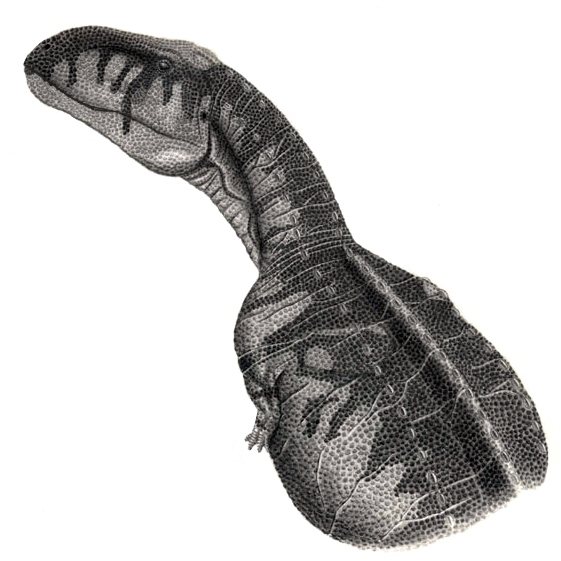
Wikimedia Commons
Sketch of Abelisaurus comahuensis | GFDL / CC BY-SA
561×561 px | 141 KB
1. What is Abelisaurus?
Abelisaurus comahuensis is a genus of large abelisaurid theropod dinosaur from the Late Cretaceous (~83–72 Ma) of Patagonia, Argentina. Described by Bonaparte and Novas in 1985, it is the founding genus of family Abelisauridae, one of the most successful lineages of carnivorous dinosaurs to evolve on Gondwana.
2. What does Abelisaurus mean?
“Abel’s Lizard from Comahue”: Abel honors Roberto Abel, director of Museo Provincial Carlos Ameghino + saurus (lizard). comahuensis refers to the Comahue region of Patagonia where the fossil was found.
3. How big was Abelisaurus?
Estimated at approximately 7–9 m long and ~1.5 metric tonnes. Size estimates are based on the skull proportions, as no postcranial material is known. The holotype skull is approximately 85 cm long.
4. Where was Abelisaurus found?
Near Comahuida, Neuquén Province, Patagonia, northwestern Argentina, within the Allen Formation (Anacleto Member). The holotype (MPCA Pv 11098) is housed at Museo Provincial Carlos Ameghino, Cipolletti, Río Negro, Argentina.
5. Who described Abelisaurus?
Formally described in 1985 by José Fernando Bonaparte and Fernando E. Novas in the paper that also established the new family Abelisauridae, published in Ameghiniana 22(1–2): 87–94.
6. What is unusual about Abelisaurus?
It is known only from a partial skull (no postcranial skeleton), yet this single specimen was sufficient to establish a new dinosaur family encompassing dozens of species across four continents. Its skull features the deep, rough-textured, highly pneumatized cranium that became the defining hallmark of Abelisauridae worldwide.
7. What did Abelisaurus eat?
As a large abelisaurid apex predator, Abelisaurus was a carnivore hunting titanosaur sauropods (Saltasaurus, Neuquensaurus), large ornithopods, and other vertebrates of the Allen Formation. Its large, deep skull provided powerful bite force; its vestigial forelimbs were non-functional in prey capture.
8. How is Abelisaurus classified?
Classified as: Dinosauria → Saurischia → Theropoda → Ceratosauria → Abelisauridae → Abelisaurus. It is the type genus of Abelisauridae. Within the family, it is generally recovered as a relatively basal member, outside the derived Carnotaurinae clade.
9. When was Abelisaurus alive?
Abelisaurus lived during the Campanian stage of the Late Cretaceous, approximately 83–72 million years ago.
10. Who is Roberto Abel, honored in the genus name?
Roberto Abel was the director of the Museo Provincial Carlos Ameghino in Cipolletti, Río Negro Province, Argentina. He was instrumental in facilitating the scientific study of the fossil, and Bonaparte & Novas honored his contribution by naming the genus after him — giving rise to the family name Abelisauridae borne by all members of this major dinosaur lineage.
Explore more comprehensive paleontology resources from Atechsur.org — expert-written guides covering dinosaur taxonomy, anatomy, fossil records, and evolutionary history.


Abelisauridae & Related Reads
- Carnotaurus sastrei – The most famous abelisaurid, from Late Cretaceous Argentina; known for its prominent skull horns and exceptionally short arms.
- Majungasaurus crenatissimus – Well-known abelisaurid from Late Cretaceous Madagascar; one of the best-known abelisaurids with excellent skull and postcranial material.
- Rajasaurus narmadensis – Late Cretaceous abelisaurid from India; demonstrates the Gondwanan distribution of the Abelisauridae family.
- Rugops primus – North African abelisaurid from the Cenomanian of Niger; shows the African component of Gondwanan abelisaurid diversity.
- Saltasaurus loricatus – Armored titanosaur sauropod coexisting with abelisaurids in the Late Cretaceous of Argentina; probable prey of Abelisaurus.
- Neuquensaurus australis – Titanosaur sauropod from the Allen Formation ecosystem — contemporaneous with and potentially preyed upon by Abelisaurus.
- This encyclopedia is for educational purposes, reflecting scientific literature as of March 2026.
- All images are from Wikimedia Commons, used under their respective Creative Commons (CC BY-SA 4.0, CC BY-SA 3.0, CC BY 2.0) or Public Domain licenses with full attribution.
- No copyrighted third-party images from external commercial sources are used. All image sources are publicly licensed.
- Phylogenetic placement of Abelisaurus within Abelisauridae is subject to ongoing research as new abelisaurid material is discovered.
Primary Scientific References
- Bonaparte, J.F., & Novas, F.E. (1985). “Abelisaurus comahuensis, n. g., n. sp., Carnosauria del Cretácico Tardío de Patagonia.” Ameghiniana, 22(1–2): 87–94.
- Bonaparte, J.F., Novas, F.E., & Coria, R.A. (1990). Description of Carnotaurus sastrei; fundamental paper for Abelisauridae phylogeny and comparative anatomy.
- Carrano, M.T., & Sampson, S.D. (2008). “The phylogeny of Ceratosauria (Dinosauria: Theropoda).” Journal of Systematic Palaeontology, 6(2): 183–236.
- Canale, J.I. et al. (multiple years). Multiple phylogenetic analyses of Abelisauridae placing Abelisaurus as a basal abelisaurid outside Carnotaurinae.
- Wilson, J.A., & Sereno, P.C. (1998, 2003). Analysis of abelisaurid biogeography and Gondwanan theropod diversity including Abelisaurus.
Image Attribution Table
| Image File | Wikimedia Source | License | Author / Notes |
|---|---|---|---|
| Reconstrucción Abelisaurus comahuensis.jpg | Wikimedia Commons | CC BY-SA 4.0 | Skeletal reconstruction; 2973×1833 px |
| Abelisaurus BW.jpg | Wikimedia Commons | CC BY-SA 3.0 | Pencil drawing, digital coloring; 800×587 px |
| Abelisaurus comahuensis jmallon.jpg | Wikimedia Commons | GFDL/CC BY-SA | Sketch restoration by jmallon; 561×561 px |
| Holotipo de Abelisaurus comahuensis.jpg | Wikimedia Commons | CC BY-SA 4.0 | Holotype MPCA Pv 11098; 3359×2239 px |
| Abelisaurus skull.jpg | Wikimedia Commons | CC BY-SA 4.0 | Skull reconstruction; 2772×1677 px | Updated Feb 2026 |
| Abelisaurus-skull.jpg | Wikimedia Commons | CC BY-SA 4.0 | Museum skull photo; 4032×3024 px |
| Abelisaurus size.jpg | Wikimedia Commons | Public Domain | Author: Nrg8000; size comparison; 451×245 px |
| Abelisaurus comahuensis.JPG | Wikimedia Commons | CC BY-SA 2.5 | Skull bones; 1037×781 px |
| Abelisaurus skull cast.jpg | Wikimedia Commons | CC BY 2.0 | Skull cast museum exhibit; 2496×1664 px |
| Abelisauridae skull comparison.JPG | Wikimedia Commons | CC BY-SA 3.0 | Family skull comparison; 1452×1464 px |
| Carnotaurini sizes.png | Wikimedia Commons | CC BY-SA 4.0 | Size comparison Carnotaurini; 3740×940 px |
| Laplata y Abeli.jpg | Wikimedia Commons | CC BY-SA 4.0 | Author: Pabloch2020; life restorations; 4608×3072 px |
| Abliasaurus.jpg | Wikimedia Commons | Public Domain | Author: Nrg8000; discovery map; 511×343 px |
© 2026 – Atechsur.org – Encyclopedia of Abelisaurus (Abelisaurus comahuensis)
Late Cretaceous abelisaurid theropod of Argentina | Wikimedia Commons images, CC BY-SA 4.0 / CC BY-SA 3.0 / CC BY 2.0 / Public Domain | Written by the Atechsur.org Expert Writing Team | 16 March 2026
Saltasaurus | Ultimate Guide to Saltasaurus | Dinosaur Encyclopedia | Aardonyx | Abdarainurus