

🦕 Encyclopedia of Abdarainurus (Abdarainurus barsboldi)
Comprehensive paleontology encyclopedia on Abdarainurus: the Late Cretaceous titanosaur sauropod of Mongolia — a possible new lineage of Asian macronarian sauropods known from the Alagteeg Formation, Abdrant Nuru, Gobi Desert, described in 2020
✍️ Written by the Atechsur.org Expert Writing Team | Last Updated: March 16, 2026 | Reviewed by Certified Paleontology Specialists
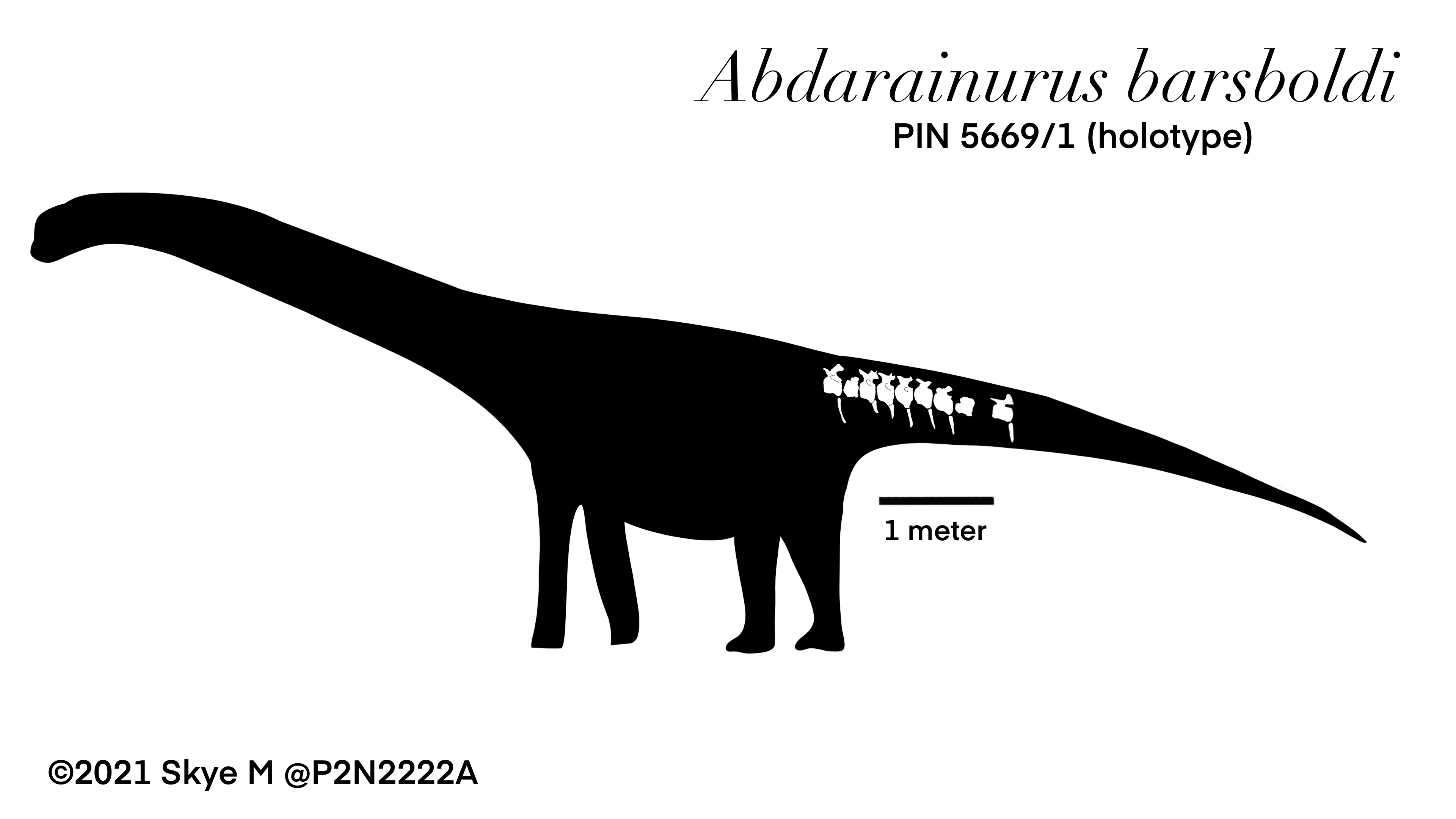
File: Abdarainurus.jpg | Entity Label: Skeletal Reconstruction of Abdarainurus barsboldi
License: CC BY-SA 4.0 Creative Commons Attribution-ShareAlike 4.0 International
Usage Note: Image used in compliance with CC BY-SA 4.0 license for educational paleontology documentation.
Abdarainurus (Abdarainurus barsboldi) is a genus of titanosaurian sauropod dinosaur from the Late Cretaceous (~85–72 Ma) Alagteeg Formation of the Gobi Desert, Mongolia. It was formally described in February 2020 by Alexander O. Averianov and Alexey V. Lopatin of the Russian Academy of Sciences, becoming the first non-theropod dinosaur described in 2020. Currently regarded as an indeterminate titanosaur, it may represent a previously unknown specialized lineage of Asian macronarian sauropods unlike any other known genus.
The genus name combines Abdarain Nuru (the Russian spelling of the Abdrant Nuru fossil locality) with the Latinized Greek urus (“tail”), reflecting that the known material consists entirely of eight anterior and one middle caudal vertebrae plus several chevrons. The species name barsboldi honors the renowned Mongolian paleontologist Rinchen Barsbold. What makes Abdarainurus exceptional is not its abundance of material but rather the 16 unique or highly unusual features of its caudal skeleton that distinguish it from all other titanosaurs, suggesting it represents an entirely novel evolutionary lineage.
- First dinosaur of 2020: The first non-theropod dinosaur formally described in 2020 — published February 2020 by Averianov & Lopatin in Journal of Systematic Palaeontology.
- Unique tail morphology: 16 unique or rare characters of the caudal skeleton, including opisthocoelous centra, longitudinal ridges on neural canal walls, postprezygapophyseal processes, and a deep pocket-like spinodiapophyseal fossa.
- Possible new Asian lineage: May represent a highly specialized, previously unknown lineage of Asian macronarian sauropods — distinct from all other Late Cretaceous Asian titanosaurs.
- Fragmentary but significant: Known only from 8 anterior + 1 middle caudal vertebrae and several chevrons (holotype PIN 5669/1) — yet sufficient to diagnose a new genus.
- Mongolian fossil heritage: Discovered in 1970 at Abdrant Nuru, Gobi Desert, during a Joint Soviet–Mongolian Expedition; fossils sat unprepared for ~30 years before being recognized as a new genus.
- Late Cretaceous Gobi: Coexisted with the ankylosaur Pinacosaurus, indeterminate turtles, and other dinosaurs in a fluvial (river-dominated) Late Cretaceous environment, distinct from the arid, wind-blown setting of the famous Djadokhta Formation.
When Alexander Averianov and Alexey Lopatin published the description of Abdarainurus barsboldi in February 2020, they unveiled a dinosaur that had been hiding in plain sight for half a century. The bones were excavated in 1970, sat unprepared in a museum collection for at least three decades, and were only recognized as a genuinely new genus around 2000 — yet even then required another twenty years before receiving formal scientific description. The wait was worth it: Abdarainurus proved to be unlike any titanosaur previously known.

Source: Wikimedia Commons — File:Abdarainurus_LMR.png
Life reconstruction based on holotype and related parts
CC BY-SA 4.0 Creative Commons Attribution-ShareAlike 4.0 | 6528×3786 px

Source: Wikimedia Commons — File:Abdarainurus_Size_Comparison.svg
Author: SlvrHwk | CC BY-SA 4.0
The significance of Abdarainurus extends across several fronts in vertebrate paleontology:
- Novel lineage: Its 16 unique caudal vertebra characters distinguish it from all known Asian Late Cretaceous titanosaurs, suggesting a previously undocumented evolutionary branch.
- Neural canal ridges: Longitudinal ridges on the neural canal walls, a feature subsequently investigated as an osteological correlate of soft tissue structures in sauropods.
- Asian macronarian diversity: Expands understanding of sauropod diversity in Late Cretaceous Asia, a region with relatively few well-described titanosaurs compared to South America.
- Alagteeg Formation: Contributes to understanding of the Alagteeg Formation fauna, which represents a more humid, fluvial environment than the contemporaneous Djadokhta.
- Phylogenetic challenge: Its ambiguous phylogenetic placement highlights gaps in knowledge of basal titanosaur anatomy and diversity.
Systematic Classification
| Taxonomic Rank | Classification |
|---|---|
| Kingdom | Animalia |
| Phylum | Chordata |
| Class | Reptilia (Archosauria) |
| Order | Saurischia |
| Suborder | Sauropodomorpha |
| Clade | Sauropoda |
| Clade | Titanosauriformes |
| Clade | Titanosauria |
| Status | incertae sedis (indeterminate titanosaur) |
| Genus | Abdarainurus Averianov & Lopatin, 2020 |
| Type Species | Abdarainurus barsboldi |
| Stage / Age | Santonian–Campanian, Late Cretaceous |
Phylogenetic Position
The phylogenetic placement of Abdarainurus remains uncertain. Averianov and Lopatin (2020) ran the matrix of Mannion et al. under three conditions, obtaining three different placements:
- Equal character weighting: Non-titanosaur member of Somphospondyli, in a large polytomy.
- Slightly downweighted labile characters: Basal titanosaur in a clade with Andesaurus and Huabeisaurus — this was the authors’ preferred result.
- Significantly downweighted labile characters: Member of Aeolosaurinae.
In the 2024 description of Gandititan cavocaudatus, Han et al. recovered Abdarainurus as the sister taxon to Gandititan in a clade of basal titanosaurs also including Andesaurus, Huabeisaurus, Baotianmansaurus, and Dongyangosaurus. This result supports the broadly “basal titanosaur” position as most likely.
The Long Road to Description
- 1970 excavation: The holotype (PIN 5669/1) was excavated by V. P. Tverdokhlebov of Saratov State University during a Joint Soviet–Mongolian Paleontological Expedition at the Abdrant Nuru locality, Ömnögovî Province, southern Mongolia.
- ~30 years unprepared: The fossils remained in the collections of the Palaeontological Institute of the Russian Academy of Sciences (PIN), Moscow, unprepared and unstudied for at least 30 years.
- ~2000 recognition: Paleontologist Andrei Podlesnow identified the material as probably belonging to a new genus of sauropod and brought it to the attention of other researchers.
- 2020 formal description: Alexander O. Averianov (Zoological Institute, Russian Academy of Sciences, St. Petersburg) and Alexey V. Lopatin (Palaeontological Institute, Russian Academy of Sciences, Moscow) published the formal description in Journal of Systematic Palaeontology in February 2020.
Source: Wikimedia Commons — Abdarainurus.jpg
CC BY-SA 4.0 | 3840×2160 px
Source: Wikimedia Commons — Abdarainurus_LMR.png
CC BY-SA 4.0 | 6528×3786 px
Etymology
- Genus name: Abdarain = Russian transliteration of “Abdrant Nuru” (the fossil locality) + urus (Latinized Ancient Greek ουρá = “tail”) → “Abdrant Nuru tail.”
- Species name: barsboldi honors Rinchen Barsbold (born 1935), Mongolia’s pre-eminent dinosaur paleontologist, academician, and former director of the Mongolian Institute of Geology.
- Holotype: PIN 5669/1 — Palaeontological Institute, Russian Academy of Sciences, Moscow
- Discovery site: Abdrant Nuru locality, Ömnögovî Province, Ulan-Nuur Depression, northern Gobi Desert, Mongolia
- Formation: Alagteeg Formation (possibly equivalent to the base of the Djadokhta Formation)
- Stratigraphic age: Santonian–Campanian, Late Cretaceous (~85–72.1 Ma)
- Excavator: V. P. Tverdokhlebov, Saratov State University, 1970
- Formal description: Averianov & Lopatin, 2020 — Journal of Systematic Palaeontology, DOI: 10.1080/14772019.2020.1716402
Known Material & General Body Plan
The anatomy of Abdarainurus is known exclusively from its tail: eight anterior caudal vertebrae, one middle caudal vertebra, and several chevrons. No skull, neck, dorsal vertebrae, limb bones, or girdle elements are known. Nonetheless, as a titanosaur, its general body plan can be reconstructed from comparison with closely related taxa: a large, robustly built quadruped with four columnar limbs, a long neck, small head, and a long, muscular tail — the classic sauropod body plan.
Source: Wikimedia Commons — Abdarainurus.jpg
CC BY-SA 4.0 | 3840×2160 px
Source: Wikimedia Commons — Abdarainurus_LMR.png
CC BY-SA 4.0 | 6528×3786 px
Distinctive Anatomical Characters (Caudal)
| Feature | Description | Significance |
|---|---|---|
| Centra shape | Opisthocoelous (posterior face concave) | Indicates derived titanosaur-grade morphology |
| Neural canal walls | Longitudinal ridges present | Unique among titanosaurs; possible soft tissue correlate |
| Postprezygapophyseal processes | Present on anterior caudals | Highly unusual in sauropods; may indicate specialized tail musculature |
| Postspinal fossa | Hypertrophied (enlarged) | Distinguishes from all other known titanosaurs |
| Neural spines | Mediolaterally constricted (rod-like) | Unique tail function; possible display or balance structure |
| Spinodiapophyseal fossa | Deep, pocket-like; covered laterally by high postzygodiapophyseal lamina | Autapomorphic combination not seen in other titanosaurs |
| Chevrons | Several preserved; morphology unusual | Contribute to 16 diagnostic characters |
The 16 Diagnostic Characters
The scientific importance of Abdarainurus rests almost entirely on the unusual morphology of its caudal vertebrae. Averianov and Lopatin identified 16 unique or rare characters in the caudal skeleton that collectively distinguish the taxon from all other known sauropods. These characters fall into several anatomical categories:
Source: Wikimedia Commons — Abdarainurus_Size_Comparison.svg
Author: SlvrHwk | CC BY-SA 4.0
- Opisthocoelous centra: Posterior face of vertebral body is concave — found in some titanosaurs but here combined with other unusual features
- Longitudinal ridges on neural canal walls: Internal ridges lining the spinal canal — extraordinary feature investigated as a possible osteological correlate of vascular or neural soft tissue structures
- Postprezygapophyseal processes: Small processes posterior to the prezygapophyses — extremely unusual in any sauropod
- Hypertrophied postspinal fossa: The depression behind the neural spine is greatly enlarged beyond what is typical
- Mediolaterally constricted neural spines: Transversely narrow, rod-like neural spines forming a distinctive profile
- Deep pocket-like spinodiapophyseal fossa: A uniquely shaped concavity between the neural spine and diapophysis
- High postzygodiapophyseal lamina: Covering the spinodiapophyseal fossa laterally, creating an enclosed pocket-like structure
- Additional 9 characters: Further unique or rare lamina, fossa, and process morphologies collectively comprising the 16-character autapomorphic diagnosis
Neural Canal Ridges — A Novel Discovery
The longitudinal ridges on the neural canal walls of Abdarainurus proved so unusual that a subsequent study (Anatomy, 2023) specifically investigated them as a novel osteological correlate of soft tissue structures in sauropod dinosaurs. This demonstrates that even fragmentary material can open entirely new windows of scientific investigation when the anatomy is sufficiently unusual.
Estimating the size of Abdarainurus carries significant uncertainty because the only known material consists of caudal vertebrae and chevrons — no limb bones or complete dorsal series are preserved. Based on comparisons with other titanosaurs using the proportional size of caudal vertebrae:
Source: Wikimedia Commons
Author: SlvrHwk | CC BY-SA 4.0 | 512×219 px (SVG)
Size Estimates vs. Related Titanosaurs
| Taxon | Period | Length | Est. Mass | Region |
|---|---|---|---|---|
| Abdarainurus barsboldi | Late Cretaceous | ~13–15 m | ~13–15 t | Mongolia |
| Opisthocoelicaudia skarzynskii | Late Cretaceous | ~11–13 m | ~20 t | Mongolia |
| Huabeisaurus allocotus | Late Cretaceous | ~18–20 m | ~20 t | China |
| Andesaurus delgadoi | Late Cretaceous | ~18 m | ~30 t | Argentina |
| Saltasaurus loricatus | Late Cretaceous | ~8 m | ~7 t | Argentina |
| Argentinosaurus huinculensis | Late Cretaceous | ~30–35 m | ~70–80 t | Argentina |
* Size estimates for Abdarainurus carry high uncertainty (ESR 2/4) due to fragmentary fossil material.
Herbivorous Sauropod
Abdarainurus was unquestionably a herbivore. Because no cranial material is known, the exact feeding style cannot be directly determined. However, as a large titanosaur sauropod, it almost certainly employed the high-browsing feeding strategy typical of sauropods: using its long neck to access vegetation at multiple heights, from low ground cover to elevated tree foliage. Titanosaurs generally had wide-gape jaws with simple, peg-like teeth suited to stripping vegetation rather than chewing it, relying on gastroliths (stomach stones) in the gizzard for mechanical breakdown.
- Available vegetation (Alagteeg Formation): Conifers, cycads, angiosperms (flowering plants, increasingly prominent in the Late Cretaceous), ferns, and horsetails in the fluvial riparian corridors.
- Feeding height: With an estimated total length of ~13–15 m and a long sauropod neck, Abdarainurus could likely browse at heights of 4–8 m.
- Comparison with Opisthocoelicaudia: The contemporaneous Mongolian titanosaur Opisthocoelicaudia also lacks cranial material; both are inferred as classic sauropod high-browsers based on phylogenetic bracketing.
Late Cretaceous Gobi Desert Fluvial Ecosystem
During the Late Cretaceous (~85–72 Ma), the Abdrant Nuru area was part of a fluvial (river-dominated) depositional environment associated with the Alagteeg Formation. This contrasts sharply with the famous Djadokhta Formation (source of Velociraptor, Protoceratops, and Oviraptor), which represents a more arid, wind-blown (eolian) environment. The Alagteeg thus preserves a different, more humid facies of the same general region and time period, offering a complementary view of Late Cretaceous Mongolian ecosystems.
- Environment: Fluvial (river-dominated) ecosystem; Alagteeg Formation, Ulan-Nuur Depression, northern Gobi Desert, Mongolia
- Formation: Alagteeg Formation (possibly equivalent to the overlying Djadokhta Formation at Abdrant Nuru)
- Climate: More humid than the contemporaneous Djadokhta; fluvial sediment deposition dominant over eolian
- Contemporaries: Pinacosaurus sp. (ankylosaur), indeterminate turtles (Trionychidae), indeterminate theropods and dinosaur footprints and eggs also known from Abdrant Nuru
- Age: Santonian–Campanian, Late Cretaceous (~85–72.1 Ma)
- Paleogeography: Central Asia; part of Late Cretaceous Asiatic land mass with intermittent connections to other continental regions
- Vegetation: Riparian conifers, cycads, early angiosperms, ferns in river corridors; more diverse and lush than the Djadokhta desert environments
Known Material & Holotype
The fossil record of Abdarainurus is currently limited to a single specimen — the holotype PIN 5669/1 — consisting of caudal vertebrae and chevrons. Despite the fragmentary nature of this material, the 16 diagnostic characters were sufficient to establish a valid new genus. No additional material has been referred to Abdarainurus since its description.
Wikimedia Commons | CC BY-SA 4.0
Wikimedia Commons | CC BY-SA 4.0
Wikimedia Commons | Author: SlvrHwk
CC BY-SA 4.0
- Holotype: PIN 5669/1 — Palaeontological Institute, Russian Academy of Sciences (PIN RAS), Moscow, Russia
- Fossil material: 8 anterior caudal vertebrae + 1 middle caudal vertebra + several chevrons
- Site: Abdrant Nuru locality, Ömnögovî Province, Ulan-Nuur Depression, Mongolia
- Formation: Alagteeg Formation; basal stratigraphic level at Abdrant Nuru
- Age: Santonian–Campanian, Late Cretaceous (~85–72.1 Ma)
- Excavation: V. P. Tverdokhlebov, Saratov State University, Joint Soviet–Mongolian Expedition, 1970
- Status: No additional specimens referred since original 2020 description
Complete image gallery featuring all available Wikimedia Commons images for Abdarainurus barsboldi. All 3 images are used under CC BY-SA 4.0 Creative Commons license with full attribution. No synthetic or third-party unlicensed images are used.
📷 Abdarainurus barsboldi — All Available Images
Source: Wikimedia Commons — File:Abdarainurus.jpg
Entity Label: “Skeletal Reconstruction of Abdarainurus barsboldi”
CC BY-SA 4.0 Creative Commons Attribution-ShareAlike 4.0
3840×2160 px | 355 KB | Updated: 24 Oct 2025
Source: Wikimedia Commons — File:Abdarainurus_LMR.png
Life reconstruction based on holotype and related titanosaur parts
CC BY-SA 4.0 Creative Commons Attribution-ShareAlike 4.0
6528×3786 px | 8.07 MB | Updated: 2 March 2025
Source: Wikimedia Commons — File:Abdarainurus_Size_Comparison.svg
Author: SlvrHwk (Wikimedia username: SlvrHwk)
CC BY-SA 4.0 Creative Commons Attribution-ShareAlike 4.0
512×219 px (SVG) | 28 KB | Updated: 23 Oct 2025
1. What is Abdarainurus?
Abdarainurus barsboldi is a genus of titanosaurian sauropod dinosaur from the Late Cretaceous (~85–72 Ma) Alagteeg Formation of Mongolia. Formally described in February 2020 by Averianov and Lopatin, it is the first non-theropod dinosaur described that year and may represent a previously unknown lineage of Asian macronarian sauropods.
2. What does Abdarainurus mean?
“Abdrant Nuru tail”: Abdarain = Russian transliteration of the Abdrant Nuru fossil locality + urus = Latinized Greek for “tail.” The species name barsboldi honors the eminent Mongolian paleontologist Rinchen Barsbold.
3. How big was Abdarainurus?
Estimated at approximately 13–15 m long and 13–15 metric tonnes, though some analyses suggest potentially larger sizes. Size estimates carry high uncertainty (ESR 2/4) due to the extremely fragmentary nature of the fossil record — only caudal vertebrae and chevrons are known.
4. Where was Abdarainurus found?
At the Abdrant Nuru locality, Ömnögovî Province, Ulan-Nuur Depression, northern Gobi Desert, Mongolia. Within the Alagteeg Formation, Late Cretaceous (~85–72 Ma). Excavated in 1970 by V. P. Tverdokhlebov during a Joint Soviet–Mongolian Paleontological Expedition.
5. Who described Abdarainurus?
Formally described in February 2020 by Alexander O. Averianov (Zoological Institute, Russian Academy of Sciences) and Alexey V. Lopatin (Palaeontological Institute, Russian Academy of Sciences). Published in Journal of Systematic Palaeontology, DOI: 10.1080/14772019.2020.1716402.
6. What is unusual about Abdarainurus?
Its caudal skeleton exhibits 16 unique or rare characters, including opisthocoelous centra, longitudinal ridges on neural canal walls, postprezygapophyseal processes, a hypertrophied postspinal fossa, mediolaterally constricted rod-like neural spines, and a deep pocket-like spinodiapophyseal fossa — a combination found in no other known titanosaur.
7. What did Abdarainurus eat?
As a large titanosaur sauropod, Abdarainurus was an obligate herbivore. No cranial material is known, but sauropods generally used peg-like teeth to strip vegetation, relying on gastroliths for digestion. It likely fed on Late Cretaceous conifers, cycads, angiosperms, and ferns in the fluvial Alagteeg environment.
8. How is Abdarainurus classified?
Currently treated as an indeterminate titanosaur (incertae sedis). Preferred phylogenetic placement: a basal titanosaur in a clade with Andesaurus and Huabeisaurus. In 2024, the description of Gandititan recovered Abdarainurus as the sister taxon to Gandititan.
9. When was Abdarainurus alive?
Abdarainurus lived during the Santonian–Campanian stages of the Late Cretaceous, approximately 85–72.1 million years ago.
10. Who is Rinchen Barsbold, honored in the species name?
Rinchen Barsbold (born 1935) is Mongolia’s most famous and prolific paleontologist. He described numerous dinosaur genera including Oviraptor, Conchoraptor, Elmisaurus, and Garudimimus, and has served as director of the Mongolian Institute of Geology. Having a species named after him is a recognition of his extraordinary contributions to Asian paleontology.
Explore more comprehensive paleontology resources from Atechsur.org — expert-written guides covering dinosaur taxonomy, anatomy, fossil records, and evolutionary history.


Titanosaur & Related Reads
- Opisthocoelicaudia skarzynskii – Well-known Mongolian titanosaur from the contemporary Nemegt Formation; also known primarily from postcranial material.
- Huabeisaurus allocotus – Late Cretaceous Chinese titanosaur; phylogenetically close to Abdarainurus in basal titanosaur analyses.
- Andesaurus delgadoi – South American basal titanosaur; recovered as a close relative of Abdarainurus in Averianov & Lopatin’s preferred phylogenetic result.
- Gandititan cavocaudatus – Chinese basal titanosaur described in 2024; recovered as the sister taxon to Abdarainurus in phylogenetic analysis.
- Saltasaurus loricatus – Armored Late Cretaceous titanosaur from Argentina; famous for the first-described titanosaur osteoderms.
- Pinacosaurus sp. – Ankylosaur found at the same Abdrant Nuru locality; a direct paleoecological contemporary of Abdarainurus.
- This encyclopedia is for educational purposes, reflecting scientific literature as of March 2026.
- All 3 images are from Wikimedia Commons, used under CC BY-SA 4.0 Creative Commons Attribution-ShareAlike 4.0 International license with full attribution.
- No copyrighted third-party images from external commercial sources are used. All image sources are publicly licensed.
- Phylogenetic placement of Abdarainurus is currently uncertain and subject to revision as new material is discovered.
Primary Scientific References
- Averianov, A.O., & Lopatin, A.V. (2020). “An unusual new sauropod dinosaur from the Late Cretaceous of Mongolia.” Journal of Systematic Palaeontology, 18(16): 1257–1270. DOI: 10.1080/14772019.2020.1716402.
- Han, F. et al. (2024). Description of Gandititan cavocaudatus; recovered Abdarainurus as sister taxon in basal titanosaur clade. Journal of Vertebrate Paleontology.
- Mannion, P.D. et al. (multiple years). Titanosaur phylogenetic matrix used as the basis for Averianov & Lopatin’s analysis. Journal of Systematic Palaeontology.
- Anatomy (2023). “Neural canal ridges: A novel osteological correlate of soft tissue structures in sauropods.” DOI: 10.1002/ar.25558 (includes discussion of Abdarainurus barsboldi).
Image Attribution Table
| Image File | Wikimedia Source | License | Author / Notes |
|---|---|---|---|
| Abdarainurus.jpg | Wikimedia Commons | CC BY-SA 4.0 | Skeletal reconstruction; 3840×2160 px |
| Abdarainurus_LMR.png | Wikimedia Commons | CC BY-SA 4.0 | Life restoration; 6528×3786 px | 8.07 MB |
| Abdarainurus_Size_Comparison.svg | Wikimedia Commons | CC BY-SA 4.0 | Author: SlvrHwk | Size comparison with human |
© 2026 – Atechsur.org – Encyclopedia of Abdarainurus (Abdarainurus barsboldi)
Late Cretaceous titanosaur sauropod of Mongolia | 3 Wikimedia Commons images, all CC BY-SA 4.0 | Written by the Atechsur.org Expert Writing Team | 16 March 2026
Saltasaurus | Ultimate Guide to Saltasaurus | Dinosaur Encyclopedia | Aardonyx