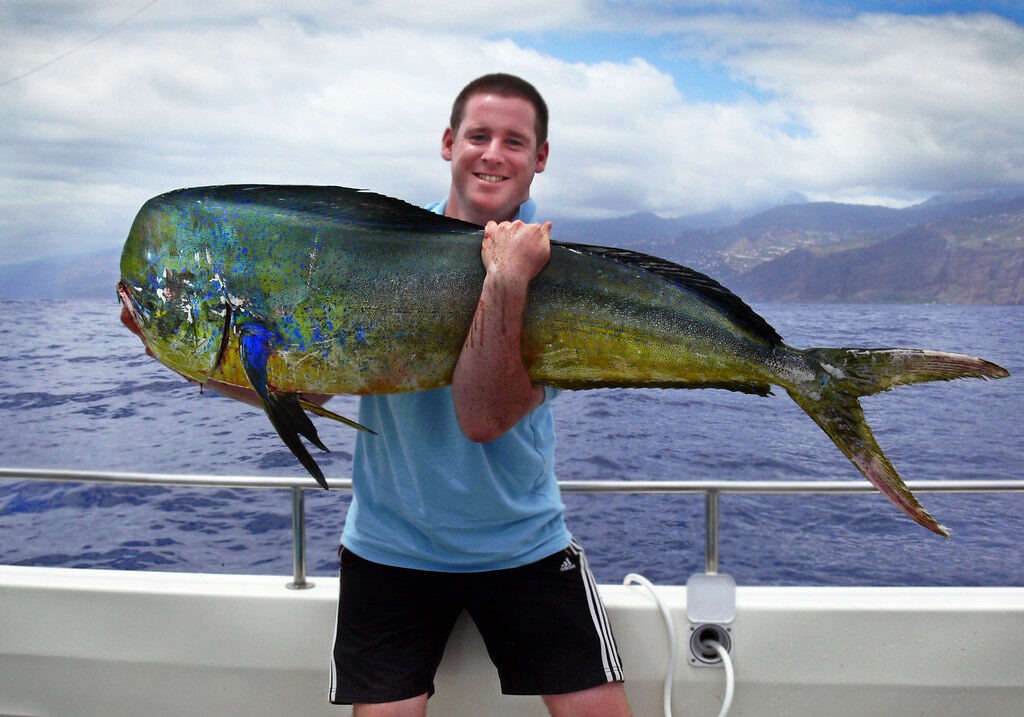
🐟 The Rabbit of the Sea: Encyclopedia of the Mahi-Mahi
An exhaustive 25-chapter documentation dissecting the biology, hyper-fast growth rate, vibrant coloration, and immense culinary prestige of Coryphaena hippurus.
✏️ Written & Curated by the Atechsur.org Marine Biology Team | Last Updated: April 1, 2026

The Mahi-Mahi (Coryphaena hippurus), widely known as the Dolphinfish or Dorado, is one of the most vibrant and intensely pursued pelagic fishes in the world’s oceans. Instantly recognizable by its dazzling neon colors and unique blunt head, it is a staple of offshore sport fishing and high-end seafood menus globally.
This 25-chapter encyclopedia offers a deep dive into the fast-paced life of this incredible species. We will explore the confusing nomenclature surrounding the “dolphinfish,” its staggering growth rates, its acrobatic hunting tactics under floating debris, and the endless ways it is prepared in coastal cuisines from Hawaii to the Mediterranean.
- The Naming Confusion: Despite being called the “Dolphinfish” in English, it is 100% fish and completely unrelated to marine mammals like Flipper. The Hawaiian name “Mahi-Mahi” (meaning “strong strong”) was heavily adopted by restaurants to avoid this consumer confusion.
- Hyper-Growth: They are one of the fastest-growing fish in the ocean, capable of growing over an inch in length per week, reaching sexual maturity in just 4 to 5 months.
- Fading Colors: The brilliant iridescent greens, yellows, and blues of a live Mahi-Mahi fade to a dull grey within minutes of it dying after being pulled from the water.
- Flotsam Hunters: They are famously attracted to floating objects (flotsam) in the open ocean, gathering under sargassum weed lines, floating logs, or even trash to hunt smaller fish seeking shelter.
Part I: Taxonomy, Anatomy, and Color (Chapters 1-7)
 1. Taxonomy and the “Dolphin” Confusion
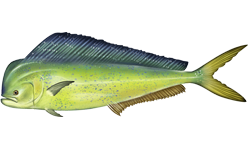
A classic NOAA illustration of the species. It is the sole member of the genus Coryphaena, alongside its smaller cousin, the Pompano Dolphinfish.
Described by Carl Linnaeus in 1758, Coryphaena hippurus has suffered from centuries of confusing nomenclature. The name “Dolphinfish” comes from their habit of swimming ahead of sailing ships, much like mammalian dolphins.
To avoid horrifying restaurant patrons who thought they were eating marine mammals, the culinary world widely adopted the Hawaiian name “Mahi-Mahi” in the 1980s. In Spanish-speaking countries, it is almost exclusively referred to as the Dorado (the golden one).
 2. Sexual Dimorphism: The Bull
As males mature, they develop a prominent, bony crest on their forehead, giving them a very blunt, square profile.
The Mahi-Mahi is one of the few open-ocean pelagic fish to exhibit stark sexual dimorphism. Mature males, commonly referred to by anglers as “Bulls,” develop a highly pronounced, protruding bony crest on their forehead.
This blunt, squared-off head shape becomes more exaggerated as the male ages and grows larger, making it instantly recognizable from a distance when it leaps from the water.
 3. Sexual Dimorphism: The Cow

A 34lb female caught off the coast of Jamaica. Notice the smoothly sloping, rounded forehead.
Conversely, female Mahi-Mahi, known as “Cows,” do not develop the bony crest. They retain a smooth, gently sloping, rounded forehead throughout their entire lives.
Females are also generally smaller than the massive bull males, though exceptions occur. Because they are highly prolific spawners, maintaining healthy populations of these female “cows” is vital to the rapid regeneration of the species.
 4. Chromatic Brilliance

A painting by I.V. Passmoore capturing the brilliant, iridescent greens, yellows, and blues of a live specimen.
The coloration of a living Mahi-Mahi is arguably the most spectacular of any large fish. When hunting near the surface, they shine with iridescent, neon shades of golden-yellow on their flanks, bright aquatic blue and green on their backs, and striking blue pectoral fins.
These colors are not created by pigment alone, but by specialized, light-reflecting cells called iridophores. The fish can actually “flash” or change the intensity of these colors based on its mood, stress level, or while hunting.
 5. The Fading of the Gold

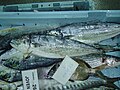
A specimen from Águilas, Spain. Upon death, the brilliant neon colors quickly drain away to a dull grey-green.
Tragically for photographers and fishermen, the brilliant colors of the Dorado are ephemeral. The moment the fish is pulled from the water and dies, its nervous system ceases to control the iridophores.
Within minutes, the dazzling neon greens and yellows literally drain away before the eyes, leaving behind a muted, dull greyish-green or silver fish. This rapid loss of color has added a layer of mythos to the fish among offshore anglers.
 6. The Continuous Dorsal Fin

A NOAA image showing the single dorsal fin extending almost the entire length of the body.
Anatomically, the Mahi-Mahi is built for sustained, high-speed pursuit. A defining characteristic is its single, continuous dorsal fin. Unlike tuna or marlin which have separated or sharply peaked fins, the Mahi’s dorsal fin starts directly behind the eye and runs the entire length of its back, nearly reaching the tail.
This long “sail” acts as a stabilizer, preventing the fish from rolling when it makes lightning-fast, high-speed turns to intercept dodging flying fish.
 7. The Forked Tail and Speed

A specimen at the Smithsonian National Museum of Natural History, showing the deeply forked caudal fin structure.
The caudal fin (tail) of the Mahi-Mahi is deeply forked and highly rigid. This is the biological hallmark of an oceanic sprinter. Powered by massive bands of fast-twitch muscle along its flanks, a mature Mahi can reach burst speeds exceeding 50 mph (80 km/h).
This explosive speed is an absolute necessity, as their primary food source—the flying fish—can glide through the air for hundreds of feet to escape. The Mahi must sprint through the water directly beneath the gliding fish, ready to snap it up the moment it re-enters the ocean.
Part II: Ecology, Behavior, and the Open Ocean (Chapters 8-15)
 8. A Circumtropical Distribution

Two smaller specimens caught off the coast of Tunisia, proving their global reach.
The Mahi-Mahi is a highly migratory, circumtropical species. This means they are found in almost all tropical and subtropical oceans around the world, from the Gulf of Mexico and the Caribbean to the Indian Ocean, the Pacific around Hawaii, and the Mediterranean Sea.
They are highly temperature-dependent, generally remaining in warm waters above 70°F (21°C). They follow massive ocean currents, constantly on the move to stay within optimal temperature ranges and to follow migrating schools of baitfish.
 9. The Flotsam Hunters

A 28 lb bull caught offshore in Islamorada, Florida. Anglers find them by hunting for floating debris.
In the vast, featureless expanse of the open ocean, any floating structure becomes an oasis. Mahi-Mahi are famously associated with flotsam. They will congregate in massive numbers underneath floating weed lines (like Sargassum), floating logs, discarded pallets, or even large pieces of marine trash.
They don’t stay under the debris for shade; they use it as an ambush point. Small baitfish and crabs seek shelter in the floating weeds to escape seabirds, making the debris a concentrated buffet for the patrolling Mahi.
 10. An Insatiable Appetite
Mahi-Mahi have an incredibly high metabolic rate, requiring them to consume an enormous amount of food daily to sustain their rapid growth and continuous swimming. They are aggressive, opportunistic predators.
While flying fish are their staple, stomach content analyses frequently reveal juvenile tuna, mackerel, pelagic squid, and pelagic crabs. They are known to enter feeding frenzies, violently thrashing at the surface to gorge on tightly packed bait balls.
 11. Hyper-Growth: The Rabbit of the Sea

A specimen landed in Dominica. Fish of this size may be less than a year old.
Among marine biologists, the Mahi-Mahi is often referred to as the “rabbit of the sea” due to its staggering growth rate and prolific reproduction. A newly hatched larval Mahi can grow to a catchable size of 3 to 4 pounds in just a few months.
They can reach sexual maturity in as little as 4 to 5 months. Because they live their lives in the fast lane, their lifespans are incredibly short for a fish of their size; a 5-year-old Mahi is considered an ancient, geriatric fish.
 12. Schooling Behavior
While massive, 50-pound bulls are often solitary or travel in pairs, younger, smaller Mahi-Mahi (often called “schoolies” or “peanuts” by anglers) form massive, highly coordinated schools.
These schools, which can number in the thousands, are incredibly competitive. If an angler hooks one fish, the rest of the school will frequently follow the hooked fish right up to the side of the boat, driven by a frantic mob mentality to steal whatever food the hooked fish has found.
 13. Predators of the Mahi

FDA Reference Standard. While apex predators themselves, Mahi are a vital food source for the ocean’s true giants.
Despite their speed and size, Mahi-Mahi sit firmly in the middle of the pelagic food web. They are a primary, crucial food source for the true titans of the open ocean.
Marlin (especially Blue and Black Marlin), large Yellowfin Tuna, Wahoo, and pelagic sharks (like the Mako and Oceanic Whitetip) actively hunt them. In fact, many sport fishermen will catch a small Mahi simply to use it as live bait to attract a massive Marlin.
 14. Historical Encounters by Sailors

A drawing of the fish found in the journal of the Dutch ship Gelderland during its voyage to Asia (1601-1603).
The Mahi-Mahi has been a familiar sight to mariners for centuries. Because they are attracted to floating objects, massive schools would frequently accumulate under the hulls of slow-moving, wooden sailing ships crossing the Atlantic or Pacific.
For sailors on months-long voyages subsisting on salted meat and hardtack, a school of Mahi swimming under the bow provided a vital, fresh, and easily catchable source of high-quality protein, preventing scurvy and starvation.
 15. Reproduction and Spawning
Mahi-Mahi are incredibly fecund (capable of producing abundant offspring). They do not have a single set spawning season; rather, they spawn frequently year-round whenever they are in warm oceanic currents.
A single large female can release anywhere from 100,000 to over a million eggs in a single spawning event. The eggs and subsequent larvae drift freely in the pelagic currents, highly vulnerable to predation but produced in such massive numbers that enough survive to sustain the global population.
Part III: Sport Fishing and Economics (Chapters 16-19)
 16. The Global Sport Fishery

A specimen caught in Bushehr, Iran, highlighting their presence in the Persian Gulf.
The Mahi-Mahi is universally considered one of the premier game fish in the world. They are highly sought after by recreational anglers for three reasons: their beautiful colors, their willingness to aggressively strike trolled artificial lures or rigged ballyhoo, and their spectacular fighting ability.
When hooked, a Mahi is famous for its frantic, high-flying aerial acrobatics, repeatedly launching itself completely out of the water in an attempt to throw the hook, providing a thrilling battle on light tackle.
 17. Commercial Value and Bycatch

A bustling fish market in Rudsar, Iran. Mahi is a vital commercial staple globally.
Commercially, the Mahi-Mahi is heavily targeted by longline and purse seine fleets worldwide. The United States, Japan, and Taiwan are massive consumers of the fish.
Because they are drawn to floating objects, commercial fleets increasingly use FADs (Fish Aggregating Devices)—large, man-made floating buoys equipped with sonar—to intentionally attract massive schools of Mahi, which are then scooped up entirely by purse seine nets. This highly efficient method is controversial, as it results in significant bycatch of juvenile tuna and sharks.
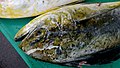 18. Conservation and Sustainability
Despite heavy commercial and recreational pressure, the IUCN lists the Mahi-Mahi as a species of Least Concern. This highly favorable status is almost entirely due to their “rabbit of the sea” biology.
Because they mature in mere months and spawn continuously, their populations are incredibly resilient to overfishing compared to slow-growing species like Bluefin Tuna or Swordfish. For this reason, many seafood watch organizations rate troll-caught Mahi-Mahi as a highly sustainable, eco-friendly seafood choice.
 19. The Aquaculture Challenge
Given their rapid growth rate and high market value, Mahi-Mahi would seem to be the perfect candidate for commercial aquaculture (fish farming). However, farming them has proven incredibly difficult.
They require vast amounts of space; in confined pens, they become highly stressed, leading to disease and aggressive cannibalism. Furthermore, their extreme metabolism requires massive amounts of high-protein food, making it economically difficult to farm them profitably compared to slower, more docile fish like Salmon or Tilapia.
Part IV: Culinary Preparations (Chapters 20-25)
 20. The Flesh Profile

The meat is lean, pale pink to whitish, and incredibly firm.
In the kitchen, Mahi-Mahi is prized for its lean, firm texture and mild, sweet flavor. The raw flesh is typically light pink to off-white, turning a brilliant, opaque white when cooked.
Because it is an active swimmer, the meat has a large, distinct flake and holds together exceptionally well. This makes it an incredibly versatile fish; unlike delicate flounders or sole, Mahi can stand up to aggressive cooking methods without falling apart.
 21. Grilling and Pan-Roasting

Served over quinoa risotto with shishito peppers. Its firm texture holds a beautiful sear.
Because the meat is so firm, Mahi-Mahi is arguably one of the best fish in the world for grilling over an open flame or searing in a hot cast-iron pan. It develops a beautiful, caramelized crust without breaking apart on the grill grates.
However, because it is extremely lean, chefs must be careful not to overcook it, as it can dry out quickly. It is frequently paired with citrus, mango salsas, or rich butter sauces to add moisture back into the dish.
 22. The Ultimate Fish Taco

A staple of coastal American cuisine, offering a meaty, satisfying bite.
In the United States, particularly in Florida, California, and Hawaii, Mahi-Mahi is the undisputed king of the fish taco. The firm, large flakes of the meat hold up perfectly inside a tortilla, whether it is blackened, grilled, or deep-fried in beer batter.
Its mild flavor provides a perfect blank canvas for spicy chipotle cremas, acidic lime juice, and crunchy cabbage slaws.
 23. Regional Taco Variations

Two Mahi tacos served in Sonoma, California, showcasing regional Mexican-American preparation.
The preparation of the Mahi taco varies wildly by region. In Baja California, it is traditionally battered and fried. In healthier, modern Californian cuisine, it is heavily spiced and grilled (“blackened”), served with avocado and pico de gallo.
 24. Restaurant Ubiquity

Mahi tacos served at Elysian Brewing in Seattle, WA, showing its reach far beyond tropical coasts.
Because frozen Mahi-Mahi fillets ship exceptionally well without losing their firm texture, the fish has transcended coastal regions. It is now a standard, recognizable menu item in landlocked pubs and restaurants globally, offering consumers a safe, approachable, and highly sustainable white fish option.
 25. Summary FAQ: The Golden Dorado
Is Mahi-Mahi related to dolphins?
Absolutely not. The English common name “dolphinfish” is a historical misnomer. They are 100% fish with gills and scales, completely unrelated to marine mammals.
Why is it considered a sustainable seafood?
They grow incredibly fast and reproduce constantly throughout the year. Their populations regenerate so quickly that they can withstand heavy commercial and recreational fishing pressure without facing extinction.
What is the difference between a Bull and a Cow?
Mature male Mahi-Mahi (Bulls) develop a very prominent, blunt, flat forehead. Females (Cows) retain a smoothly sloping, rounded head profile throughout their lives.
Explore our trusted network of partner websites covering directories, encyclopedias, marketplaces, education, and finance.
- This digital encyclopedia is created solely as an educational reference material detailing the ecological behaviors and culinary uses of the Mahi-Mahi.
- All included image multimedia content is distributed from the free open-license directory (GNU/Creative Commons Attribution) belonging to the worldwide Wikimedia Commons database.
- Marine statistics and conservation statuses discussed are based on scientific consensus from institutions like NOAA and the IUCN.
About the Drafting Team: Atechsur.org Marine Experts
The scientific biology editorial board of Atechsur.org proactively provides accurate, in-depth scientific reports with a dedication to engaging, humanistic language to promote sustainable fishing practices and marine conservation globally.
© 2026 – Atechsur.org – Complete Mahi-Mahi Encyclopedia (Chapters 1 – 25)
Coryphaenidae • Sustainable Seafood • Updated: April 1, 2026