🐟 The Silver Hunter: A Comprehensive Encyclopedia of the European Seabass
An exhaustive 50-chapter documentation dissecting the biology, ecology, culinary prestige, and aquaculture success of Dicentrarchus labrax.
✏️ Written & Curated by the Atechsur.org Marine Biology Team | Last Updated: March 27, 2026

The European Seabass (Dicentrarchus labrax) is arguably one of the most culturally, ecologically, and economically significant marine fish in the Western hemisphere. Often revered by chefs as the pinnacle of white-fleshed fish and deeply respected by anglers for its fierce fighting spirit, this sleek predator dominates the coastal waters of Europe and North Africa.
This encyclopedia provides an unprecedented 50-chapter deep dive into the world of the European Seabass. We will journey through its fascinating larval development, dissect its specialized anatomy, track its migratory routes through the Mediterranean Sea, and understand how modern aquaculture transformed it from a seasonal luxury into a global culinary staple.
- Euryhaline Adaptation: The European seabass is incredibly resilient, capable of surviving in pure saltwater, brackish estuaries, and occasionally even venturing into freshwater rivers.
- Nocturnal Hunter: While they can feed during the day, they are highly active nocturnal predators, using the cover of darkness to ambush smaller prey.
- Aquaculture Pioneer: It was the very first marine non-salmonid fish species to be commercially cultured in Europe, sparking a massive Mediterranean industry.
- The “Wolf of the Sea”: The French name Loup de mer literally translates to “sea wolf,” reflecting its voracious, pack-hunting mentality when targeting baitfish.
The European seabass was well-known to the ancient Greeks and Romans, featuring heavily in their mosaics and culinary texts. However, it was not scientifically formalized until the dawn of modern taxonomy.
The esteemed Swedish botanist and zoologist Carl Linnaeus first officially described the species in the 10th edition of his landmark Systema Naturae in 1758. Linnaeus originally placed it in the perch family, naming it Perca labrax. Over centuries of taxonomic refinement, it was eventually moved to its own distinct family and genus.
Today, the European seabass belongs to the family Moronidae, commonly known as the temperate basses. This family includes highly prized sport and commercial fish.
The Moronidae family is relatively small, consisting of only a few genera. The European seabass shares its family tree with the closely related Spotted Seabass (Dicentrarchus punctatus), which looks very similar but retains black spots into adulthood, and the famous Striped Bass (Morone saxatilis) native to the North American Atlantic coast.
The generic name Dicentrarchus provides a perfect anatomical description of the fish. It is derived from Ancient Greek words: “di” meaning two, “kentron” meaning sting or spine, and “archos” meaning anus or rear.
Together, the name translates roughly to “two-spined anus.” This refers directly to the presence of two distinct, sharp spines located at the very front of the fish’s anal fin, a key identifying characteristic for biologists separating this genus from similar-looking coastal predators.
The specific epithet labrax (λάβραξ) is a direct borrowing from Ancient Greek. In antiquity, the Greeks used the word “labrax” to refer specifically to the sea bass.
The root of this Greek word implies voraciousness, fierceness, or greediness. This is incredibly fitting for the European seabass, known for its aggressive predatory strikes and its willingness to voraciously swallow prey whole, earning its ancient reputation as a ravenous hunter of the shallows.
Because its habitat stretches across so many distinct human cultures, the European seabass boasts a rich tapestry of common names. In the UK and Ireland, it is simply called the sea bass. In France, it is elegantly known as Bar commun or Loup de mer (sea wolf).
In Italy, it is famously known as Branzino (in Northern Italy) or Spigola (in the peninsular regions). In Spain, you will find it on menus as Lubina. When farmed and sold in North American restaurants, it is almost universally marketed under its Italian moniker, Branzino, to denote its premium status.

The elongated, streamlined shape is built for sustained cruising and sudden bursts of speed in strong currents.
The European seabass possesses a classic fusiform body shape—torpedo-like, elongated, and moderately compressed from side to side. This is the ultimate hydrodynamic design for an active pelagic and coastal swimmer.
They are robustly built, not overly deep-bodied like a snapper, nor extremely slender like an eel. This perfectly balanced morphology allows them to hold their ground in the turbulent surf zones of ocean beaches, as well as maneuver deftly through the complicated structures of rocky reefs and kelp beds.
The fish is covered in moderately sized, firmly attached ctenoid scales, which feel rough to the touch when stroked from tail to head. As for coloration, the adult European seabass is a beautiful study in metallic minimalism.
The dorsal (back) area ranges from a dark lead-grey to a greenish or bluish hue, which seamlessly fades down the flanks into a brilliant, shining silver. The belly is a pure, stark white. While juveniles often feature distinct black spotting on their upper bodies to help camouflage them in shallow seagrass, these spots invariably fade and disappear as they reach adulthood (unlike their cousin, the spotted seabass).
One of the easiest ways to identify a European seabass is by looking at its back. It has two distinct dorsal fins that are separated by a small gap, not joined together.
The first (anterior) dorsal fin is supported exclusively by sharp, rigid, defensive spines—usually numbering between 8 and 9. The second (posterior) dorsal fin features one leading spine followed immediately by 12 to 13 soft, flexible rays. When threatened or aggressive, the fish can flare its front dorsal fin, presenting a formidable array of spikes to deter predators or careless anglers.
The pectoral fins are relatively short, rounded, and positioned low on the body just behind the gills. They provide excellent fine-motor control, allowing the seabass to hover in place facing a current or reverse backward into a rocky crevice.
Directly below the pectorals are the pelvic fins. This thoracic placement is typical of advanced teleost (bony) fishes. These fins act as hydroplanes, helping the seabass brake sharply after an explosive lunge at a prey item, preventing it from crashing into the seafloor or rocks.
The tail, or caudal fin, of the European seabass is broad, powerful, and slightly forked or emarginate (having a slight inward curve). It is not deeply forked like that of a tuna, nor rounded like that of a slow-moving bottom dweller.
This “in-between” design is ideal for a versatile predator. It provides the massive surface area needed for explosive acceleration from a standstill (crucial for ambushing prey), while still being streamlined enough to allow for continuous, efficient cruising along miles of coastline.

Notice the sloping forehead and the prominent lower jaw extending past the upper lip.
The head of the European seabass makes up a significant portion of its body length. It features a gently sloping, somewhat straight forehead profile that ends in a pointed snout. There is often a dark, diffuse spot located on the upper edge of the gill cover (operculum).
The skull is heavily ossified to protect the brain and support the massive jaw muscles required to capture and subdue struggling, slippery prey like squid and mullet.

The seabass is a suction feeder, capable of expanding its mouth cavity to pull in water and prey simultaneously.
The mouth is terminal, large, and slightly superior, meaning the lower jaw protrudes just slightly beyond the upper jaw. The gape is massive. When hunting, the seabass utilizes a technique called suction feeding.
By rapidly opening its cavernous mouth and expanding its gill covers, the fish creates a sudden negative pressure vacuum. This literally sucks the unsuspecting prey item into its mouth along with a rush of water, giving the prey no chance to escape.

Unlike sharks, the seabass possesses bands of tiny, inward-pointing teeth designed to grip, not slice.
Unlike the razor-sharp slicing teeth of a shark or a piranha, the European seabass is equipped with villiform teeth. These are very fine, tiny, bristle-like teeth arranged in dense bands along the upper and lower jaws, the vomer, and the palatines (the roof of the mouth).
They act like heavy-duty Velcro. Because the seabass swallows its prey whole rather than biting it into chunks, these inward-curving abrasive bands ensure that once a slippery fish or squid is sucked in, it cannot wriggle backward out of the mouth.

A distinct biological feature: the dark, raspy tongue.

The tongue assists in holding and maneuvering prey toward the throat.
A unique anatomical quirk of Dicentrarchus labrax is its distinctively pigmented tongue (langue pigmentée). The tongue often features dark grey or blackish coloration, particularly down the center.
Furthermore, the base of the tongue actually contains its own patch of tiny teeth. When the fish snaps its mouth shut, the tongue presses the prey against the teeth on the roof of the mouth, ensuring total immobilization before swallowing.

The sharp spines on the gill plate can cause painful injuries to careless fishermen.
The gill covers (operculum) of the European seabass serve a dual purpose: pumping water over the gills and acting as a primary defense mechanism. The rear edge of the operculum is armed with two flat, incredibly sharp, backward-pointing spines.
In addition, the preopercle (the bone just in front of the main gill cover) features a serrated edge along its lower margin. Experienced anglers know to handle a thrashing seabass with extreme caution, as a careless grip near the head will almost certainly result in a deeply sliced or punctured hand.
Beneath the armored operculum lie the highly efficient gills. Unlike sharks that must keep swimming to breathe, the European seabass uses buccal pumping. It actively gulps water through its mouth and forces it out over the gill filaments by flexing its gill covers.
The gill arches are lined with bright red filaments rich in capillaries for oxygen exchange. On the inner curve of the gill arches are the gill rakers—comb-like structures that prevent debris, and the struggling prey items, from escaping out the side of the head or damaging the delicate respiratory filaments.
The eyes of the European seabass are relatively large and positioned high on the sides of its head, providing excellent binocular vision forward and upward. This is crucial for a predator that often hunts by looking up toward the surface to spot the silhouettes of baitfish against the moonlight or sunlight.
Their retinas are packed with rod cells, which are highly sensitive to low light conditions. This visual adaptation makes them highly successful nocturnal and crepuscular (dawn and dusk) hunters, capable of spotting movement in murky water or total darkness long before their prey sees them.
Running clearly along the flanks of the seabass, from the top of the gill cover all the way to the base of the tail, is a distinct dark stripe: the lateral line. This is a vital sensory organ shared by most fish.
The lateral line is a canal filled with fluid and microscopic hair cells (neuromasts). It detects minute changes in water pressure and vibrations. When a wounded baitfish struggles nearby, or a crab scurries across the sand in pitch darkness, the seabass “feels” the movement through its lateral line, allowing it to strike with pinpoint accuracy without needing to see.
Internally, the European seabass is a standard highly evolved teleost. It has a relatively short, muscular digestive tract typical of an obligate carnivore, designed to rapidly digest high-protein meals.
Its skeletal structure is heavily ossified, providing a rigid anchor for the massive W-shaped myomere muscle bands running down its flanks. The heart is a simple two-chambered pump located just behind the gills, driving blood directly through the respiratory system before circulating it to the rest of the body.
To maintain neutral buoyancy and conserve energy, the seabass possesses a well-developed swim bladder (or gas bladder) located just below the spinal column. This sac is filled with oxygen and other gases extracted directly from the blood.
By regulating the volume of gas in the bladder, the seabass can hover effortlessly at any depth without needing to constantly swim. This is essential for their ambush hunting style, allowing them to remain perfectly still behind a rock or in a kelp bed while waiting for a meal to swim by.
The European seabass is endemic to the waters of the eastern Atlantic Ocean and its associated seas. Its natural distribution is vast, spanning from the chilly waters of southern Norway and the British Isles, down the western coast of Europe, and extending as far south as Senegal in West Africa.
However, its most famous and densely populated strongholds are the entire Mediterranean Sea basin and the Black Sea. The species has historically dominated the coastal ecology of these regions for thousands of years.

A specimen sourced from the Belgian Continental Shelf.
The Atlantic population of the European seabass experiences significantly colder temperatures and wilder tidal environments than their Mediterranean counterparts. Fish off the coasts of the UK, Ireland, and Belgium are often highly prized by surfcasters hunting the turbulent, oxygen-rich surf zones.
Interestingly, genetic studies have shown that the Atlantic populations and the Mediterranean populations show slight genetic divergence, suggesting limited mixing of the two groups across the Strait of Gibraltar, though they remain the exact same species.
The warm, highly saline, and relatively calm waters of the Mediterranean Sea provide the ultimate thriving ground for Dicentrarchus labrax. Here, the fish holds supreme cultural, culinary, and economic importance.
In countries like Italy, Greece, Spain, and Turkey, wild seabass prowl the rocky coastlines, seagrass meadows (Posidonia), and ancient sunken ruins. Because the Mediterranean is a highly competitive, nutrient-poor (oligotrophic) sea, seabass here are exceptionally aggressive and efficient hunters.
The range of the European seabass naturally extends through the Dardanelles and the Bosphorus into the Black Sea. The Black Sea is unique due to its significantly lower salinity compared to the Mediterranean.
The seabass’s incredible physiological adaptability allows it to thrive even in these brackish conditions. However, due to severe overfishing, pollution, and the anoxic (oxygen-depleted) deep layers of the Black Sea, wild seabass populations here are sparser and under much higher ecological stress.

Specimen photographed in the harbor of Brest, France. Seabass thrive in areas where rivers meet the sea.
Estuaries (where river mouths meet the ocean) and coastal lagoons are absolutely vital to the lifecycle of the European seabass. These murky, nutrient-rich environments provide shelter and boundless food for the developing young.
Adult seabass frequently invade harbors, tidal rivers, and brackish marshes during high tide to hunt crabs and mullet, before retreating back to deeper water as the tide ebbs. It is not uncommon to catch large adult seabass several miles upstream in completely fresh water during the summer months.
While some populations are resident (staying in one area year-round), many Atlantic European seabass are highly migratory. Their movements are largely dictated by water temperature and spawning instincts.
In the autumn and winter, as coastal waters rapidly cool, large shoals of seabass will migrate southwards or move offshore into deeper, more temperature-stable oceanic waters to overwinter and spawn. In the spring, as temperatures rise, they migrate back inshore and disperse northward along the coastlines and into estuaries to feed ravenously through the summer.
The European seabass is primarily a demersal (bottom-dwelling) and coastal pelagic fish. During the summer feeding months, they are frequently found in extremely shallow water—sometimes hunting in less than 1 meter of water right in the crashing surf line.
However, during their winter migrations and spawning aggregations, they are known to dive significantly deeper, commonly congregating at depths of 50 to 100 meters (160 to 330 feet) off the continental shelf edges where temperatures are milder.
Dicentrarchus labrax is a highly adaptable species, thriving in temperatures ranging from a chilly 5°C (41°F) in the wintering grounds of the North Sea, up to a bath-warm 28°C (82°F) in the shallow Mediterranean summer lagoons.
Their optimal growth temperature, highly relevant to the aquaculture industry, is generally between 20°C and 24°C. Rapid, extreme drops in temperature (cold snaps) in shallow coastal estuaries can occasionally lead to cold-shock fish kills, but generally, their thermal hardiness is exceptional.
The European seabass is a classic euryhaline species—meaning it can adapt to a vast range of salinities. Their kidneys and gills are incredibly efficient at osmoregulation.
A seabass can swim from the hypersaline waters of the open Mediterranean (approx. 38 ppt salinity) directly into a freshwater river mouth (0 ppt) to hunt for eels, and experience no biological shock. This fluid adaptation allows them to exploit food sources in environments where strictly marine predators cannot follow.

While large adults become solitary, younger fish often hunt in coordinated packs just below the surface.
The social behavior of the European seabass changes as it ages. Juveniles and young adults (often called “schoolies”) form tight, highly coordinated shoals. This schooling behavior provides safety from larger predators and allows them to pack-hunt, driving schools of baitfish into tight bait balls.
As the seabass grow older and heavier (exceeding 3-4 kg), they tend to become increasingly solitary, territorial, and reclusive. These large, solitary individuals (often female) are affectionately referred to by anglers as “lunkers” or “pigs,” preferring to ambush prey alone from hidden coastal structure rather than expend energy chasing down bait in a pack.
The diet of the European seabass evolves dramatically with its size. In their early juvenile stages within estuaries and lagoons, their tiny mouths restrict them to hunting small invertebrates.
They feed heavily on copepods, amphipods, small marine worms, and tiny shrimp. As they reach 10 to 15 cm in length, they begin to incorporate the fry of other fish, small gobies, and larger crustaceans into their daily intake.

Adults are apex coastal predators, consuming a wide variety of fish, crabs, and cephalopods.
Adult European seabass are formidable, opportunistic carnivores. Their absolute favorite prey items are schooling pelagic fish, heavily targeting European pilchards (sardines), sand eels, sprats, and grey mullet.
However, they are not exclusively fish-eaters (piscivores). A large portion of an adult seabass’s diet consists of cephalopods (squid and cuttlefish) and hard-shelled crustaceans, particularly shore crabs and swimming crabs, which they hunt in the rocky shallows at night, crushing the shells with their powerful pharyngeal jaws.
The seabass is a master of the environment. In the churning white water of a surf beach, they use the foam and sand kicked up by crashing waves as cover, violently rushing in to grab disoriented sand eels or crabs washed out of the sand.
In calmer rocky reefs or harbors, they adopt a stealthy ambush strategy. They will hover motionless in the shadows of a bridge piling, a kelp stalk, or a submerged wreck, relying on their lateral line to detect approaching mullet. When the prey enters striking distance, the bass lunges forward, opening its massive mouth to inhale the victim instantly.

A whole channel crab found inside a seabass caught by a sport fisher in a river in Tuscany, Italy.
Biologists and anglers routinely perform stomach content analyses to understand local seabass behavior. As seen in the image above, a seabass will swallow large, heavily armored prey entirely whole. Their stomach acids are incredibly potent, capable of dissolving thick crab carapaces and fish bones rapidly.
Finding entire crabs, large squid, or whole mackerel inside the stomach of a freshly caught seabass is common. This opportunistic gluttony dictates the types of lures and baits anglers use to target them in different seasons.
While an adult European seabass is a top-tier predator in the coastal zone, it is not immune to predation itself. As juveniles, they face a gauntlet of threats from larger fish, seabirds (like cormorants and herons), and even larger cannibalistic seabass.
As adults, their primary non-human predators are marine mammals. Grey seals, harbor seals, and bottlenose dolphins are known to actively hunt large seabass. In certain areas of the Mediterranean, large pelagic sharks may also pick off seabass that venture too far from protective coastal structures.
The journey to sexual maturity for the European seabass varies depending on its geographic location. In the warmer waters of the Mediterranean, males typically reach maturity between 2 and 3 years of age, while females take 3 to 4 years.
In the colder Atlantic waters, growth is slower, and maturity is delayed by an additional year or two. This biological factor makes northern Atlantic populations more vulnerable to overfishing, as fish are often caught before they have had a chance to spawn even once.
Spawning is a massive, highly synchronized event. In the Mediterranean, it occurs during the winter months (December to March). In the Atlantic, spawning is slightly later, peaking from February to May.
Adult seabass gather in massive breeding aggregations offshore, typically in deeper water with strong currents. A single large, healthy female (a “broodmare”) can release anywhere from a quarter of a million to over two million eggs in a single season, releasing them in batches (pelagic spawning) directly into the water column to be fertilized externally by attending males.
The fertilized eggs of Dicentrarchus labrax are pelagic, meaning they float freely in the open ocean currents. They are tiny, roughly 1.1 to 1.2 millimeters in diameter, and contain a small oil globule that provides buoyancy.
The eggs drift helplessly for roughly 4 to 6 days, depending entirely on water temperature (warmer water accelerates hatching). During this phase, they suffer catastrophic mortality rates, eaten by filter feeders and planktivores, before the survivors finally hatch into the harsh ocean environment.

Source: IFREMER • At this stage, the larvae are incredibly fragile, transparent, and just beginning to develop functioning organs.
Upon hatching, the larvae are microscopic, transparent, and entirely helpless. They lack a functional mouth, fins, or digestive tract. For the first few days, they survive purely by absorbing the nutrients remaining in their attached yolk sac.
These initial days are the most critical bottleneck in both wild populations and commercial aquaculture hatcheries. The larvae are highly susceptible to changes in temperature, salinity, and water quality.

Sea bass larvae are blind when they hatch and their mouths are not yet open.
An incredible fact about European seabass larvae is that they are completely blind when they hatch. Their eyes are not fully pigmented or functional. To ensure normal development in aquaculture hatcheries, the beginning of breeding is done in total darkness without food.
It is only around day 4 to 6 that the mouth finally opens, the eyes pigment and become functional, and the yolk sac is depleted. At this exact moment, they must immediately transition to active hunting, feeding on microscopic live prey like rotifers or Artemia (zooplankton). If they fail to find food within hours of this transition, they will starve.

As days pass, the digestive tract and fins begin to take shape.
As the larvae continue to drift toward the coastlines over several weeks, they undergo a profound metamorphosis. They slowly transform from a transparent, tadpole-like creature into a miniature fish, developing scales, a functional swim bladder, and distinct fin rays.
By the time they are roughly 1.5 to 2 centimeters long, they use the tidal currents to actively migrate into shallow, protected estuaries, salt marshes, and river mouths, where they will spend their crucial first years of life.

Laboratory image tracking the rapid growth of juvenile seabass at days 11, 13, and 15.

A fully formed juvenile showing the typical dark spotting that acts as camouflage in shallow eelgrass beds.
Once metamorphosed, the juvenile seabass (often called “school-bass”) exhibit the aggressive, predatory behavior of their parents. They school tightly for protection and to hunt small shrimp and fry.
Laboratory studies, vital for the aquaculture industry, track their rapid growth day by day. In the wild, their survival through the first winter is heavily dependent on the water temperatures inside their estuarine nurseries. A particularly harsh winter can wipe out an entire year-class of juveniles.
The farming of European seabass is an ancient practice. Historically, the Romans and Egyptians practiced extensive aquaculture by trapping wild juveniles in coastal lagoons and salt pans (valli), allowing them to grow naturally before harvesting them.
However, the true modern intensive Aquaculture boom began in the late 1960s in France and Italy. Scientists successfully mastered the mass-rearing of live prey (rotifers and Artemia) required to feed the blind, fragile larvae, breaking the final bottleneck to commercial farming. Seabass was the first marine non-salmonid species to be commercially cultured in Europe.

A perfectly uniform farmed seabass from Cannes, France (Aquaculture).

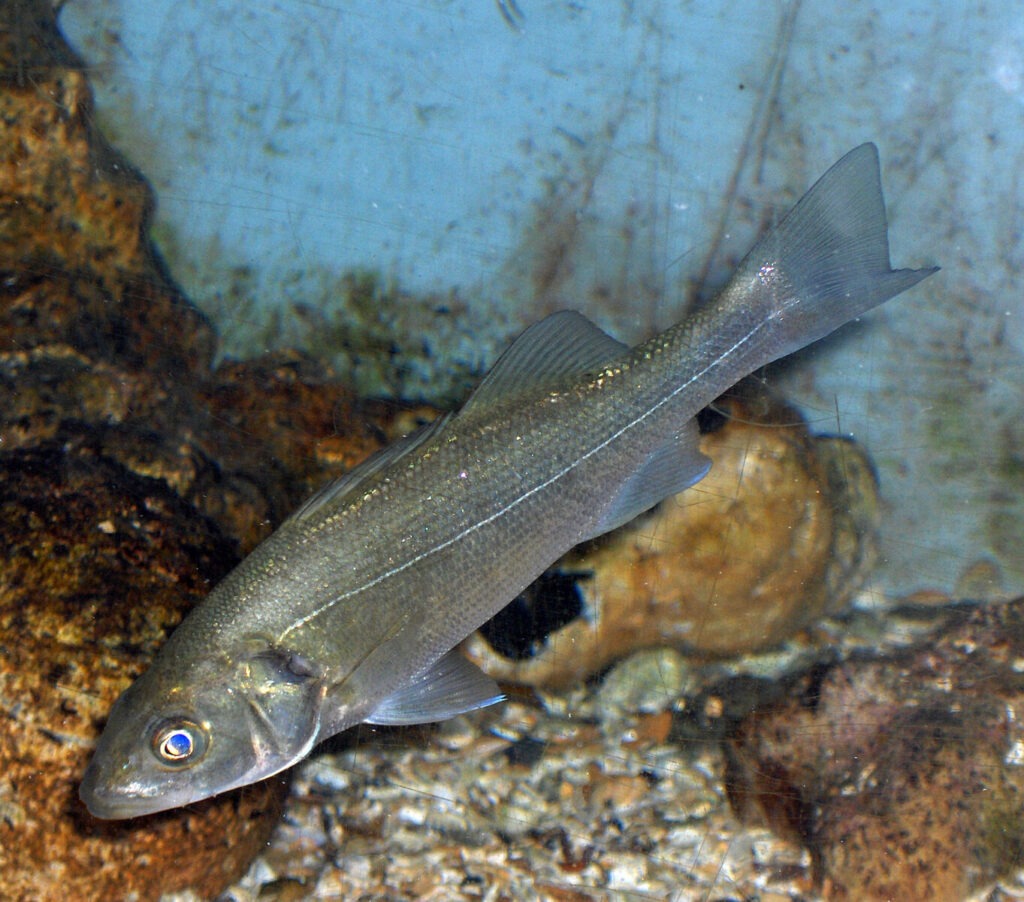
Specimen kept in pristine condition at the Loro Parque aquarium, Tenerife.
Today, the Mediterranean is dotted with massive offshore sea-cages dedicated to farming seabass. Greece, Turkey, Italy, and Spain are the dominant global producers, churning out hundreds of thousands of tons annually.
The fish are bred in land-based, climate-controlled hatcheries before being transferred to floating sea-pens to grow out. The industry has become so advanced that the fish are bred for uniform size, rapid growth, and disease resistance. Because of their hardiness, they also make excellent display specimens in public aquariums, as seen in the exhibits at Loro Parque, Tenerife.
The massive influx of farmed seabass (Branzino) democratized the fish, transforming it from a rare, expensive luxury reserved for elite coastal restaurants into an affordable, ubiquitous item found in supermarkets worldwide.
However, purists and high-end chefs often argue there is a distinct difference. Wild-caught seabass command a massive price premium. They are usually larger, have a firmer flesh texture due to a lifetime of swimming against ocean currents, and possess a more complex, nuanced flavor profile derived from a varied wild diet of crabs and squid, rather than standardized commercial fish pellets.

A magnificent wild specimen caught off the coast of Brest, France.

Wild seabass from the Atlantic command top market prices in European fish markets.
Commercial fishing for wild seabass is a highly lucrative, albeit heavily regulated, industry. Fishermen target them using mid-water trawls, gillnets, and, for the highest quality fish, commercial hook-and-line methods (rod and line or longlines) which preserve the impeccable quality of the flesh without bruising it in nets.
The winter months, when the fish aggregate in large schools offshore to spawn, have historically been the peak catching season. However, this practice of targeting spawning aggregations led to severe population crashes in the early 21st century.
For the sport fisherman standing on the rocky, wave-battered coastlines of Ireland, the UK, or France, catching a large wild seabass is considered the ultimate angling achievement. They are renowned for their cunning, their explosive strikes on surface lures, and their powerful, dogged fighting ability.
Anglers spend hours casting topwater poppers and diving minnow lures into the churning white surf at dawn and dusk. Due to declining wild stocks, a strong “catch and release” ethos has developed among the sport fishing community, advocating for the protection of large, breeding-age females to ensure the future of the fishery.

Two whole European seabass (Branzino) prepared and ready to be cooked, a staple of Mediterranean cuisine.
In the culinary world, the European seabass is royalty. Its flesh is brilliantly white, firm yet flaky, with a remarkably delicate, sweet, and mild flavor profile that lacks any overpowering “fishy” taste. It is highly forgiving to cook and exceptionally versatile.
The traditional Mediterranean preparation is a study in minimalism: scaling and gutting the fish, stuffing the cavity with lemon, fresh thyme, and rosemary, and roasting or grilling it whole. Another iconic method is baking the whole fish encased in a thick crust of sea salt, which locks in the moisture and perfumes the flesh perfectly.

The FDA maintains a Reference Standard Sequence Library for Seafood Identification to prevent fish fraud in the US market.
Nutritionally, seabass is an exceptional lean protein source. It is low in overall fat but provides a healthy dose of Omega-3 fatty acids, along with significant amounts of B-vitamins, selenium, and phosphorus.
Because of its high market value in the United States, farmed Branzino is a common target for “seafood fraud” (where a cheaper white fish is mislabeled and sold as Branzino). To combat this, the US Food and Drug Administration (FDA) maintains a strict reference standard library, utilizing genetic sequencing and standardized photographic records to guarantee market authenticity and protect consumers.
Globally, the IUCN lists the European Seabass as Least Concern, largely owing to the massive, stable populations sustained by the booming aquaculture industry. However, this broad classification masks a severe crisis facing wild Atlantic and Mediterranean stocks.
Overfishing, particularly the commercial targeting of pre-spawning aggregations, led to a near-collapse of the wild Northern Atlantic population in the 2010s. In response, the European Union implemented emergency emergency measures, including strict catch limits, increased minimum landing sizes, and complete bans on commercial netting during the crucial winter spawning months. While wild stocks are slowly showing signs of recovery, continuous vigilant management is absolutely critical to ensure this magnificent silver predator continues to patrol the coasts of Europe for generations to come.
Explore our trusted network of partner websites covering directories, encyclopedias, marketplaces, education, and finance.
- This digital documentation is created solely as a basic reference material for marine biology education and the observation of the European Seabass.
- All included image multimedia content is purely distributed from the free open-license directory (GNU/Creative Commons) belonging to the worldwide Wikimedia Commons database.
- The conservation status ranking of this species refers to the verified assessments by the IUCN Red List.
About the Drafting Team: Atechsur.org Biology Experts
The scientific biology editorial board of Atechsur.org proactively provides accurate, in-depth scientific reports with a dedication to engaging, humanistic language to promote a future of improved marine conservation and sustainable ecosystems.
© 2026 – Atechsur.org – Complete European Seabass Encyclopedia (Chapters 1 – 50)
Dicentrarchus labrax • Least Concern • Updated: March 27, 2026