🐟 The Relic of the Swamps: An Encyclopedia of the African Lungfish
An exhaustive 50-chapter documentation dissecting the biology, evolutionary significance, aestivation behavior, and ecology of the genus Protopterus.
✏️ Written & Curated by the Atechsur.org Evolutionary Biology Team | Last Updated: March 27, 2026

The African Lungfish (genus Protopterus) represents one of the most fascinating evolutionary bridges in the animal kingdom. Existing as a “living fossil,” these remarkable creatures possess features that blur the line between ancient fish and the earliest terrestrial tetrapods. Capable of breathing atmospheric air, they dominate the challenging aquatic environments of the African continent.
This encyclopedia provides an unprecedented 50-chapter deep dive into the world of the African Lungfish. We will explore its four distinct species, its incredible physiological ability to survive years of drought encased in a mud cocoon, its unique anatomy, and its crucial position in the study of vertebrate evolution.
- Obligate Air Breathers: Adult African lungfish have highly atrophied gills; they will actually drown if prevented from reaching the surface to gulp atmospheric air.
- Drought Survivors: They can survive for years without water by burying themselves in the mud and forming a hard, protective mucus cocoon.
- Lobe-Finned Ancestry: Their stringy, limb-like pelvic and pectoral fins share homologous bone structures with the limbs of early amphibians.
- Living Fossils: Their basic anatomical design has remained largely unchanged for hundreds of millions of years, providing a window into the Devonian period.
The scientific community’s introduction to the African lungfish was met with astonishment. The genus Protopterus was first formally described by the renowned British biologist Richard Owen in 1839. The specimen he examined caused a sensation because it possessed both fish-like gills and tetrapod-like lungs.
Early biologists debated fiercely whether it should be classified as a fish or an amphibian. Its discovery fundamentally altered the scientific understanding of vertebrate evolution, offering tangible proof of a transitional stage between fully aquatic and terrestrial life.
African lungfish belong to the class Sarcopterygii, commonly known as lobe-finned fishes. This is a crucial distinction from the vast majority of living fish, which are ray-finned (Actinopterygii).
The Sarcopterygians are evolutionary VIPs. This class includes the coelacanths, the lungfishes (Dipnoi), and, crucially, the ancestors of all tetrapods (amphibians, reptiles, birds, and mammals). Therefore, a lungfish is more closely related to a human than it is to a salmon or a shark.
Within the lobe-finned fishes, lungfish constitute the order Dipnoi (from Greek di meaning ‘two’ and pnoe meaning ‘breath’, referencing their dual ability to breathe in water and air).
The Dipnoi were incredibly diverse and abundant during the Devonian period (the “Age of Fishes”). Today, they are represented by only three surviving genera, geographically isolated on three different continents: Neoceratodus in Australia, Lepidosiren in South America, and Protopterus in Africa.
The genus Protopterus is the sole member of the family Protopteridae. They are distinguished from their Australian cousin (which has a single lung and uses gills more heavily) by possessing paired lungs and being obligate air-breathers as adults.
Morphologically, Protopterids are characterized by their elongated, eel-like bodies, soft cycloid scales, and thread-like pectoral and pelvic fins, which they use more for sensing their environment and propping themselves up rather than for active swimming.

The combined range of all four species covers a vast portion of sub-Saharan Africa.
There are currently four recognized extant species within the genus Protopterus, distributed across different freshwater basins in Africa:
- Protopterus aethiopicus (Marbled lungfish)
- Protopterus annectens (West African lungfish)
- Protopterus dolloi (Slender lungfish)
- Protopterus amphibius (Gilled lungfish)
While sharing the same basic morphology and survival strategies, they differ in size, specific habitat preferences, and geographic range.

Noted for its striking dark mottling over a yellowish or grayish background.

Dominating the Nile and Congo basins, including Lake Victoria and Lake Tanganyika.
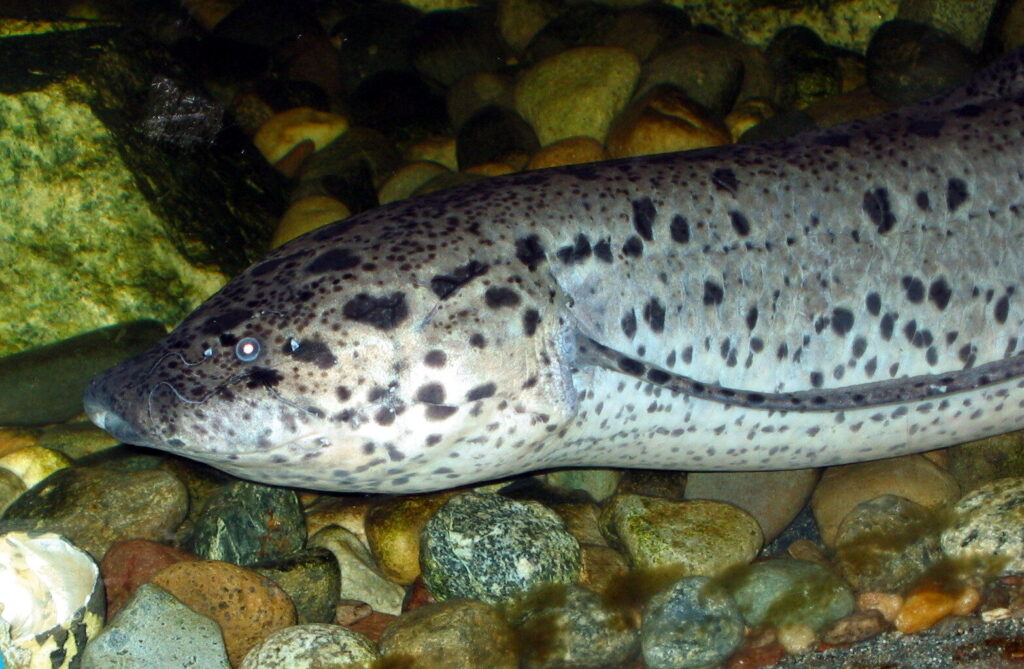
P. aethiopicus is the largest of the lungfishes, capable of reaching lengths up to 200 cm (6.6 ft). It is easily recognizable by its robust body and attractive marbled or leopard-like spotting.
This species holds a unique biological record: it possesses one of the largest known genomes of any living organism, with a massive amount of DNA per cell, significantly larger than the human genome. It is widely distributed across eastern and central Africa, particularly in the Nile and Congo river basins.

Photographed at the Aquarium Dubuisson, Liège. This species is slightly smaller and lighter in color.

Spanning the Sahel region from Senegal to the Sudan.
P. annectens is arguably the most widely studied species, often utilized in laboratory settings to investigate the physiological mechanisms of aestivation. It has a prominent snout and relatively small eyes.
Its distribution covers a broad swathe of West Africa and the Sahel, inhabiting the Senegal, Niger, Gambia, and Volta river basins, as well as the Lake Chad basin. It is highly adapted to the extreme seasonal dry periods characterizing these regions.

Noted for its extremely elongated, eel-like body structure compared to its cousins.

Concentrated primarily within the Congo River basin.
P. dolloi, the Slender lungfish, lives up to its name with a highly elongated, almost serpentine body. It typically has the highest number of ribs among the Protopterus species.
This species is endemic primarily to the Congo River basin and the Ogowe River basin. Interestingly, unlike P. annectens, the Slender lungfish is often found in permanent water bodies and is believed to aestivate less frequently in the wild, doing so only when its specific swamp dries out entirely.

The smallest species, often retaining external gill features longer than the others.

Restricted to East Africa, particularly coastal drainages.
P. amphibius is the smallest of the four species, rarely exceeding 45 cm (18 inches) in length. It is characterized by a relatively large head and the fact that adults often retain remnants of their external gills longer than other species.
Its geographic range is the most restricted, found primarily in East Africa, including the coastal drainages of Kenya and Somalia, and the Zambezi River system.

Illustration from 1908 highlighting the continuous dorsal-caudal-anal fin fold.
The body of an African lungfish is highly modified for its environment. It is elongated and cylindrical, resembling an eel. They lack distinct dorsal, anal, and caudal (tail) fins; instead, these are fused into a single, continuous fin fold that runs along the rear half of the body.
They are covered in small, cycloid scales embedded deeply in the skin, which is rich in mucous glands. This heavy mucus layer is vital for mobility in muddy environments and plays a critical role in the formation of their aestivation cocoon.

The paired fins are reduced to long, slender filaments used for sensing and propping the body.
One of the most striking features of Protopterus is its paired pectoral and pelvic fins. Unlike the broad, fan-like fins of most fish, these are reduced to long, slender, whip-like filaments.
Despite their fragile appearance, these fins contain a central axis of bone and muscle. They are highly mobile and are used by the lungfish to “walk” or prop themselves up on the muddy bottom of swamps, feeling their way through dense vegetation. These structures are the evolutionary precursors to the legs of terrestrial vertebrates.
The defining anatomical feature of the lungfish is, of course, its lungs. In Protopterus, the swim bladder has evolved into a pair of highly vascularized, functional lungs connected to the esophagus.
While they possess gills, the gills of adult African lungfish are highly atrophied (reduced in size and function). They are incapable of extracting sufficient oxygen from the water to survive. Therefore, they are obligate air-breathers. They must periodically swim to the surface, break the water with their mouths, and gulp atmospheric air to survive.
To support this dual respiratory system, the African lungfish has a highly modified circulatory system that bridges the gap between fish and amphibians. They possess a partially divided heart, allowing for a separation of oxygenated and deoxygenated blood.
Blood oxygenated in the lungs is returned directly to the left side of the heart and then pumped to the body, bypassing the inefficient gills. This complex routing is essential for sustaining them during periods when they rely entirely on their lungs for oxygen.
The lungfish possesses a unique and powerful jaw structure. Their teeth are not individual pegs like in most fish or reptiles; instead, they are fused into solid, bony, ridged plates known as tooth plates.
These massive upper and lower tooth plates function like heavy-duty shears or nutcrackers. The skull is heavily ossified to anchor the immense jaw muscles required to power these plates, allowing the lungfish to effortlessly crush the hard shells of snails, clams, and heavily armored crustaceans.

The unique structure of the parasphenoid bone is a key feature used by paleontologists to trace lungfish evolution.
A critical anatomical feature for studying the evolutionary history of lungfishes is the parasphenoid bone, located at the base of the skull. In lungfishes, this bone is elongated and highly distinct.
Paleontologists rely heavily on the morphology of the parasphenoid (as shown in the comparative diagram) when examining Paleozoic fossils, as it often survives intact and helps trace the lineage of modern Protopterus back to its ancient Devonian ancestors.

Lungfish are heavily associated with muddy, vegetated bottoms in slow-moving water bodies.
African lungfish are primarily freshwater species that favor environments that would be lethal to most other fish. They thrive in swamps, marshes, stagnant pools, and the floodplains of major river systems.
They prefer shallow, heavily vegetated areas with soft, muddy bottoms. These environments are often hypoxic (low in oxygen) due to decaying plant matter and high temperatures. Because the lungfish relies on its lungs for oxygen, it faces no competition from gill-breathing fish in these harsh zones.
The most legendary ability of the African lungfish is Aestivation—a state of prolonged dormancy during hot, dry periods. When the dry season approaches and their swamps begin to evaporate, the lungfish does not perish; it burrows.
Using its mouth, it chews into the soft mud, creating a vertical, bulb-shaped burrow. As the water disappears completely, the fish secretes a copious amount of mucus from its skin. This mucus hardens into a thin, leathery, parchment-like cocoon that encases the entire body, leaving only a small breathing tube connected to the mouth.

Historical illustration showing a clod of dry earth broken open to reveal the encapsulated lungfish inside.
Once inside the cocoon, the lungfish’s metabolism drops drastically—by up to 60%. Heart rate slows, and oxygen consumption plummets. To survive without food, the fish begins to slowly metabolize its own muscle tissue for energy.
Normally, protein breakdown produces highly toxic ammonia, which fish excrete into the water. Because there is no water, the lungfish converts this ammonia into less toxic urea, which builds up in its tissues until the rains return. A lungfish can survive in this state of suspended animation for an astonishing 3 to 5 years if necessary.
When the seasonal rains finally arrive and flood the baked earth, the water seeps down into the burrow. The moisture softens the leathery mucus cocoon.
The lungfish awakens from its torpor, bursts out of the cocoon, and wriggles its way back up the burrow to the surface. It immediately begins feeding voraciously to rebuild its depleted muscle mass and excrete the massive buildup of urea into the surrounding water.
African lungfish are opportunistic omnivores, though they lean heavily toward carnivory. They are benthic (bottom-feeding) foragers.
Using their sensitive, thread-like pelvic and pectoral fins, they probe the muddy bottom for prey. Their powerful tooth plates allow them to crush freshwater snails, clams, and crabs with ease. They will also actively hunt small fish, frogs, and aquatic insects, occasionally supplementing their diet with plant matter.
Reproduction typically occurs shortly after the rainy season begins and the swamps flood. Lungfish exhibit remarkable parental care, a trait uncommon among many fish species.
The male constructs a U-shaped nest in the muddy bottom among dense reeds or swamp grass. He will entice one or more females to deposit eggs into the nest, which he then fertilizes externally.
Once the eggs are laid, the male assumes full responsibility for guarding the nest against predators. He fiercely defends the perimeter and continually aerates the water around the eggs by thrashing his tail.
The eggs hatch into tadpole-like larvae. Strikingly, these larvae possess prominent, feathery external gills (similar to salamander tadpoles) and a ventral adhesive organ used to attach themselves to the walls of the nest. As they mature, the external gills regress, the lungs develop, and they transition to obligate air breathing.

Historical diagrams depicting the undulating swimming motion and the use of paired fins for propping.
In the water, the lungfish swims primarily using an anguilliform (eel-like) motion, undulating its long body and continuous fin fold to propel itself forward.
However, when navigating the shallow, vegetation-choked bottoms of their habitat, they employ a unique form of locomotion. They use their filamentous pectoral and pelvic fins as struts, essentially “walking” or punting themselves along the mud. This behavior is heavily studied by biomechanists attempting to understand how the first vertebrates transitioned onto land.
The African lungfish is one of the most critical organisms in the study of evolutionary biology. They represent a surviving remnant of the osteichthyan lineage that gave rise to all terrestrial vertebrates.
By studying their lung morphology, their partially divided heart, and the mechanics of their pelvic fin movements, scientists can make highly educated models of how ancient aquatic creatures like Tiktaalik first breached the surface and began the colonization of the terrestrial world.

Fossilized remains of an ancient Protopterus species. The basic body plan has remained virtually unchanged for millions of years.
The fossil record shows that lungfishes were highly diverse and globally distributed during the Devonian and Carboniferous periods. However, the basic anatomical design of the genus Protopterus has remained stubbornly static.
Fossils dating back over 100 million years look remarkably similar to the lungfish swimming in African swamps today. This evolutionary stasis suggests that their highly specialized adaptations (lungs and aestivation) were so successful at surviving localized environmental extremes that further drastic morphological changes were unnecessary.
Living in heavily vegetated, muddy, and often tannin-stained waters, vision is of limited use to the African lungfish. Consequently, they have evolved robust alternative sensory systems.
They possess an advanced olfactory (smell) system to locate decaying organic matter or hidden prey. Furthermore, their skin, particularly around the head and the thread-like fins, is packed with mechanoreceptors and possibly electroreceptors, allowing them to sense vibrations and navigate effectively in total darkness.
Throughout their range, African lungfish are an important source of protein for local communities. They are frequently caught by artisanal fishermen using traps, nets, and longlines set in swamps and river margins.
Due to their ability to survive out of water, fishermen can catch them alive, transport them long distances in damp sacks or mud, and keep them fresh for days before consumption, making them a highly resilient and valuable food source in regions lacking refrigeration.
The lungfish’s aestivation habits have given rise to fascinating local legends. Because they burrow into the mud, locals often dig up the dry, baked earth of former swamps to harvest the encased fish.
In regions where mudbricks are used for construction, there are documented, albeit rare, instances where a lungfish cocoon was inadvertently incorporated into a dried mudbrick. When the heavy seasonal rains eventually soak the walls of the dwelling, the lungfish rehydrates, breaks its cocoon, and literally emerges from the wall of the house, much to the shock of the inhabitants.
As sizable benthic predators, lungfish play a crucial role in regulating populations of crustaceans and mollusks within swamp ecosystems. They act as top predators in hypoxic zones where other large fish cannot survive.
Conversely, they are preyed upon by crocodiles, large predatory birds like the shoebill stork, and mammals. During aestivation, if their burrows are discovered, they are vulnerable to being dug up by monitor lizards and humans.

A Protopterus annectens gracefully navigating a large tank at the Paris Aquarium.
Due to their unique biology and relative hardiness (requiring only poor water quality as long as they have access to surface air), African lungfish are popular exhibits in public aquariums worldwide. They are fascinating educational tools for demonstrating evolutionary concepts.
However, they are aggressive and highly territorial, meaning they usually must be housed alone in large, heavily planted tanks with sandy substrates to prevent them from damaging themselves or attacking tankmates.
The medical and scientific community is intensely interested in the lungfish’s ability to aestivate. The physiological changes that occur—halting digestion, massively reducing metabolic rate, and surviving high levels of urea toxicity without organ damage—are remarkable.
Researchers study these mechanisms hoping to find applications for human medicine, particularly in fields related to organ preservation, managing kidney failure, and understanding the cellular mechanics of suspended animation for critical care scenarios.

Museum models comparing the South American lungfish (top) and the African lungfish (bottom).
To fully appreciate the African lungfish, one must look at its surviving relatives. The South American lungfish (Lepidosiren paradoxa) is its closest cousin; both share an eel-like body, paired lungs, and aestivate in mud.
The Australian lungfish (Neoceratodus forsteri) is more primitive. It has a single lung, relies heavily on its gills, has broad flipper-like fins, and cannot survive total desiccation. This global distribution is a classic example of continental drift and Gondwanan vicariance.
During a three-year aestivation in a dried mud cocoon, a lungfish obviously cannot drink water. To survive this extreme dehydration, the fish allows its blood to become incredibly thick and viscous.
To prevent this sludge-like blood from clotting or causing heart failure, the lungfish’s cardiovascular system undergoes complex biochemical adjustments. Their tissues become highly tolerant to desiccation, protecting cellular walls from collapsing until water is reintroduced to the system.
The paired lungs of the African lungfish did not appear out of nowhere; they are homologous to the swim bladder found in most modern teleost fish. In evolutionary history, the ancestral organ likely served a dual purpose of buoyancy control and supplemental respiration in hypoxic Devonian swamps.
While the ancestors of modern fish modified this organ strictly into a gas bladder for buoyancy, the Sarcopterygians modified it heavily into a highly vascularized surface for extracting atmospheric oxygen, leading directly to the lungs of terrestrial animals.
While fish are generally thought to be silent, lungfish are known to be quite vocal. When they come to the surface to breathe, the forceful expulsion of air followed by a sharp intake often creates a loud, distinct “belching” or gulping sound that can be heard clearly across a quiet swamp.
Additionally, when threatened, handled, or during aggressive territorial disputes, they are known to emit deep grunting or croaking sounds, likely produced by forcing air back and forth between their lungs and esophagus.
Behind the massive primary tooth plates located in the front of their jaws, lungfish rely on heavily muscled pharyngeal jaws located deeper in the throat.
When a lungfish sucks in a hard-shelled snail or a tough crab, the primary jaws grip and crush the outer shell. The item is then passed back to the pharyngeal teeth, which act like a grinding mill, completely pulverizing the shell into manageable, digestible fragments before it enters the stomach.

A specimen of P. dolloi preserved in fluid at the Royal Museum for Central Africa.

Specimen housed at the Natural History Museum, University of Pisa.
Because they are difficult to observe in their murky, swampy habitats, fluid-preserved specimens in museums play a critical role in the ongoing morphological study of the Protopterus genus.
Institutions like the Royal Museum for Central Africa in Belgium hold extensive collections of lungfish collected during the 19th and 20th centuries, allowing scientists to study variations in scale patterns, fin structure, and bone anatomy without needing to harvest new wild specimens.
African lungfish serve as important indicator species for the health of wetland ecosystems across the continent. Because they are top predators in hypoxic zones, their presence indicates a thriving, complex invertebrate and amphibian food web.
Conversely, the disappearance of lungfish from historical floodplains often points to severe ecological degradation, usually caused by agricultural runoff, pesticide pollution, or the catastrophic draining of wetlands for human development, which destroys their aestivation grounds.
While currently not listed as highly endangered on a global scale, local populations of lungfish face significant threats. The primary danger is the rapid destruction of their habitats.
As Africa’s population expands, massive swaths of swamps and seasonal floodplains—the very areas lungfish require to breed and aestivate—are being dammed, drained, and converted into agricultural land. When a swamp is permanently paved over, the encased, sleeping lungfish beneath the soil are destroyed.
Living fossils often host unique ecosystems of parasites, and the lungfish is no exception. Because their evolutionary line diverged so long ago, many of the nematodes, flatworms, and specialized leeches that infect them are found on no other modern fish species.
Studying the specific parasites that infect Protopterus helps parasitologists understand the co-evolution of host and parasite over hundreds of millions of years, tracing pathways back to the Devonian era.
The brain of the African lungfish is relatively small compared to modern teleost fishes, encased in a thick, cartilaginous cranium. However, its structure is highly informative for neurobiologists.
The forebrain (telencephalon) is notably enlarged compared to typical fish, a feature more aligned with the brain structure of early amphibians. This enlargement is likely associated with processing complex olfactory signals necessary for navigating and hunting in dense, dark swamps.
One of the most perplexing mysteries surrounding the African lungfish, particularly P. aethiopicus, is its genome size. It holds the record for the largest known genome among all animals, possessing nearly 40 times the amount of DNA found in a human cell.
Geneticists are still unraveling why this is. Much of it consists of “junk DNA” or highly repetitive sequences. Understanding how the lungfish manages and replicates such a colossal amount of genetic material without cellular collapse is a major focus in genomic research.
Because they are obligate air breathers, the commercial transport of live lungfish is remarkably unique. Unlike other fish that require large vats of oxygenated water, lungfish can be transported essentially dry.
Fishermen and traders often transport them tightly packed in damp burlap sacks or baskets filled with wet mud. As long as their skin remains moist to prevent desiccation and they can breathe air, they can survive long journeys to inland markets or export facilities, a trait highly valued in the live fish trade.
In many regions surrounding Lake Victoria and the Congo basin, the lungfish (often known locally as Kamongo or similar names) holds significant cultural and economic value.
It is considered a delicacy and a staple protein source, often smoked or dried. In some local folklore, the lungfish’s ability to survive in the dry earth and “resurrect” with the rains gives it a mythical status, symbolizing endurance, rebirth, and the cyclical nature of the seasons.

Stuffed lungfish specimen displayed alongside other regional fish at the Royal Museum for Central Africa.
For educational purposes, museums rely heavily on taxidermy mounts and detailed plaster models to demonstrate the lungfish’s unique anatomy to the public. Because their bodies are soft and fleshy, traditional taxidermy is difficult, often resulting in shrunken or distorted specimens.
Modern museums increasingly use high-fidelity resin casts taken from fresh specimens to accurately portray the robust, eel-like body and the delicate, thread-like paired fins, providing a vital tool for comparative anatomy education.
The “lungs” of the Protopterus are highly complex structures. Unlike a simple sac, the interior surface of the lungfish’s lung is heavily septated—divided into numerous small, honeycomb-like compartments.
This massive increase in internal surface area is packed with capillaries, making it exceptionally efficient at gas exchange. This structural complexity is remarkably similar to the simple lungs found in early amphibians, proving the evolutionary pathway from a buoyancy organ to a respiratory organ.
In the murky depths of African swamps, lungfish share their habitat with other formidable predators, most notably the African lungfish’s primary natural enemy: the crocodile.
When caught in the open water, a large lungfish is a prime target for a juvenile or adult crocodile. However, the lungfish’s ability to bury deep into the thick mud and hide in dense papyrus reeds provides a highly effective evasion strategy against large aquatic reptiles.
Determining the age of a wild lungfish is challenging because traditional methods, like counting rings on scales or otoliths (ear bones), are difficult to apply to their specific biology. However, observations in captivity suggest they are incredibly long-lived.
With their slow metabolism, especially during years spent in aestivation, it is widely believed that large adult specimens in the wild can live for several decades, quietly enduring the cycles of flood and drought over a span of 30 to 50 years or more.
The physical act of digging an aestivation burrow is a laborious process. The lungfish does not use its thread-like fins to dig; instead, it uses its powerful mouth.
It bites into the drying mud, chewing and expelling the mud through its gills to create a vertical shaft. Once it reaches a sufficient depth (often half a meter or more), it widens the bottom into a chamber. It then folds its long tail over its head to fit snugly, waiting for the mud to dry around it before secreting its protective cocoon.
Is the African lungfish an amphibian or a fish?
It is definitively classified as a fish (specifically a lobe-finned fish in the class Sarcopterygii). However, it represents an evolutionary stepping stone, possessing anatomical features (like paired lungs) that closely link it to the ancestors of all amphibians and terrestrial animals.
How long can they survive out of water?
By entering a state of suspended animation known as aestivation and encasing themselves in a hardened mucus cocoon deep in the mud, an African lungfish can survive completely without water for an astonishing 3 to 5 years, waiting for the rains to return.
Can they drown?
Yes. Ironically, despite being fish, adult African lungfishes are obligate air breathers. Their gills are highly atrophied. If they are trapped underwater (for instance, caught in a submerged net) and cannot reach the surface to gulp atmospheric air, they will drown and die.
Explore our trusted network of partner websites covering directories, encyclopedias, marketplaces, education, and finance.
- This digital encyclopedia is created to document the evolutionary marvels of the genus Protopterus, providing accessible biological education.
- All embedded multimedia assets are distributed from the open-source Wikimedia Commons database under various Creative Commons and Public Domain licenses.
- Scientific classifications and evolutionary data reflect current consensus within paleontological and ichthyological academic circles.
About the Drafting Team: Atechsur.org Biology Experts
The biological curation board at Atechsur.org is dedicated to presenting intricate evolutionary science through engaging, human-centric narratives, fostering a deeper appreciation for the planet’s most unique surviving living fossils.
© 2026 – Atechsur.org – Complete African Lungfish Encyclopedia (Chapters 1 – 50)
Genus Protopterus • Living Fossil • Updated: March 27, 2026