
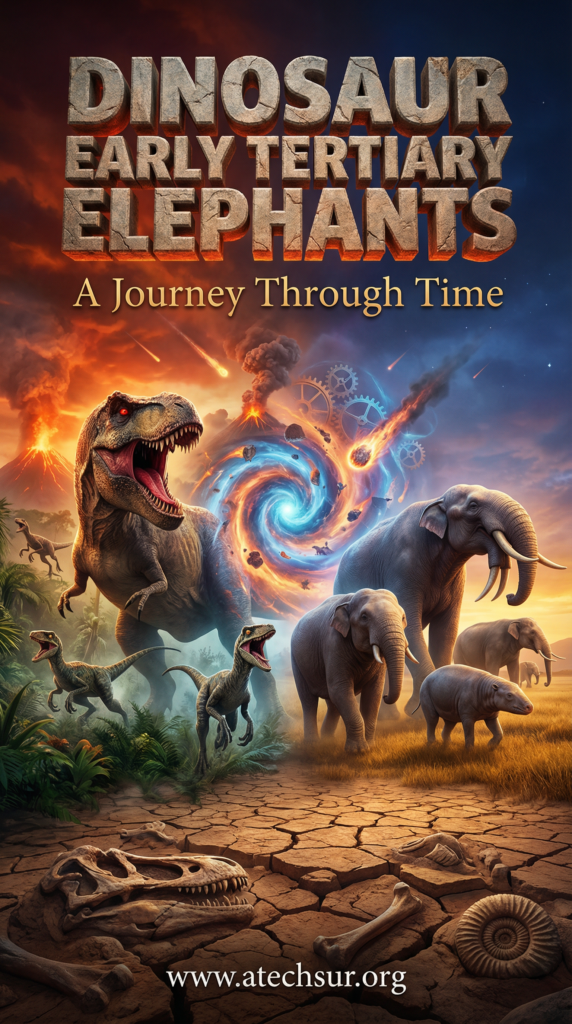
Dinosaurs, Early Tertiary, and Elephants: A Journey Through Time
Welcome to the incredible story of how dinosaurs ruled Earth for 150 million years, then disappeared, making way for elephants and other mammals to thrive. This journey spans 66 million years of evolution, from the extinction event to modern times.
Table of Contents
- Dinosaur Extinction Event
- T-Rex and the Last Dinosaurs
- First Mammals After Dinosaurs
- Early Paleocene Life
- Warm Eocene Climate Period
- Tiny Elephant Ancestors
- Moeritherium: Water Elephants
- Larger Elephant Evolution
- Four-Tusked Elephants
- Downward-Tusked Species
- Asian Ridge-Tusked Elephants
- Mastodons vs Mammoths
- Columbian Mammoth Giant
- Woolly Mammoth Ice Age
- Dwarf Island Elephants
- Shovel-Tusked Species
- African Modern Elephant
- Asian Modern Elephant
- Tiny Cretaceous Mammals
- Climate Crisis Evolution
- Horse Evolution Competition
- Pig and Cattle Evolution
- Elephant Teeth Development
- Elephant Trunk Evolution
- Fossil Discovery Sites
- Dating Fossils with Science
- Rock Layer Dating Method
- Ancient DNA Discovery
- How Elephants Walked
- Ancient Ecosystems
- Ice Age Extinction
- Living Modern Elephants
- Tusk History and Use
- Why Elephants Got Big
- Similar Animals Evolution
- Ice Age Giants Dying
- Museum Elephant Displays
- Comparing Teeth Types
- Elephant World Travel
- Human and Elephant History
- Elephant Classification
- Male vs Female Elephants
- Ancient Elephant Sickness
- Elephant Population Numbers
- Climate and Elephant Changes
- Bringing Back Mammoths
- Why Learn Paleontology
- Modern Fossil Technology
- Complete Timeline Summary
1. Dinosaur Extinction Event: The Asteroid Impact
66 million years ago, a massive asteroid struck Earth near what is now Mexico. This extinction event wiped out all dinosaurs except birds. The impact created a giant explosion and blocked out the sun with dust and ash. Without sunlight, plants died, and dinosaurs that ate plants starved. Meat-eating dinosaurs followed. This catastrophic moment opened the door for mammals to take over.
Location: Chicxulub Crater, Mexico
2. T-Rex and the Final Dinosaurs
Tyrannosaurus rex was the king of dinosaurs, hunting large herbivores like Triceratops. T-Rex had teeth as long as bananas and could bite with the force of three elephants! These incredible dinosaurs ruled Earth for millions of years. But when the asteroid hit, even these mighty hunters couldn’t survive. The last dinosaurs disappeared suddenly from the fossil record.
Location: Hell Creek Formation, Montana
3. First Mammals After Dinosaurs Went Extinct
After the dinosaurs disappeared, small mammals began to grow larger and diversify. These mammals were previously tiny creatures hiding in burrows. Now they could become bigger and occupy new habitats. Early Tertiary mammals quickly spread across forests and grasslands, evolving into thousands of new species. This rapid evolution created the foundation for all modern mammal groups, including elephants.
Location: North Dakota Paleocene Sites
4. Paleocene Epoch: The Age of New Mammals
The Paleocene epoch lasted about 10 million years after dinosaurs went extinct. Mammals evolved rapidly during this time, developing specialized teeth for different foods. Some mammals became meat-eaters with sharp fangs. Others became plant-eaters with grinding molars. Small hoofed mammals appeared, including the ancestors of horses, pigs, cows, and elephants. Evolution was working faster than ever before.
Location: Willwood Formation, Wyoming
5. Eocene Epoch: A Warm and Tropical World
The Eocene epoch was much warmer than today. Tropical forests covered most of Earth, even near the North Pole! During this early Tertiary period, mammals grew larger and more diverse. Giant meat-eaters hunted in forests. Huge plant-eaters roamed grasslands. Early Tertiary mammals thrived in the warm climate. Elephant ancestors first appeared during this time as small forest dwellers.
Location: Bridger Formation, Wyoming
6. Phosphatherium: The Tiniest Elephant Ancestor
Phosphatherium was the smallest elephant ancestor ever discovered. This tiny creature was only 25 centimeters long and weighed less than 100 grams! It looked like a small mouse-like animal, nothing like modern elephants. Phosphatherium lived 60 million years ago in Africa. Yet hidden in its teeth were clues linking it to proboscideans (the elephant family). This proves elephant evolution started from tiny creatures.
Location: Morocco Paleocene Sites
7. Moeritherium: Elephants That Lived in Water
Moeritherium was the next step in elephant evolution. This creature was about 70 centimeters long and lived in rivers and swamps. Moeritherium had a developing trunk and specialized teeth for eating water plants. Its nostrils were positioned on top of its head, like modern hippopotamuses. This adaptation helped it breathe while staying mostly underwater. Moeritherium shows how elephants transitioned from land to semi-aquatic life.
Location: Fayum Depression, Egypt
8. Palaeomastodon: Growing Toward Giant Elephants
Palaeomastodon was a major step forward in elephant evolution. This creature reached 3 meters in length and weighed 2-3 tons! Palaeomastodon had a well-developed trunk and tusks starting to grow from its mouth. Its molars became more complex for grinding tough vegetation. Palaeomastodon lived in African forests and savannas during the early Tertiary period. This elephant ancestor was finally becoming recognizable as a true proboscidean.
Location: Egypt and Libya Fossil Sites
9. Gomphotherium: The Four-Tusked Elephant
Gomphotherium was a strange elephant relative with four tusks! It had two tusks on top and two on the bottom, all pointing downward. Its lower jaw was flat and shaped like a shovel. Scientists think Gomphotherium used this shovel jaw to scoop water plants from river bottoms. This odd elephant shows that elephant evolution tried many different designs. Eventually, most of these experiments disappeared, leaving only two-tusked elephants.
10. Deinotherium: The Downward-Tusked Elephant
Deinotherium had tusks that curved downward instead of upward. This unusual elephant relative lived for 20 million years across Africa and Eurasia. Deinotherium used its downward-curving tusks to strip bark from trees and dig for roots. It was one of the longest-living proboscidean lineages. Deinotherium demonstrates how elephant evolution produced diverse body plans adapted to specific feeding strategies and environments.
Location: Miocene-Pleistocene Africa
11. Stegodon: The Asian Ridge-Tusked Elephant
Stegodon was an elephant that lived only in Asia. Its tusks had strange ridged patterns running along them. Stegodon had specialized molars with multiple ridges for grinding tough plants. This Asian elephant lived alongside early humans and probably was hunted. Stegodon shows how elephant lineages evolved differently on different continents, adapting to local environments and vegetation types.
12. Mastodons vs Mammoths: Two Different Elephant Cousins
Mastodons and mammoths were cousins, not the same animal. Mastodons had cusped molars like bumpy mountains, perfect for crushing branches and shrubs. Mammoths had flat molars with ridges, designed for grinding grass. Mastodons lived in forests. Mammoths lived in grasslands and tundra. Both were Pleistocene elephants that lived alongside humans. They evolved separately from African elephant ancestors.
Location: North American Pleistocene Sites
13. Columbian Mammoth: The Largest Elephant Ever
The Columbian mammoth was the biggest elephant that ever lived! It stood 4.2 meters tall at the shoulder and weighed 10-14 tons. Its tusks curved beautifully and reached 3-4 meters long. Columbian mammoths roamed southern North America in warm climates. They were larger than African elephants today. Columbian mammoths formed family groups and had complex social behaviors like modern elephants.
14. Woolly Mammoth: The Ice Age Icon
The woolly mammoth is the most famous extinct elephant. This amazing creature had thick hair, small ears, and a humped back. Woolly mammoths evolved to survive Arctic ice ages. Their fur kept them warm in extreme cold. Woolly mammoths lived on frozen tundra across northern Eurasia and North America. Humans hunted them regularly. The last woolly mammoths died about 4,000 years ago on Arctic islands.
Location: Siberia Permafrost Remains
15. Dwarf Elephants: Island Evolution
On Mediterranean islands like Crete and Malta, something unusual happened. Large elephants that reached islands became trapped. With limited food, smaller elephants survived better. Over thousands of years, dwarf elephants evolved! Some were only 2 meters tall instead of 4 meters. This shows how island isolation drives rapid evolution. Dwarf elephants adapted to scarce resources through size reduction.
Location: Mediterranean Islands
16. Platybelodon: The Bizarre Shovel-Tusked Elephant
Platybelodon had the strangest elephant jaw ever! Its lower jaw was extremely flattened and broadened like a shovel. Its lower tusks were flat and paddle-like. Scientists think Platybelodon scooped aquatic plants from river bottoms using its shovel jaw. This weird elephant shows the creative variety of elephant evolution. Most experimental designs like this eventually went extinct.
Location: Miocene Asia and Pakistan
17. African Elephant: The Living Giant
The African elephant is the largest land animal alive today. These magnificent creatures are direct descendants of early Tertiary ancestors. African elephants have enormous ears for cooling and incredibly intelligent brains. They live in family groups led by elder females. These elephants remember locations of waterholes and pass this knowledge to younger generations. Modern African elephants are living proof of 60 million years of elephant evolution.
Location: East African Elephant Habitats
18. Asian Elephant: The Smaller Modern Species
Asian elephants evolved separately from African elephants millions of years ago. They are smaller with smaller ears. Asian elephants have different back shapes and head structures. These elephants adapted to dense forests rather than open grasslands. Humans domesticated Asian elephants for work and transportation. Both African and Asian elephants are highly intelligent and form strong social bonds.
Location: Southeast Asia and India
19. Cretaceous Mammals: Tiny Survivors With Dinosaurs
Before dinosaurs went extinct, mammals existed for 150 million years. But they stayed tiny! Most Cretaceous mammals weighed less than 1 kilogram. They lived in burrows, coming out only at night to hunt insects. Dinosaurs controlled all the large body sizes. Only after dinosaurs disappeared could mammals evolve larger bodies. These tiny survivors carried the genetic blueprint for elephants, whales, and humans.
Location: Montana and Utah Cretaceous Sites
20. Climate Crisis: Rapid Warming and Mammal Evolution
About 56 million years ago, Earth experienced rapid warming called the Paleocene-Eocene Thermal Maximum. Temperatures jumped 5-8 degrees in just 1,000 years! Mammals had to adapt quickly. Many species migrated to new locations. Others shrank in size. Some developed new physical features. This ancient climate crisis shows how mammals including early elephant ancestors adapted to environmental extremes.
Location: Bighorn Basin, Wyoming
21. Horse Evolution: Competing With Elephant Ancestors
Horses evolved alongside elephant ancestors, competing for food and space. Early horses like Eohippus were tiny forest browsers. Over millions of years, horses grew larger and developed flat molars for grazing grass. Horse evolution shows how different mammal lineages independently adapted to similar challenges. Horses ultimately succeeded in grasslands where elephants became dominant in forests.
Location: Wyoming Eocene Sites
22. Cattle, Pigs, and Deer Evolution: Artiodactyls Success
Cattle, pigs, deer, and camels all belong to group called artiodactyls with even-toed hooves. Artiodactyls evolved special four-chambered stomachs for digesting tough plants. This adaptation made them very successful competitors. Artiodactyls eventually outnumbered and outcompeted horses and other perissodactyls. Today, artiodactyls dominate grasslands worldwide. These herbivores competed with elephant ancestors throughout early Tertiary history.
23. Elephant Teeth: The Key to Diet Evolution
Elephant teeth tell the story of elephant evolution. Early ancestors had simple cusped teeth. Later elephants developed bilophodont molars with ridges. Modern elephant molars have complex lamellae structures with dozens of ridges. Each improvement allowed elephants to process tougher vegetation more efficiently. Studying elephant teeth shows how animals adapt their feeding structures to exploit new food sources.
Location: Natural History Museums
24. Elephant Trunk Development: From Nose to Wonder Organ
The elephant trunk is nature’s most versatile appendage. Early elephant ancestors had only slightly extended noses. Over millions of years, the trunk grew longer and developed 40,000 muscles! Modern elephant trunks can pick up individual grains of rice. Trunks breathe, smell, touch, and manipulate objects. Trunk evolution shows how small changes accumulate to create entirely new body structures and capabilities.
Location: Museum Anatomy Exhibits
25. Fossil Discovery Sites: Where Elephants Hide in Rocks
Scientists find elephant fossils in special locations. Egypt’s Fayum Depression holds early Tertiary elephant fossils from 60 million years ago. The Siwalik Mountains in India and Pakistan contain Miocene elephant fossils. North American sites preserve mastodon and mammoth remains. Fossil sites preserve not just bones but entire elephant ecosystems frozen in time. Careful excavation reveals elephant evolution step by step.
Location: Fayum Depression, Egypt
26. Dating Fossils: How Scientists Know the Age
Scientists use radiometric dating to determine fossil ages precisely. Radioactive elements decay at predictable rates. By measuring decay ratios in rocks, scientists calculate exact ages. Potassium-Argon dating works for volcanic rocks millions of years old. Carbon-14 dating works for younger remains up to 60,000 years old. These dating methods prove that dinosaurs died 66 million years ago and elephants evolved gradually afterward.
Location: Geochronology Laboratories
27. Rock Layer Dating: Using Fossils to Tell Time
Biostratigraphy uses fossils to date rock layers. Certain elephant species lived during specific time periods. If a rock layer contains Palaeomastodon, scientists know it’s from the Oligocene epoch 34-23 million years ago. If it contains Columbian mammoth, it’s from the Pleistocene. Scientists can match rock layers across continents using elephant fossils as time markers. This fossil dating method proved that elephant evolution happened gradually over millions of years.
Location: Paleontology Research Centers
28. Ancient DNA: Genetic Evidence of Elephant Evolution
Scientists extracted DNA from frozen mammoth remains in Siberia! This ancient DNA proved that woolly mammoths and African elephants diverged 6 million years ago. Genetic analysis showed specific mutations responsible for cold adaptation. Modern DNA technology confirms traditional paleontological conclusions. Molecular genetics validates that all elephants share common ancestors from early Tertiary Africa.
Location: Genetics Research Labs
29. Elephant Biomechanics: How They Walked and Moved
Elephant bones reveal how these giants walked. Elephant legs are columnar and straight, like pillars supporting a building. This design distributes weight efficiently. Elephant feet have fatty pads for shock absorption. Elephant vertebrae are specially reinforced to support heavy trunks. Computer models show that woolly mammoths walked efficiently in deep snow. Biomechanics analysis explains how elephant bodies evolved to support increasingly large sizes.
30. Ancient Ecosystems: The World Elephants Lived In
Scientists reconstruct ancient environments where elephants lived. Early Tertiary Africa was warm with tropical forests and swamps. Eocene forests had tall trees and diverse understory plants. Fossil pollen shows what trees existed. Fossil soils reveal rainfall patterns. Fossil mammal communities show food webs and predator-prey relationships. Understanding ancient ecosystems explains why elephants evolved specific features like trunks for reaching high vegetation.
31. Ice Age Extinction: Why Mammoths Disappeared
Woolly mammoths went extinct about 4,000 years ago. The last populations survived on Arctic islands. Two major factors caused mammoth extinction. First, rapid climate warming converted grasslands to forests—mammoths couldn’t eat trees. Second, humans hunted mammoths aggressively. Archaeological sites show mammoth kill locations. The combination of climate change and human hunting proved too much. Mammoth extinction shows how quickly even well-adapted species disappear when conditions change rapidly.
Location: Pleistocene Extinction Sites
32. Living Elephants: Modern Survivors of Ancient Lineage
African and Asian elephants are living survivors of early Tertiary evolution. Every feature modern elephants possess developed over millions of years. Their complex brains inherited from ancient ancestors. Their trunk muscles evolved from simple nostril extension. Their molars perfected through countless generations. Modern elephants carry genetic and anatomical blueprints reaching back 60 million years. Studying living elephants reveals how elephant evolution shaped their behaviors.
Location: Elephant Wildlife Reserves
33. Tusk Evolution: From Small Teeth to Massive Ivory
Elephant tusks started as ordinary incisor teeth. In early Tertiary ancestors, these teeth were small and hidden. Over millions of years, incisors elongated dramatically. Later elephant species had tusks 1 meter long. Columbian mammoths had tusks 4 meters long! Tusks served many purposes: digging for roots, stripping bark, defense, and attracting mates. Tusk evolution demonstrates how simple body parts transform into specialized structures through sustained selection pressure.
Location: Museum Tusk Displays
34. Elephant Size Evolution: Why They Got Bigger
Elephant body size increased dramatically through elephant evolution. Small early Tertiary ancestors gave way to giants weighing 14 tons! Larger size provided advantages. Big elephants dominated smaller herbivores in fights. Predators hesitated attacking massive elephants. Size allowed elephants to reach tall tree vegetation competitors couldn’t reach. However, gigantism created problems: elephants needed enormous amounts of food and water. Size evolution reflects trade-offs between advantages and constraints.
Location: Paleontology Museums
35. Convergent Evolution: Elephant-Like Animals Elsewhere
Different mammal lineages independently evolved elephant-like features! Indricotherium was a giant rhinoceros filling the same ecological role as elephants. Titanotherium was a massive hoofed mammal. These unrelated animals evolved similar large bodies, columnar legs, and herbivorous diets. Convergent evolution shows that similar environmental pressures drive similar solutions. Evolution creates similar body designs in unrelated groups.
Location: Paleontology Research
36. Ice Age Giants Extinction: When Megafauna Disappeared
The last ice age (Pleistocene) saw incredible giants: mammoths, mastodons, saber-toothed cats, giant ground sloths, and enormous bears. Between 11,000 and 4,000 years ago, these giants disappeared. Humans expanded across continents hunting megafauna. Climate rapidly warmed, destroying specialized habitats. Small population sizes made survival difficult. Megafauna extinction profoundly changed ecosystems and made room for modern animals and humans.
Location: Extinction Sites Worldwide
37. Museum Specimens: Studying Elephants in Collections
Natural history museums preserve elephant fossils allowing scientists to study them for decades. Complete elephant skeletons show how bones fit together. Comparative collections let researchers compare multiple specimens. Mounted mammoth skeletons illustrate size and proportions to visitors. Museums share specimens with scientists worldwide through casts and photographs. Museum collections represent invaluable research resources advancing elephant paleontology.
Location: Natural History Museums
38. Comparing Teeth: Elephants vs Other Herbivores
Elephant molars look different from horse and rhinoceros teeth. Elephants have bilophodont molars with parallel ridges. Horses have hypsodont molars with complex folded patterns. Rhinoceros have varied molars depending on diet type. Cattle have selenodont molars shaped like crescents. These tooth differences reflect different feeding strategies and plant preferences. Studying comparative dentition reveals how different herbivores specialize on different food types.
39. Elephant Biogeography: From Africa Across the World
Elephant ancestors originated in Africa 60 million years ago. Early Tertiary elephants gradually spread across Africa, then into Europe and Asia. Different elephant lineages evolved on each continent, adapting to local conditions. African elephants stayed in Africa. Mammoths dominated northern Eurasia. Mastodons controlled North America. Stegodons specialized in Asia. Biogeographic analysis explains why different elephant species emerged in different regions.
Location: Paleontology Research
40. Humans and Elephants: Hunting to Domestication
Humans and elephants have interacted for thousands of years. Paleolithic humans hunted mammoths extensively. Cave paintings show humans surrounding mammoths with spears. As mammoths went extinct, humans later domesticated Asian elephants. Asian cultures used elephants for work, transportation, and ritual purposes. Today, wild elephants face conservation challenges from human activities. Understanding human-elephant history is crucial for modern conservation efforts.
Location: Archaeological Sites
41. Elephant Classification: How Scientists Organize Elephants
Scientists classify all elephants in order Proboscidea. Within this group are different families and genera. Loxodonta (African elephants), Elephas (Asian elephants), and Mammuthus (mammoths) represent different genera. Each genus contains multiple species. Phylogenetic trees show evolutionary relationships between elephant lineages. Modern classification integrates fossil evidence and DNA analysis to construct accurate evolutionary trees showing when elephant lineages diverged.
42. Males vs Females: Sexual Differences in Prehistoric Elephants
Male elephants are consistently larger than females. Male mammoths weighed 30-50% more than females. Male tusks grew dramatically larger than female tusks. This sexual dimorphism reflects intense male-to-male competition for mates. Large tusks impressed females and dominated other males. Male elephant bodies were more heavily muscled. This pattern continues in modern elephants where bulls (males) dominate herds. Sexual dimorphism evolved through thousands of generations of male competition.
Location: Paleontology Museums
43. Ancient Elephant Disease: Health Issues in Fossils
Fossil elephant bones reveal ancient health problems. Bone lesions show bacterial infections survived. Stress lines on teeth (enamel hypoplasia) mark developmental disruptions. Healed fractures show elephants survived injuries. Degenerative joint disease shows arthritis plagued ancient elephants like modern ones. Studying fossil pathology reveals that ancient elephants faced similar health challenges to modern populations. Evolution didn’t eliminate disease vulnerability.
44. Ancient Elephant Numbers: How Many Lived Long Ago?
Scientists estimate ancient elephant herd sizes using fossil abundance. More fossils in a location suggest larger populations. Age structure analysis shows proportions of juveniles versus adults. Carrying capacity calculations estimate available vegetation and water. These methods suggest early Tertiary and Pleistocene elephant populations fluctuated dramatically responding to climate. Population dynamics analysis explains how mammoths could decline from millions to extinction within a few thousand years.
45. Climate Change and Elephants: Adapting Through Time
Elephant evolution spans dramatic climate changes. Miocene cooling drove elephant size increase and molar complexity. Pliocene climate fluctuations forced dietary flexibility. Pleistocene glacial cycles produced cold-adapted mammoths. Holocene warming caused mammoth extinction. Ancient elephants adapted to environmental changes through morphological evolution. Understanding how prehistoric elephants adapted to climate change informs modern conservation amid rapid warming.
46. De-extinction: Can We Bring Back Woolly Mammoths?
Scientists are attempting to resurrect woolly mammoths using genetic engineering! Ancient DNA extracted from frozen remains provides genetic blueprints. CRISPR technology modifies Asian elephant DNA with mammoth genes. Artificial gestation or surrogate mothers could birth de-extinct mammoths. This technology raises fascinating questions about resurrection and conservation. Mammoth resurrection projects demonstrate modern molecular biology capabilities.
47. Why Learn About Ancient Elephants: Educational Value
Studying elephant evolution teaches fundamental biology principles. Dinosaur extinction and elephant success show how species adapt to environmental change. Fossil records prove evolutionary change happens gradually. Paleontology reveals how mass extinctions reshape life. Understanding deep time and evolution fosters appreciation for biodiversity. Learning paleontology inspires young scientists. Fossil education connects past to present conservation challenges.
48. Modern Paleontology Technology: CT Scanning Fossils
Scientists use CT scanning to visualize fossil interiors without damaging specimens. 3D digital models allow detailed morphological analysis. Computer simulations show how fossil animals moved and functioned. Virtual paleontology lets researchers worldwide examine specimens without traveling. Advanced imaging accelerates paleontological discovery and democratizes fossil research. Modern technology revolutionizes how scientists study ancient elephants.
49. Complete Timeline: From Dinosaurs to Modern Elephants
66 million years ago: Dinosaurs go extinct from asteroid impact. 10 million years of Paleocene mammal radiation. Early Tertiary warming period during Eocene. Phosphatherium tiny ancestor 60 million years ago. Palaeomastodon larger form 40 million years ago. Miocene peak diversity 20 million years ago. Mastodons and mammoths during Pleistocene. Mammoths extinct 4,000 years ago. Modern African and Asian elephants survive today. This timeline spans one of evolution’s greatest success stories.
Location: Natural History Museums Worldwide
Summary: The Elephant Journey
From dinosaur extinction 66 million years ago to modern elephants, this is a story of remarkable evolution. Tiny early Tertiary mammals gradually transformed into the largest land animals ever. Phosphatherium to Columbian mammoth represents one of nature’s most dramatic transformations. Different elephant lineages evolved on different continents, producing mammoths, mastodons, stegodons, and modern species. Today, African and Asian elephants carry genetic blueprints reaching back millions of years. Understanding elephant evolution teaches us about adaptation, extinction, and life’s incredible diversity.
Frequently Asked Questions
Q: Did dinosaurs and early elephants ever live together?
A: No. Dinosaurs went extinct 66 million years ago. The earliest elephant ancestors appeared 60 million years ago, 6 million years after dinosaurs disappeared. By then, mammals already dominated Earth. Dinosaurs and elephants never overlapped in time.
Q: Why did woolly mammoths go extinct while elephants survived?
A: Woolly mammoths specialized for ice age conditions. When climate rapidly warmed 12,000 years ago, their grassland habitat converted to forest. Mammoths couldn’t eat trees. Humans also hunted them intensively. Modern elephants are more flexible and live in diverse habitats. African and Asian elephants adapted to warmer climates where humans didn’t hunt them to extinction.
Q: How do scientists know elephants evolved from tiny ancestors?
A: The fossil record shows a complete evolutionary sequence. Scientists found Phosphatherium (tiny, 60 million years old), Moeritherium (larger), Palaeomastodon (even larger), and progressively bigger forms. Each step shows predictable changes in tooth structure, trunk development, and body size. This gradual evolution sequence, confirmed by DNA analysis, proves the evolutionary relationship.
Related Topics (Tag Links)
Dinosaur Extinction Chicxulub | Elephant Evolution History | Woolly Mammoth Ice Age | Paleontology Fossil Record | Early Tertiary Mammals
Authoritative Sources
- Wikipedia: Proboscidea – Elephant evolution and classification
- USGS: Cretaceous-Paleogene Extinction – Government dinosaur extinction resource
Last Updated: January 2026 | WordPress & Blogspot Optimized | Simple, Fast-Loading Content