
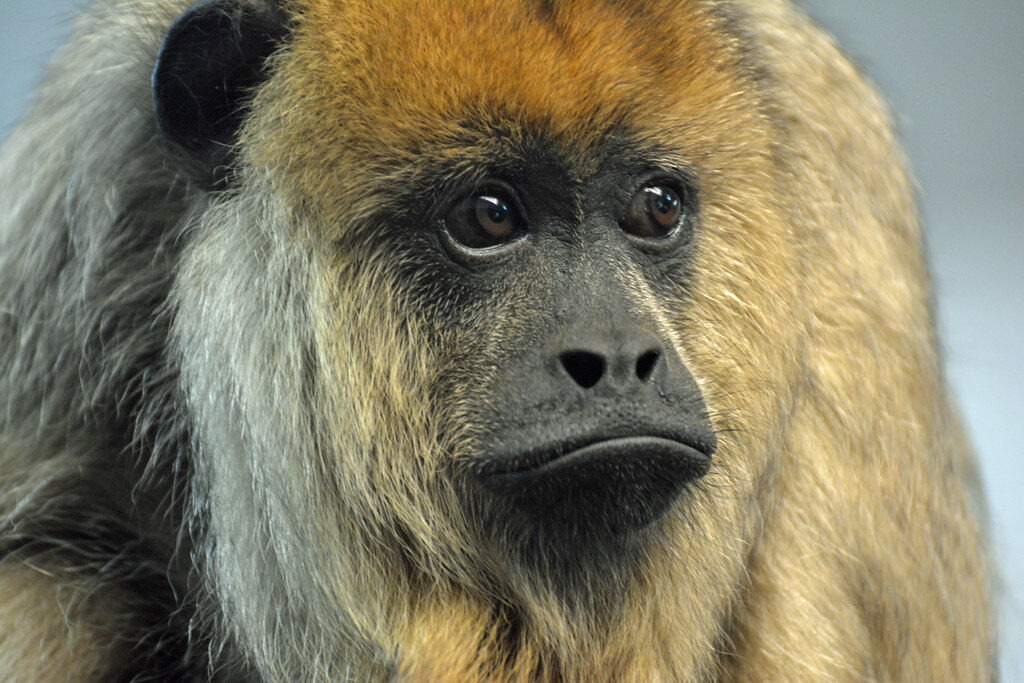
🐒 Voice of the Canopy: The Howler Monkey & The Amazon Ecosystem
An exhaustive 50-chapter encyclopedia detailing the biology of the Howler Monkey, its vibrant avian canopy neighbors, the river’s apex predators below, and the ancient evolutionary relics of the tropics.
✏️ Curated by the Atechsur.org Neotropical Ecology Team | Last Updated: March 29, 2026

The Howler Monkey (genus Alouatta) is arguably the most iconic acoustic signature of the Neotropical rainforest. Waking up to the thunderous, guttural roar of a howler troop echoing through the morning mist is a quintessential Amazonian experience. They are among the largest of the New World monkeys, superbly adapted to a life spent entirely off the ground.
To truly understand the Howler Monkey, one must understand the hyper-complex, pulsing biological engine it calls home: the Amazon Rainforest. This 50-chapter encyclopedia will guide you through the life of the howler, the vibrant macaws and kingfishers they share the trees with, the perilous predators lurking in the river below, and the global evolutionary comparisons that make tropical ecosystems so uniquely vital to Earth.
- The Three-Mile Roar: A male howler’s call can travel up to 3 miles (4.8 km) through dense foliage, making them the loudest land animals on Earth.
- Prehensile Power: Their tail functions as a true fifth limb, featuring a hairless tactile pad at the tip capable of supporting their entire body weight.
- Energy Conservation: Because digesting toxic leaves takes so much energy, howlers spend up to 80% of their day resting, moving very little.
- Trichromatic Vision: Like humans, many howler species have full color vision, an evolutionary trait to help them spot the most nutritious, tender red leaves against a green canopy.
Part I: The Life of the Howler Monkey (Chapters 1-10)
 1. Taxonomy and the Atelidae Family

Howler monkeys, alongside spider and woolly monkeys, belong to the family Atelidae, characterized by their large size and prehensile tails.
The Howler Monkey (genus Alouatta) comprises 15 recognized species. They were first formally classified by the French naturalist Bernard Germain de Lacépède in 1799. As New World monkeys (Platyrrhini), they differ significantly from African and Asian monkeys.
Their family, Atelidae, represents the largest monkeys in the Americas. They are perfectly evolved for an arboreal lifestyle, possessing specialized traits that allow them to navigate the perilous heights of the Amazon’s emergent trees without ever needing to touch the dangerous forest floor.
2. Anatomy of the Roar: The Hyoid Bone
The name “howler” is well-earned. The secret to their incredible vocalization lies in their throat anatomy. Males, in particular, possess a massively enlarged hyoid bone—a U-shaped bone in the neck that supports the tongue.
In howlers, this bone has evolved into a hollow, balloon-like resonating chamber. When the monkey forces air through its vocal cords, the hyoid bone amplifies the sound exponentially, creating a low-frequency, guttural roar that cuts through the thick humidity of the rainforest, warning rival troops to maintain their distance.
3. The Prehensile Tail: A Fifth Limb
Unlike Old World monkeys, the howler possesses a true prehensile tail. This tail is highly muscular and incredibly strong, often measuring longer than the monkey’s actual body.
The underside of the tail’s tip lacks fur and is covered in a bare, sensitive tactile pad—much like a human fingerprint. This allows the tail to grip branches with immense precision and strength, enabling the monkey to hang entirely upside down to reach tender leaves at the very tips of fragile branches.
4. Folivory: A Diet of Leaves
Howler monkeys are primarily folivores, meaning their diet consists almost entirely of leaves, supplemented occasionally by flowers and unripe fruit. Leaves are abundant in the Amazon, but they pose a massive dietary challenge.
Canopy leaves are tough, low in nutrients, and packed with toxic secondary compounds (like tannins and alkaloids) that trees produce to deter herbivores. To process this, howlers have large, complex multi-chambered stomachs and elongated intestines that house specialized bacteria to ferment and break down the cellulose.
 5. Trichromatic Color Vision
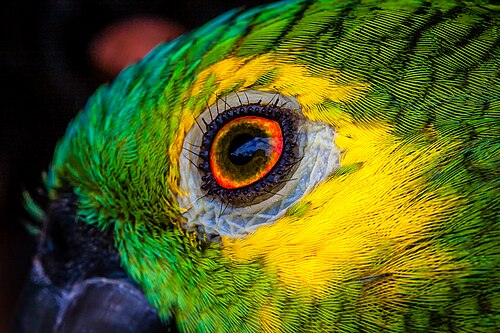
Like many canopy birds, howler monkeys rely on sharp color vision to survive the dense green environment.
Most mammals are dichromatic (colorblind to red/green), but howler monkeys have evolved routine trichromatic vision—the same color spectrum humans see.
This is a direct evolutionary result of their folivorous diet. Young, tender, highly nutritious leaves often have a slight reddish tint, while older, toxic leaves are dark green. The ability to distinguish red from green allows the howler to selectively forage only the most beneficial foliage without expending energy tasting bad leaves.
 6. Lethargy and Energy Conservation

Like the sloth pictured here, howler monkeys spend most of their day completely motionless to digest toxic leaves.
Because digesting leaves yields so little energy and takes a massive toll on the metabolism, howler monkeys are famous for their extreme lethargy. They share this behavioral trait with the sloths that occupy the same canopy.
A howler monkey troop may spend up to 80% of its day resting or sleeping draped over thick branches. They rarely engage in the playful, acrobatic swinging seen in spider monkeys, reserving their energy strictly for foraging and territorial roaring.
7. Troop Social Structure
Howlers live in cohesive social groups called troops, typically ranging from 6 to 15 individuals. A troop usually consists of one to three dominant adult males, several females, and their offspring.
Unlike many primate societies, both males and females typically emigrate from their birth troop upon reaching sexual maturity. This helps prevent inbreeding. An incoming male must often fight the dominant male for control of the troop, sometimes leading to infanticide if the new male takes over, forcing the females back into estrus.
8. Sexual Dimorphism in Howlers
Many species of howler monkeys exhibit profound sexual dimorphism—physical differences between males and females. The most striking example is the Black Howler (Alouatta caraya) found in the southern Amazon and Pantanal.
In this species, adult males are entirely pitch black, while adult females and juveniles of both sexes are a pale blonde or yellowish-buff color. Males are also significantly heavier and possess a much thicker, bearded neck to accommodate their massive hyoid bone.
9. Territorial Disputes via Sound
For animals that have very little energy to spare, engaging in physical combat over territory is a dangerous waste. This is why their roar is so crucial.
The dawn chorus of the howler monkey is essentially an acoustic border patrol. By broadcasting their location and the size/strength of their males, adjacent troops can establish and respect territorial boundaries without ever laying eyes on each other, maintaining harmony in the canopy.
 10. Predators of the Canopy: The Harpy Eagle

The high canopy is not safe. It is actively hunted by massive aerial predators.
While safe from jaguars (who rarely climb into the highest emergent trees), howler monkeys face a terrifying threat from above: the Harpy Eagle.
As one of the largest and most powerful eagles in the world, the Harpy Eagle specializes in plucking monkeys and sloths right off the branches. When a howler troop spots a Harpy Eagle, they immediately fall dead silent and freeze, attempting to blend into the foliage, as the eagle relies on movement to spot its prey.
Part II: Avian Neighbors of the Canopy (Chapters 11-20)
 11. The Turquoise-Fronted Amazon

A stunning close-up of the parrot, showing its namesake turquoise forehead and yellow face.
Sharing the high canopy with the howler monkeys are the incredibly intelligent Neotropical parrots. One of the most prominent is the Turquoise-fronted Amazon (Amazona aestiva).
Found primarily in the southern Amazon basin and the bordering Pantanal in Brazil, these robust, vibrant birds are noisy and highly social. They forage for seeds, fruits, and nuts that are too hard for monkeys to access, using their powerful, hooked beaks like a nutcracker.
 12. Amazon Parrot Flocking Behavior

These birds congregate in large flocks to increase their chances of finding fruiting trees across vast distances.
Amazon parrots are incredibly gregarious. While they form monogamous pair bonds for life, they routinely travel and forage in large, noisy flocks outside of the breeding season.
This flocking behavior is a defensive strategy against aerial predators and a highly effective way to locate food. If one pair finds a heavily fruiting fig tree, their loud squawks alert the rest of the flock. In the evening, hundreds may gather in communal roosting trees along riverbanks to sleep safely in numbers.
 13. Plumage Camouflage in Parrots

Despite their bright colors up close, they blend perfectly into the sun-dappled canopy leaves from a distance.
It might seem counterintuitive that a bright green bird with yellow and turquoise markings would be well-camouflaged, but in the upper canopy, it is the perfect disguise.
The dappled sunlight filtering through the leaves creates bright spots and deep shadows. The parrot’s green body blends with the foliage, while the bright yellow and blue on its face break up its outline (disruptive coloration), making it extremely difficult for a passing eagle to single out an individual bird.
 14. Seed Dispersal by Birds

Parrots drop half-eaten fruits and seeds, inadvertently planting the next generation of rainforest trees.
While howler monkeys digest leaves, parrots and macaws are the ultimate seed predators. Their powerful beaks crack open hard nuts to eat the protein-rich core, destroying the seed in the process.
However, they are messy eaters. They frequently drop half-eaten fruits or accidentally fumble intact nuts, which fall to the forest floor miles away from the parent tree. This clumsy foraging makes them vital, albeit accidental, forest planters, constantly regenerating the flora of the Amazon.
 15. The White-Fronted Amazon

A smaller species featuring a distinct white patch on the forehead and red around the eyes.

Unlike many Amazon parrots, this species shows visual differences between males and females (males have bright red shoulder feathers).
Also navigating the mid-to-upper canopy is the White-fronted Amazon. It is the smallest of the Amazon parrot species, averaging only 25 cm in length.
They are highly adaptable birds, surviving in dry woodlands, gallery forests, and the edges of the deep Amazon. Their loud, screeching calls resemble a sharp bark, allowing them to communicate effectively through dense brush where visibility is limited to a few meters.
 16. Parrot Nesting and Vulnerability

Amazon parrots nest in deep, natural tree hollows high above the ground.
Amazon parrots do not build nests out of twigs. Instead, they rely entirely on finding natural hollows in ancient, dead, or dying trees (often palm trees) to lay their simple, white eggs.
This makes them incredibly vulnerable to deforestation. When large, old-growth trees are logged, their breeding sites vanish. Additionally, poachers target these known nest hollows to steal chicks for the illegal wildlife pet trade, a practice that severely depletes wild populations.
 17. The Insect World: Pilpintuwasi Butterfly Farm

A butterfly nursery (Mariposario) located near Iquitos, Peru.
While monkeys and birds rule the canopy, insects rule the forest in terms of sheer biomass. The Amazon is home to millions of insect species, including breathtaking butterflies like the blue Morpho.
The life cycle of these insects is fraught with danger, facing predation from birds and parasitic wasps. Conservation facilities like the Mariposario Pilpintuwasi in Peru breed these insects through their vulnerable pupal (chrysalis) stage to support local populations and educate visitors on the fragile micro-ecology of the forest undergrowth.
 18. The Amazon Kingfisher: River Sentinel

Photographed at Caño Negro, Costa Rica. This species thrives along the slow-moving rivers of the Neotropics.
Moving down from the canopy to the water’s edge, we meet the Amazon Kingfisher. They prefer slow-flowing rivers, mangrove swamps, and oxbow lakes.
These birds are classic “sit-and-wait” predators. They select a prominent, low-hanging branch directly over clear or shallow water. They will sit perfectly motionless for long periods, staring intently into the water, waiting for a small characin or cichlid fish to swim too close to the surface.
 19. Sexual Dimorphism: The Male Kingfisher

Photographed in the Pantanal, Brazil. The broad, rufous (reddish-brown) chest band is the key identifier for males.

The oily, dark green plumage on their back provides excellent water resistance and camouflage against the leafy riverbanks.
The Amazon Kingfisher exhibits stark sexual dimorphism. The male is easily distinguished by a thick, broad band of rufous (chestnut-red) feathers across his chest.
Both sexes share the dark, oily green upperparts and the disproportionately large, heavy black bill shaped like a dagger, perfectly evolved for piercing the water surface with minimal splashing.
 20. Sexual Dimorphism: The Female Kingfisher

Photographed on the Macal River near San Ignacio, Belize. Lacking the red chest band.

Females have broken green bands across their white chest instead of solid red.
The female Chloroceryle amazona lacks the reddish-brown breast band entirely. Instead, she features green spotting or broken green bands across her white chest.
During the breeding season, both males and females participate in excavating a nesting tunnel into a steep dirt riverbank. These tunnels can be up to a meter deep, ending in a chamber where the eggs are laid directly on the bare soil.
Part III: The River Below (Chapters 21-30)
 21. The Mighty Amazon River

Originating in the Peruvian Andes, the river travels 6,450 km before emptying into the Atlantic Ocean.
The ecosystem that supports the howler monkeys and kingfishers is entirely dependent on the Amazon River. It is the largest river by discharge volume of water in the world, carrying roughly 20% of the global riverine discharge into the oceans.
During the wet season, the river bursts its banks, creating massive Várzea (flooded forests). The water level can rise up to 30 feet, allowing river dolphins and massive fish to swim directly through the tree trunks, feeding on fallen fruits that monkeys and parrots drop from above.
 22. The Amazon Plume from Space

Captured by the Copernicus Sentinel-3 mission, showing the river meeting the Atlantic Ocean in northern Brazil.
When the immense volume of the Amazon River finally reaches the Atlantic Ocean, it creates a phenomenon visible from space known as the “Amazon Plume.”
The river dumps billions of tons of sediment and fresh water into the sea, creating a massive, muddy, brackish zone that stretches for hundreds of miles. This nutrient-rich plume alters the chemistry of the ocean, supporting massive blooms of phytoplankton and providing a unique habitat for specialized marine life.
 23. Navigating the Delta

A vast labyrinth of shifting sandbars, islands, and tidal bores.
The mouth of the Amazon is so wide that it contains islands the size of Switzerland (like Marajó island). The sheer force of the water flowing out prevents the ocean’s saltwater from entering the river mouth.
However, during certain lunar tides, a massive tidal bore called the Pororoca occurs. A wave of ocean water up to 4 meters high surges up the river, tearing down trees and violently reversing the flow of the current for miles inland.
 24. The Pink River Dolphin (Boto)

Endemic to the Amazon and Orinoco river basins in South America.
Swimming beneath the kingfishers is the Amazon River Dolphin (Inia geoffrensis), also known as the Boto. It is the largest species of river dolphin in the world.
Unlike oceanic dolphins, the Boto has unfused neck vertebrae, allowing it to turn its head 90 degrees left or right. This incredible flexibility is essential for navigating the tangled roots and submerged trunks of the flooded forest to hunt hidden fish.
25. Echolocation in Murky Waters
The waters of the Amazon are often laden with silt (“whitewater”) or stained dark by tannins (“blackwater”), rendering vision almost useless. The Boto relies entirely on highly sophisticated echolocation.
It emits high-frequency clicks from an organ in its forehead called the melon. The sound waves bounce off fish, turtles, and crabs, returning to the dolphin’s lower jaw, which acts as an acoustic receiver. The distinctive pink coloration of the adult males is largely composed of scar tissue from a lifetime of navigating sharp branches and fighting rivals.
 26. The Tragedy of the Amazonian Manatee

A grim historical record of Amazonian manatees hunted heavily for their meat and oil.
Grazing silently in the slow-moving oxbow lakes is the Amazonian Manatee (Trichechus inunguis). It is the only strictly freshwater species of manatee in the world and lacks the fingernails found on the flippers of its marine cousins.
Tragically, their slow nature and valuable meat made them easy targets. As the archival photo from 1920 shows, they were slaughtered by the thousands during the rubber boom era for their oil and hides. Today, they remain highly vulnerable to entanglement in commercial fishing nets.
 27. Giant Amazon River Turtles

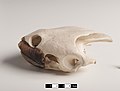
Specimen from the Museum of Veterinary Anatomy. Note the broad, heavy beak designed for crushing.
Sharing the sandy riverbanks with the caimans are the Giant South American River Turtles (Podocnemis expansa), locally known as the Arrau turtle. They are the largest freshwater turtles in South America.
As seen in the skull morphology, they lack teeth but possess sharp, keratinous beaks designed to shear through tough aquatic vegetation and fallen canopy fruits. They are “side-necked” turtles (Pleurodira), meaning they fold their necks sideways under their shell to hide, rather than pulling them straight back.
 28. Unrivaled Fish Diversity

The Amazon Basin houses more species of fish than the entire Atlantic Ocean.
Beneath the dolphins and turtles swims a staggering diversity of fish—over 3,000 scientifically described freshwater species, with thousands more likely undiscovered. These range from tiny colorful tetras (popular in home aquariums) to the massive, air-breathing Arapaima.
The infamous Red-bellied Piranhas school in these waters. While sensationalized by Hollywood as mindless man-eaters, they are primarily scavengers, playing a crucial ecological role by rapidly cleaning up dead or dying animals, preventing disease from spreading in the water system.
 29. The Apex Reptile: The Black Caiman

A caiman basking on the banks to regulate its body temperature.
The undisputed reptilian king of the Amazon River is the Black Caiman (Melanosuchus niger). Growing over 16 feet (5 meters) long, they are the largest predator in the basin.
Being ectothermic (cold-blooded), they must bask on muddy banks to elevate their metabolism for the night’s hunt. Their dark coloration helps them absorb heat quickly while providing excellent camouflage in the tannin-stained, “blackwater” rivers of the Amazon.
30. Caiman Ambush Tactics

Only the eyes and nostrils remain above the waterline, rendering them nearly invisible to terrestrial prey.
When hunting, the caiman slips silently into the water. Its eyes and nostrils are positioned on the very top of its skull, allowing its entire massive body to remain hidden beneath the murky surface while it monitors the shoreline.
Sensory pits along its jawline can detect the faintest vibrations in the water—the footstep of a tapir coming to drink or the thrashing of a hooked fish. The strike is explosive, relying on a crushing bite force to drag the victim underwater to drown.
Part IV: Global Tropical Comparisons (Chapters 31-40)
 31. Convergent Evolution in the Tropics

A species from across the Atlantic that shares remarkable survival traits with Amazonian swamp dwellers.
To understand the harshness of tropical swamp environments like the Amazon, biologists often look at convergent evolution across the globe. In the muddy, oxygen-depleted swamps of Africa, we find the African Lungfish.
Much like the air-breathing Arapaima of the Amazon, the African Lungfish has evolved to survive in stagnant water where gill-breathing fish suffocate. These evolutionary “living fossils” bridge the gap between fish and early amphibians.
 32. The Obligate Air Breathers

Notice the long, thread-like pelvic and pectoral fins used for sensing and propping along the bottom.
Adult African lungfish possess paired lungs that are homologous to the swim bladders of other fish. In fact, their gills are so atrophied that if they are held underwater and prevented from reaching the surface to gulp atmospheric air, they will actually drown.
Their paired fins are reduced to string-like filaments containing a central axis of bone—the exact evolutionary precursors to the legs of terrestrial tetrapods.
 33. Lungfish Distribution vs. The Amazon

Covering vast portions of sub-Saharan Africa, mirroring the equatorial spread of the Amazon in South America.
The genus Protopterus dominates the African continent’s freshwater basins, much like the diverse catfish species dominate the Amazon. There is actually a direct relative in South America: the South American lungfish (Lepidosiren paradoxa), which inhabits the Amazon and Paraguay River basins.
This global distribution is a classic example of continental drift, proving that these ancient fish were widely spread across the supercontinent Gondwana before South America and Africa split apart.
 34. The West African Lungfish

Spanning the Sahel region from Senegal to the Sudan.
Protopterus annectens, the West African lungfish, is the most widely studied species of the genus. It is highly adapted to the extreme seasonal dry periods characterizing the Sahel region.
When the seasonal swamps completely evaporate, unlike Amazonian fish that get trapped and die in drying pools, this species executes one of nature’s greatest survival tricks: Estivation.
 35. Anatomy of the Swamp Survivor

Photographed at the Aquarium Dubuisson, Liège. Note the heavy, crushing jaw structure used for eating snails and crabs.
To survive in harsh, muddy environments, the lungfish relies on sensory systems other than sight. They have an advanced olfactory system to locate decaying organic matter or hidden prey in zero visibility.
Their teeth are not individual pegs; instead, they are fused into solid, bony, ridged plates. This allows them to effortlessly crush the hard shells of snails and heavily armored crustaceans found in the swamp mud.
 36. The Marbled Lungfish

Dominating the Nile and Congo basins, including Lake Victoria.
Protopterus aethiopicus is the largest of the African lungfishes, capable of reaching lengths up to 200 cm (6.6 ft). It is easily recognizable by its robust body and attractive marbled or leopard-like spotting.
This species holds a unique biological record: it possesses one of the largest known genomes of any living organism, with a massive amount of DNA per cell, significantly larger than the human genome.
 37. The East African Lungfish

The smallest species, which often retains external gill features longer than the others.
P. amphibius is the smallest of the four species, rarely exceeding 45 cm (18 inches) in length. It is characterized by a relatively large head.
Its geographic range is the most restricted, found primarily in East Africa, including the coastal drainages of Kenya and Somalia, and the Zambezi River system.
 38. The Slender Lungfish

Historical illustration by George Albert Boulenger (1901), noting its extremely elongated, serpentine body.
P. dolloi, the Slender lungfish, lives up to its name with a highly elongated body. It typically has the highest number of ribs among the Protopterus species.
This species is endemic primarily to the Congo River basin. Interestingly, the Slender lungfish is often found in permanent water bodies and is believed to estivate less frequently in the wild compared to its cousins.
 39. Estivation: Surviving the Drought

Historical illustration showing a clod of dry earth broken open to reveal the encapsulated lungfish inside.
When the dry season hits and swamps evaporate, the lungfish burrows into the mud. It secretes a copious amount of mucus from its skin, which hardens into a thin, leathery, parchment-like cocoon that encases the entire body, leaving only a small breathing tube connected to the mouth.
Inside, the lungfish’s metabolism drops drastically—by up to 60%. To survive without food, the fish slowly metabolizes its own muscle tissue, converting toxic ammonia into less toxic urea. A lungfish can survive in this state of suspended animation for up to 5 years.
 40. Lungfish Locomotion: The First Steps

Historical diagrams depicting the undulating swimming motion and the use of paired fins for propping.
In the water, the lungfish swims primarily using an eel-like motion. However, when navigating the shallow, vegetation-choked bottoms of their habitat, they employ a unique form of locomotion.
They use their filamentous pectoral and pelvic fins as struts, essentially “walking” or punting themselves along the mud. This behavior is heavily studied by biomechanists attempting to understand how the first vertebrates transitioned from water onto land.
Part V: Human Impact, History, and Conservation (Chapters 41-50)
 41. Historical Exploration of the Amazon

Early biological surveys documented the sheer impenetrability and scale of the river system.
The Western understanding of the Amazon’s vast biodiversity began with arduous expeditions. Explorers like William Lewis Herndon provided some of the first comprehensive biological surveys of the valley in the 1850s.
These early narratives painted a picture of a “green hell,” an impenetrable wall of nature where humans were merely visitors, vastly outnumbered by deadly caimans, elusive jaguars, and roaring troops of canopy monkeys.
 42. Indigenous Peoples of the Amazon

Traditional communities have lived in balance with this complex ecosystem for millennia.
It is impossible to separate the ecology of the Amazon from its human inhabitants. Indigenous tribes have lived in the basin for over 10,000 years, managing the forest through sophisticated, sustainable agroforestry techniques.
They possess an encyclopedic knowledge of the flora and fauna, utilizing thousands of plant species for medicine and hunting poisons (such as curare used on blowdarts to safely hunt monkeys from the high canopy).
 43. The Myth of the Amazons

A relief from the Amazon Monument in Samsun, Turkey, depicting the legendary female warriors.
The very name “Amazon” was given to the river by the Spanish explorer Francisco de Orellana in the 16th century. After reportedly fighting a fierce tribe of indigenous women along the riverbanks, he named the river after the mythological female warriors of Ancient Greece.
This legendary aura continues to surround the rainforest today, framing it as a wild, untamable frontier filled with dangerous beasts and mysteries.
44. Modern Deforestation and the Tipping Point
The delicate 24-hour cycle of the Amazon is currently facing its greatest existential threat: human-driven deforestation. Huge swaths of the forest are being clear-cut and burned, primarily to make way for cattle ranching and soy plantations.
When the canopy is removed, the entire microclimate collapses. The arboreal highways used by howler monkeys and sloths are severed, leading to isolated, genetically doomed populations. Scientists warn that if deforestation reaches 20-25%, the Amazon may hit a “tipping point,” transitioning permanently from a lush rainforest into a dry savanna.
45. The Threat of the Wildlife Pet Trade
The immense biodiversity of the Amazon makes it a prime target for international wildlife smuggling. Parrots, such as the Amazona aestiva and Amazona albifrons, are poached from the wild by the millions to feed the global demand for exotic pets.
Poachers often cut down entire ancient nesting trees just to reach a single nest of macaw chicks, permanently destroying future nesting sites for the entire local bird population.
 46. Protecting the River Sentinels

An Amazon Kingfisher safely hunting within the borders of the Caño Negro Wildlife Refuge.
Indicator species, like the Amazon Kingfisher, rely on clean, unpolluted water to hunt. Illegal artisanal gold mining (carried out by garimpeiros) uses high-pressure hoses that tear down riverbanks and dump toxic mercury into the water, blinding the fish and destroying the birds’ hunting grounds.
The establishment of protected wildlife refuges is critical to providing safe, unpolluted riparian zones for these sensitive avian hunters to breed.
 47. Ecotourism: A Sustainable Future

Wildlife viewing in places like Parque Estadual Encontro das Águas provides crucial income for local communities.
Conservation is impossible without economic viability. Ecotourism provides a powerful alternative to logging and ranching. When a local community can earn a sustainable, recurring income by guiding tourists to photograph a wild jaguar or a troop of howler monkeys, the financial incentive shifts from destroying the forest to vehemently protecting it.
 48. Protecting the Canopy
The canopy is the most biologically active layer of the rainforest, yet it is the first to fall to the chainsaw. International efforts, supported by satellite monitoring technology (like the ESA Sentinel missions), now allow governments to track illegal deforestation in real-time, enabling faster enforcement responses to protect the high branches where the parrots and monkeys live.
49. The Future of the Howler Monkey
As long as continuous, unfragmented tracts of rainforest remain, the roar of the Howler Monkey will continue to echo across the Amazon Basin. Their survival is entirely dependent on the preservation of large, connected forest corridors that allow troops to migrate, forage, and maintain genetic diversity without being forced to cross dangerous, cleared pasture lands.
50. Summary FAQ: Amazonian Ecology

Every layer of the Amazon, from the muddy riverbed to the sunlit emergent canopy, is inextricably linked.
Why are Howler Monkeys so loud?
Their roar is a highly evolved territorial spacing mechanism. By using their enlarged hyoid bone to broadcast their presence up to 3 miles away, troops avoid physically bumping into each other, saving precious energy and preventing lethal combat over feeding grounds.
What is the biggest threat to these canopy animals?
Habitat fragmentation driven by industrial agriculture (soy and cattle ranching) and illegal logging. Deforestation not only physically destroys their homes but radically alters the regional climate, leading to lethal droughts.
Can the Amazon be saved?
Yes, but the window is closing rapidly. It requires enforcing strict anti-deforestation laws, transitioning to sustainable agroforestry, expanding and protecting indigenous land rights, and global action to curb demand for products sourced from cleared rainforest land.
Explore our trusted network of partner websites covering directories, encyclopedias, marketplaces, education, and finance.
- This digital encyclopedia is created solely as an educational reference material detailing the ecological behaviors of Amazonian wildlife, centered around the Howler Monkey.
- All included image multimedia content is distributed from the free open-license directory (GNU/Creative Commons Attribution) belonging to the worldwide Wikimedia Commons database and contributing wildlife photographers.
- Ecological statistics and conservation threats discussed are based on scientific consensus and reports from global environmental monitoring agencies.
About the Drafting Team: Atechsur.org Ecology Experts
The scientific biology editorial board of Atechsur.org proactively provides accurate, in-depth scientific reports with a dedication to engaging, humanistic language to promote a future of improved rainforest conservation and comprehensive ecosystem protection globally.
© 2026 – Atechsur.org – Complete Amazonian Ecology Database (Chapters 1 – 50)
Neotropical Ecosystem • Critically Threatened • Updated: March 29, 2026