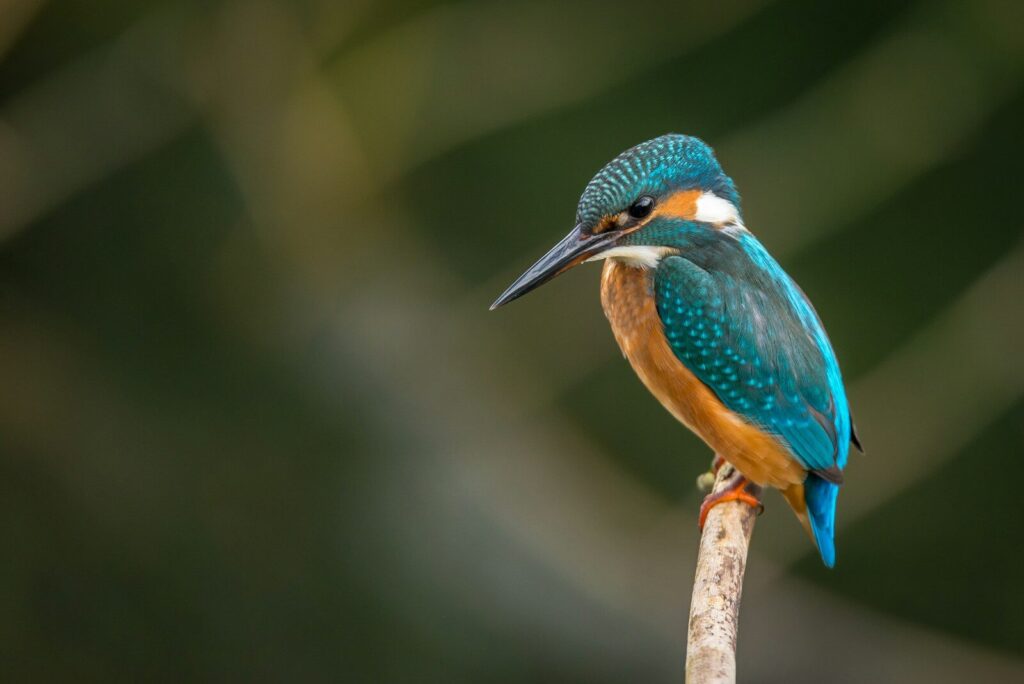
🐦 The River Sentinel: An Encyclopedia of the Amazon Kingfisher
An exhaustive 50-chapter documentation dissecting the biology, predatory tactics, striking sexual dimorphism, and ecological significance of Chloroceryle amazona.
✏️ Written & Curated by the Atechsur.org Ornithology Team | Last Updated: March 31, 2026

The Amazon Kingfisher (Chloroceryle amazona) is a quintessential resident of the Neotropical waterways. With its brilliant oily-green plumage and formidable silhouette, it stands as a vigilant sentinel over the slow-moving rivers, mangrove swamps, and oxbow lakes from Mexico down to Argentina.
This encyclopedia provides an unprecedented 50-chapter deep dive into the world of this remarkable bird. We will explore its unmistakable sexual dimorphism, its patient “sit-and-wait” hunting strategies, its impressive plunging dives, and the crucial role it plays as an indicator species for the health of the Amazon basin’s aquatic ecosystems.
- Sexual Dimorphism: It is incredibly easy to tell the sexes apart; males boast a broad, solid chestnut-red breast band, while females have broken green bands across a white chest.
- The Plunge Dive: They hunt by diving headfirst into the water from a perch up to 10 meters high, seizing fish with a heavy, dagger-like bill.
- Tunnel Nesters: Rather than building nests in trees, breeding pairs excavate horizontal tunnels up to 1.6 meters deep into steep dirt riverbanks.
- Indicator Species: Because they hunt by sight, they require relatively clear, unpolluted water to survive, making them excellent indicators of local aquatic health.
 1. Discovery and Scientific Naming
The Amazon Kingfisher was first formally described by the English physician, naturalist, and author John Latham in 1790. Latham, who provided the first scientific descriptions for many birds discovered in the Americas and Australia, originally placed it in the broad kingfisher genus Alcedo, naming it Alcedo amazona.
Later, as ornithological classification became more refined, it was moved to the genus Chloroceryle, which encompasses the green kingfishers of the Americas. The specific epithet amazona refers to its prominent presence in the Amazon River basin, although its range is much wider.
 2. The Alcedinidae Family
The Amazon Kingfisher belongs to the family Alcedinidae, a group of small to medium-sized, brightly colored birds with large heads, long, pointed bills, short legs, and stubby tails. This family has a cosmopolitan distribution, occurring across most of the globe.
Within this family, there are three subfamilies. The Amazon Kingfisher is part of the Cerylinae (the water kingfishers), which are specialized for plunge-diving for fish, distinguishing them from the tree kingfishers (like the Australian kookaburra) which often hunt terrestrial invertebrates.
 3. The Genus Chloroceryle (Green Kingfishers)
The genus Chloroceryle contains four species of “green kingfishers,” all native to the tropical Americas. The name itself is derived from the Greek khloros (green) and kerulos (a mythical bird mentioned by Aristotle, later applied to kingfishers).
The Amazon Kingfisher is the largest of these four species. Its closest relatives are the Green Kingfisher (C. americana), the Green-and-rufous Kingfisher (C. inda), and the tiny American Pygmy Kingfisher (C. aenea). All share the characteristic dark, oily-green upper plumage.
 4. General Body Morphology
The Amazon Kingfisher is a robust, heavily built bird. Measuring around 30 cm (12 in) in length and weighing between 90 and 120 grams, it has the classic kingfisher silhouette: a disproportionately large head, an almost non-existent neck, and a short, squared-off tail.
The upperparts of both sexes are a dark, glossy, bronze-green. They lack the white spotting on the wings that is common in the very similar, but much smaller, Green Kingfisher (C. americana), making this a key field mark for birdwatchers attempting to distinguish between the two species when perched.
 5. Sexual Dimorphism: The Male Profile

Photographed in Mato Grosso, Brazil. The broad rufous breast band is unmistakable.
The Amazon Kingfisher exhibits striking sexual dimorphism, making it exceptionally easy to determine the sex of an adult bird in the field. The male is characterized by a broad, solid, rufous (chestnut-red) band stretching across his entire breast.
Below this red band, his belly and undertail coverts are a clean, crisp white. Some males may also show faint green streaking on their flanks, but the dominant feature is the unbroken red chest against the white underparts.
 6. Sexual Dimorphism: The Female Profile

The female entirely lacks the red band, featuring green spotting across a white chest instead.
The female Amazon Kingfisher completely lacks the rufous breast band of the male. Instead, her underparts are entirely white, but heavily marked across the breast with green patches that often form a broken, mottled band.
She also features heavy green spotting along her flanks. Young birds (juveniles) of both sexes initially resemble the adult female, though young males will quickly begin to develop a mottled, pale reddish tint on their breasts before maturing into the solid rufous band.
 7. The Dagger Bill: Form and Function
The most crucial tool for the Amazon Kingfisher is its bill. It is disproportionately large, heavy, straight, and pointed like a dagger. It is entirely black, lacking the yellow lower mandible seen in some other kingfisher species.
This bill is an aerodynamic and hydrodynamic masterpiece. Its sharp, conical shape allows the bird to pierce the surface of the water with minimal splashing and resistance during a high-speed plunge dive, directly grasping slippery fish with deadly precision.
 8. The Shaggy Crest
Both male and female Amazon Kingfishers sport a shaggy, unkempt crest of feathers on the back of their heads. Unlike the prominent, erectile crests of the Ringed Kingfisher (Megaceryle torquata), the Amazon’s crest is less pronounced but gives the head a distinctly angular, heavy appearance.
When the bird is alarmed or engaged in territorial disputes, it can slightly raise these feathers, making its head look even larger and more intimidating to rivals.
 9. Geographic Range and Distribution
Despite its name, the Amazon Kingfisher is not restricted to the Amazon Basin. It has a massive, continuous geographic distribution across the Neotropical realm.
Its range begins in southern Mexico and stretches southward through Central America. In South America, it is found throughout Colombia, Venezuela, the Guianas, Ecuador, Peru, Bolivia, Brazil, Paraguay, and reaches as far south as central Argentina. It is a highly adaptable species, thriving wherever suitable slow-moving water and perch sites are available.
 10. Preferred Habitats
The Amazon Kingfisher is heavily tied to aquatic environments. They overwhelmingly prefer low-gradient, slow-moving bodies of water. This includes major tropical rivers, sluggish tributaries, oxbow lakes, mangrove swamps, and coastal lagoons.
They generally avoid fast-flowing mountain streams or heavy rapids, as their hunting method relies on spotting fish near the surface of relatively calm water. They are most commonly found at elevations below 1,200 meters, though they occasionally follow river valleys higher into the Andean foothills.
 11. The Sit-and-Wait Strategy

Photographed near San Ignacio, Belize. They will sit perfectly still for long periods while scanning the water below.
The Amazon Kingfisher is a classic “sit-and-wait” (or ambush) predator. Unlike some seabirds that hunt while soaring, this kingfisher selects a prominent, exposed perch—usually a bare branch extending out over the water, anywhere from 1 to 10 meters high.
From this vantage point, it sits perfectly motionless, often for long periods, staring intently into the water below. Its dark green back camouflages it against the leafy canopy behind it, making it difficult for predatory hawks to spot, while its white belly blends into the bright sky for fish looking up from the water.
 12. Visual Adaptations for Fishing
To successfully hunt from above the water, the Amazon Kingfisher must overcome refraction (the bending of light as it passes from water to air) and surface glare. Their eyes have evolved specifically for this task.
They possess exceptional binocular vision and highly specialized retinas that can cut through the glare of the sun on the water’s surface, allowing them to pinpoint the exact depth and location of a small fish swimming below before initiating a dive.
 13. The Plunge Dive
Once a target is locked in, the kingfisher drops from its perch like a stone. It plunges headfirst, accelerating rapidly. Just before impact, it tucks its wings tightly against its body to become a hydrodynamic dart.
It enters the water with its beak open to grasp the fish, not spear it. The dive is incredibly fast, and the bird is usually submerged for less than a second before using its powerful wings to thrust itself back out of the water and fly to a nearby perch.
 14. Subduing and Processing Prey
Upon returning to a branch with a successful catch, the meal is not immediately eaten. Fish possess sharp, defensive spines that could prove fatal if swallowed alive.
The kingfisher grasps the fish firmly in its bill and violently beats it back and forth against the hard branch. This process kills or stuns the fish and breaks its internal spines. Once the prey is limp, the kingfisher tosses it in the air, catches it, and swallows it headfirst so the scales and fins slide smoothly down its throat.
 15. Diet Composition
The diet of Chloroceryle amazona is overwhelmingly piscivorous (fish-eating). They target a wide variety of small, surface-dwelling or shallow-water fish, frequently preying on characins, small cichlids, and cyprinodonts.
While fish make up the vast majority of their caloric intake, they are opportunistic. If the opportunity arises, they will occasionally take aquatic crustaceans (like small crabs or shrimp), frogs, and large aquatic insects.
 16. Flight Dynamics

They fly with quick, powerful wingbeats, often staying very close to the water’s surface.
When an Amazon Kingfisher decides to move to a new hunting spot, its flight is unmistakable. It is rapid, direct, and usually very low over the water—often just inches above the surface.
Their flight pattern consists of fast, shallow wingbeats. They rarely soar or glide, preferring to commute between perches as quickly as possible to minimize their exposure to aerial predators like the Bat Falcon or various forest hawks.
 17. Vocalizations: The River Chatter
While hunting on a perch, the Amazon Kingfisher is usually silent. However, during flight, they are highly vocal. Their typical call is a harsh, raspy, rattling “teck” or a rapid, stuttering series of clicks sounding like “trrrrrrr”.
These flight calls serve to announce their territory as they move up and down a river stretch, warning rival kingfishers that a particular oxbow or lagoon is currently occupied and defended.
 18. Territoriality and Aggression
Amazon Kingfishers are fiercely territorial, especially during the breeding season. A pair will claim a stretch of riverbank and defend it aggressively against both their own species and other fishing birds.
If an intruder enters their zone, the resident bird will initiate a high-speed, noisy aerial chase, zigzagging through the overhanging branches until the trespasser is driven far past the invisible boundary lines of their territory.
 19. Breeding Season
The timing of the breeding season varies significantly across their massive geographic range, largely dictated by local rainfall patterns and the subsequent water levels of the rivers.
In general, they prefer to breed during the dry season when water levels are lower and more stable. High, stable, vertical dirt riverbanks are exposed during this time, which are absolute prerequisites for their unique nesting habits.
 20. Excavating the Nesting Tunnel
Unlike many birds that build nests out of twigs in trees, the Amazon Kingfisher is a burrower. The male and female work together to excavate a horizontal tunnel into a sheer dirt or sand bank directly overhanging the water.
Using their stout bills as pickaxes and their small feet to kick out the dirt, they dig a tunnel that can reach up to 1.6 meters (over 5 feet) deep. This deep burrow provides excellent protection from terrestrial predators and regulates the temperature for the developing eggs.
 21. The Nest Chamber and Eggs
At the end of the long tunnel, the birds excavate a widened nesting chamber. No nesting materials (like leaves or soft grass) are brought into the chamber; the eggs are laid directly on the bare earth.
A typical clutch consists of three to four pure white eggs. The eggs are white because, hidden deep within a pitch-black dirt tunnel, there is no evolutionary need for the camouflaging spots or colors seen on the eggs of open-nesting birds.
 22. Incubation and Rearing
Both the male and the female share the duties of incubating the eggs, which takes approximately 22 days. They take shifts, allowing the other partner to hunt and feed.
Once the chicks hatch, they are blind, naked, and entirely helpless (altricial). Both parents work tirelessly to catch small fish, returning to the burrow and feeding the chicks whole fish. The burrow quickly becomes lined with regurgitated fish bones and scales.
 23. Fledging the Chicks
The chicks grow rapidly on their high-protein fish diet. After about 29 to 30 days, they are fully feathered and ready to leave the dark tunnel for the first time.
Fledging is a dangerous period. The young birds must quickly master the complex physics of plunge-diving and subduing live, spiny fish. The parents will continue to feed them for a short period after they leave the nest, gradually forcing them to hunt for themselves.
24. Role as an Ecosystem Indicator

Photographed in the Iberá Wetlands, Argentina. Their presence indicates healthy fish populations and clean water.
Because the Amazon Kingfisher relies entirely on visually spotting fish from above the surface, they require relatively clean, unpolluted water to survive. If a river becomes choked with excessive agricultural runoff, industrial pollution, or heavy silt from upstream mining, the water becomes too murky for them to hunt.
Therefore, ecologists use the presence and population density of the Amazon Kingfisher as a bio-indicator. A healthy, thriving population of these birds generally signifies a healthy, balanced aquatic ecosystem.
 25. Competition with Other Kingfishers
The Amazon Kingfisher frequently shares its habitat with several other kingfisher species, particularly the massive Ringed Kingfisher (Megaceryle torquata) and the smaller Green Kingfisher (Chloroceryle americana).
They manage to coexist in the same environments through “niche partitioning.” The huge Ringed Kingfisher hunts from very high perches in deep water for large fish. The small Green Kingfisher hunts from very low perches (like rocks or low reeds) for tiny fry. The Amazon Kingfisher occupies the middle ground, hunting mid-sized fish from medium-height perches, reducing direct competition.
 26. Predators of the Kingfisher
Adult Amazon Kingfishers have few natural predators due to their speed and aggressive territoriality. However, they are occasionally taken by fast-flying raptors like the Bat Falcon or Bicolored Hawk if caught in the open.
The highest predation risk is during the nesting phase. Snakes, predatory lizards, and small mammals occasionally attempt to raid the nesting tunnels to consume the eggs or defenseless chicks, prompting the parents to dig the burrows deep into sheer, inaccessible dirt banks.
 27. Global Conservation Status
Globally, the IUCN assesses the Amazon Kingfisher as a species of Least Concern. This positive rating is due to their massive, multi-continental geographic range and their ability to adapt to somewhat altered environments, as long as clean water and fish are present.
However, localized populations can be severely impacted by deforestation, which removes their crucial overhanging hunting perches, and by the damming of rivers, which floods the sheer dirt banks they require for nesting.
 28. Local Names and Culture
Across its vast range, the bird is known by many local names. In Spanish-speaking countries, it is commonly referred to as Martín Pescador Amazónico or Martín Pescador Matraquero (referring to its rattling call).
In Brazil, it is known as the Martim-pescador-verde. To birdwatchers and ecotourists, it is often simply referred to as the “Amazon,” distinguishing it from the “Ringed” or the “Green” kingfishers encountered on the same river trips.
 29. Ecotourism and Birdwatching

Photographed in the Transpantaneira, Brazil. Their tendency to sit still on exposed perches makes them favorites among wildlife photographers.
The Amazon Kingfisher is a major draw for the lucrative Neotropical birdwatching industry. Because they are relatively large, vibrantly colored, and prefer exposed perches over open water, they are much easier to observe and photograph than the elusive birds of the deep jungle canopy.
Ecolodges located along the rivers of Costa Rica, Brazil’s Pantanal, and the Peruvian Amazon rely heavily on the presence of charismatic species like this kingfisher to attract international tourists, providing vital economic incentives to protect the riparian zones.
 30. Photography Tips: Capturing the Dive
For wildlife photographers, capturing an Amazon Kingfisher mid-dive is a highly sought-after prize. It requires intense patience and technical skill.
Photographers usually observe a perched bird to learn its preferred hunting zones. Because the dive takes less than a second, high shutter speeds (often 1/2000s or faster) and continuous burst shooting modes are necessary to freeze the dramatic moment the bird shatters the water’s surface or emerges triumphantly with a fish.
Mercury pollution from illegal gold mining (garimpeiros) not only poisons the fish but directly threatens apex predators like kingfishers through bioaccumulation.
Large dams in the Amazon alter the natural flood pulse and destroy the steep riverbanks kingfishers need for their nesting tunnels.
By preying on smaller fish, kingfishers help control populations, preventing overgrazing of aquatic insect larvae and maintaining balance.
Increased droughts in the Amazon basin evaporate the shallow oxbow lakes, eliminating prime hunting grounds for the species.
Clearing trees right up to the river edge for cattle ranching removes the essential perches kingfishers require to hunt effectively.
The bright rufous chest of the male is likely used in visual displays during courtship, contrasting sharply against the green foliage.
Kingfishers spend hours preening, using oils from their uropygial gland to ensure their feathers remain highly water-resistant for plunging.
Unlike species that hunt in saltwater, the Amazon Kingfisher does not need specialized salt-excreting glands.
The wetlands of the Brazilian Pantanal support massive populations of this species during the seasonal floods.
Kingfishers frequently hunt in the same shallows as juvenile caimans, though they are too fast to be caught by the reptiles.
High-speed motorboats create wakes that erode the steep dirt banks where the birds nest, collapsing their tunnels.
In some indigenous cultures, the sharp dive of the kingfisher is associated with precision and focus in hunting.
While generally uniform across its vast range, slight size variations exist between the Central American and deeper South American populations.
Like owls, kingfishers cannot digest the hard bones and scales of their prey; they regurgitate them in the form of compact pellets.
To clean their feathers, they will execute shallow, splashing dives into the water solely to bathe, returning to a perch to shake dry.
They generally target smaller, solitary surface fish, avoiding the dense, turbulent schools of adult piranhas.
In coastal areas, mangrove roots provide critical hunting perches and safe nurseries for the juvenile fish they prey upon.
While data is limited, small kingfishers generally survive for 4 to 7 years in the wild, constantly battling the rigors of river life.
Beyond territorial rattles, they use softer, high-pitched clicks to communicate with their mate when near the nesting burrow.
How do you tell a male from a female?
It is very simple: adult males have a solid, broad reddish-brown band across their white chest. Females lack this red band entirely, having green spotting on their chest instead.
Where does the Amazon Kingfisher nest?
They do not build nests in trees. A breeding pair will dig a horizontal tunnel into a sheer dirt riverbank, ending in a chamber where they lay their eggs directly on the soil.
Are they endangered?
No, they are currently listed as Least Concern by the IUCN due to their massive geographic range across the Neotropics, though they rely on clean water to hunt successfully.
🌐 Our Partner Network
- This digital encyclopedia is created solely as an educational reference material detailing the ecological behaviors of the Chloroceryle amazona.
- All included image multimedia content is distributed from the free open-license directory (GNU/Creative Commons Attribution) belonging to the worldwide Wikimedia Commons database and contributing wildlife photographers.
- Ecological statistics and conservation threats discussed are based on scientific consensus and reports from global ornithological monitoring agencies.
About the Drafting Team: Atechsur.org Ornithology Experts
The scientific biology editorial board of Atechsur.org proactively provides accurate, in-depth scientific reports with a dedication to engaging, humanistic language to promote a future of improved habitat conservation and comprehensive ecosystem protection globally.
© 2026 – Atechsur.org – Complete Amazon Kingfisher Encyclopedia (Chapters 1 – 50)
Chloroceryle amazona • Least Concern • Updated: March 31, 2026