🦜 The Emerald of the Canopy: Turquoise-fronted Amazon Encyclopedia
An exhaustive 50-chapter documentation dissecting the biology, social structure, vibrant plumage, and conservation status of Amazona aestiva.
✏️ Written & Curated by the Atechsur.org Ornithology Team | Last Updated: March 31, 2026

The Turquoise-fronted Amazon (Amazona aestiva), frequently referred to in aviculture as the Blue-fronted Amazon, is one of the most recognizable and beloved parrot species in the Neotropics. With its robust build, brilliant green plumage, and flashes of turquoise and yellow, it stands out as a vibrant inhabitant of South America’s forests and savannas.
This encyclopedia provides an unprecedented 50-chapter deep dive into the world of this remarkable bird. We will explore its complex social behaviors, its incredible intelligence, the mechanics behind its powerful beak, its life in regions like the Pantanal, and the severe threats it faces from habitat loss and the illegal pet trade.
- Lifespan: These parrots are incredibly long-lived; they can survive for 40 to 60 years in the wild, and sometimes even longer in captivity.
- Monogamy: They form strong, lifelong pair bonds, often seen flying closely together even within large, noisy flocks.
- Vocal Mimicry: In captivity, they are renowned for their exceptional ability to mimic human speech and other environmental sounds.
- Zygodactyl Feet: They have two toes pointing forward and two pointing backward, giving them incredible dexterity to climb and hold food like hands.
 1. Discovery and Scientific Naming
The Turquoise-fronted Amazon was first formally described by the father of modern taxonomy, Carl Linnaeus, in the tenth edition of his Systema Naturae in 1758. Linnaeus originally placed it in the genus Psittacus, a broad category he used for many parrots, naming it Psittacus aestivus.
The specific epithet aestiva comes from the Latin word aestivus, meaning “of the summer.” Later taxonomists moved it to the genus Amazona, which was established to encompass the large, predominantly green parrots native to the Americas.
 2. The Psittacidae Family
This parrot belongs to the family Psittacidae, one of the three families of “true parrots.” This family includes macaws, conures, and other Amazon parrots.
Members of this family are characterized by their strong, curved bills, upright stance, strong legs, and clawed zygodactyl feet. They are considered some of the most intelligent birds in the world, displaying problem-solving skills and complex social structures akin to those seen in primates.
 3. The Genus Amazona
The genus Amazona contains about 30 species of parrots, all native to the New World, ranging from South America up to Mexico and the Caribbean.
Amazon parrots are typically medium to large, relatively short-tailed, and predominantly green. They are highly arboreal, spending most of their lives in the canopy. The Amazona aestiva is one of the most widely recognized and populous species within this genus.
 4. General Body Morphology

The Turquoise-fronted Amazon has a stocky build and a relatively short, squared tail typical of the genus.
The Turquoise-fronted Amazon is a robust, heavily built bird. It typically measures between 33 and 38 centimeters (13 to 15 inches) from the top of its head to the tip of its tail, weighing in at a substantial 400 to 430 grams.
Its body is primarily covered in vibrant, leafy-green feathers. The feathers on the nape and back are often edged with black, giving the bird a slightly scalloped or scaled appearance when viewed up close.
5. The Signature Facial Markings
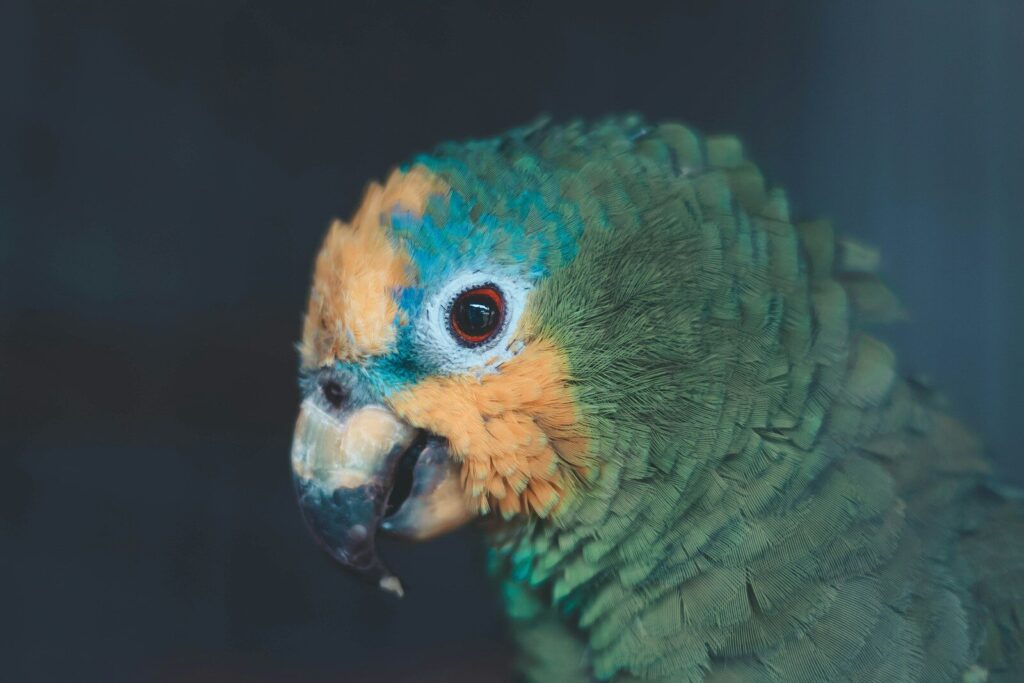
The most distinguishing feature of Amazona aestiva is its spectacularly colored face. It earns its common name from the patch of bright turquoise-blue feathers located directly above its beak on the forehead.
Surrounding the eyes, the lores, and extending down to the cheeks and throat is a wash of brilliant yellow. However, there is an incredible amount of individual variation in these facial markings; no two birds have exactly the same pattern of blue and yellow, which helps individuals recognize each other within large flocks.
 6. Hidden Splendor: Wing and Shoulder Accents

Flashes of red and blue are visible on the wing edges, particularly noticeable when the bird takes flight.
While mostly green when perched, the Turquoise-fronted Amazon hides brilliant flashes of color. The bend of the wing (the “shoulder”) often features a mix of red and yellow feathers.
The flight feathers—specifically the outer webs of the primary feathers—are a deep, striking blue. Furthermore, the base of the outer tail feathers contains patches of bright red. These colors flash vividly during flight, creating a dazzling display that helps keep the flock together in the air.
 7. The Tail Feathers

The base of the outer tail feathers features bright red patches, a common trait in many Amazon species.
The tail of the Amazona aestiva is relatively short and squared off, typical of the genus. The central tail feathers are green, but the outer tail feathers are yellowish-green with distinct red patches near the base.
These red patches are usually hidden when the bird is resting and the tail is folded. They are primarily flashed during flight or spread wide during aggressive territorial displays and courtship rituals.
 8. The Eye: Pinning and Expression
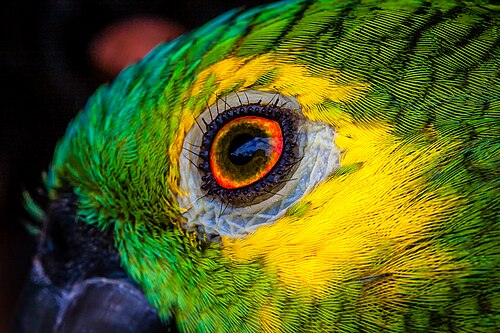
Parrots can voluntarily control their pupils, an action known as “pinning,” to express excitement or aggression.
The eyes of an adult Turquoise-fronted Amazon are a striking orange-yellow, surrounded by a subtle ring of bare, whitish skin. Juveniles, by contrast, have dark brown or grey irises that lighten as they mature.
A fascinating behavior observed in these parrots is “eye pinning” or “flashing.” They can voluntarily constrict and expand their pupils rapidly. This is not a reaction to light, but an expression of extreme emotion—be it excitement over food, aggression toward a rival, or arousal during courtship.
9. The Bill: A Multi-Tool
The bill of Amazona aestiva is thick, powerful, and deeply curved. It is typically black or dark grey. This bill is not just a mouth; it is a highly evolved multi-tool.
The upper mandible is hinged to the skull, allowing for incredible leverage and crushing power, capable of cracking open tough palm nuts that other animals cannot access. Furthermore, the beak acts as a “third foot,” allowing the heavy bird to haul itself up steep, smooth branches in the canopy with ease.
 10. Lack of Sexual Dimorphism

Unlike some bird species, male and female Turquoise-fronted Amazons look identical to the naked eye.
Unlike many bird species where males are brightly colored and females are drab, the Turquoise-fronted Amazon is sexually monomorphic. This means that males (cocks) and females (hens) look visually identical.
Without a surgical procedure or DNA testing (usually done via a feather or blood sample), it is nearly impossible for a human to determine the sex of one of these parrots just by looking at it. The birds themselves, however, use subtle behavioral cues and vocalizations to identify mates.
 11. Geographic Range and Distribution

The shaded area highlights their vast distribution across central and eastern South America.
The Turquoise-fronted Amazon enjoys a vast distribution across the heart of South America. Its range covers millions of square kilometers.
They are found in northeastern and eastern Bolivia, extending heavily into eastern Brazil (including the states of Mato Grosso, Piauí, and Rio Grande do Sul), south through Paraguay, and into northern Argentina. This wide range forces them to adapt to a variety of different ecological zones.
 12. Preferred Habitats: The Pantanal and Beyond

This species thrives in the varied environments of the Pantanal, the world’s largest tropical wetland.
While often associated with the dense “jungle,” the Turquoise-fronted Amazon actually prefers more open habitats compared to some of its deeper-rainforest cousins. They thrive in woodlands, palm groves (especially Mauritia palm swamps), gallery forests along rivers, and savannas (like the Cerrado).
One of their greatest strongholds is the Pantanal, a massive, seasonally flooded wetland spanning Brazil, Bolivia, and Paraguay. The mix of open space for flying and dense stands of trees for feeding and nesting suits them perfectly.
 13. Diet and Foraging Habits

They use their feet to hold food items, carefully extracting seeds and discarding the bitter rinds.
The diet of Amazona aestiva is highly varied and changes seasonally based on what the forest produces. They are primarily frugivores and granivores, consuming a massive variety of seeds, nuts, fruits, and berries.
During certain times of the year, they will also heavily consume blossoms, nectar, and tender leaf buds. They are known as “seed predators”—unlike birds that swallow fruit whole and disperse the seeds intact, these parrots crush and digest the seeds to access the high-fat and high-protein contents inside.
 14. Flocking Behavior and Roosting
Outside of the breeding season, Turquoise-fronted Amazons are highly gregarious. They spend their days foraging in smaller, noisy groups of a dozen or so birds, constantly squawking to maintain contact through the thick foliage.
As evening approaches, these smaller groups merge into massive communal flocks. Hundreds, sometimes thousands, of birds will congregate in a specific grove of tall trees (often along a riverbank) to sleep. This communal roosting provides safety in numbers against nocturnal predators like owls and arboreal snakes.
 15. Monogamy and Pair Bonds

Even within a flock of hundreds, a bonded pair will stay close together, flying wing-tip to wing-tip.
Like most large parrots, the Turquoise-fronted Amazon forms strong, strictly monogamous pair bonds that often last for life. These pairs are the fundamental unit of their social structure.
Bonded pairs engage in frequent mutual preening (allopreening), carefully cleaning the feathers on each other’s head and neck where the bird cannot reach itself. This behavior not only removes parasites but significantly reinforces their social and emotional bond.
 16. The Breeding Season
The breeding season typically begins with the onset of the Southern Hemisphere’s spring, usually running from August through January, though this varies slightly depending on local rainfall and food availability.
During this time, the large flocks break apart as bonded pairs leave to establish and aggressively defend a nesting territory. Courtship displays involve the male puffing up his neck feathers, fanning his tail to show off the red patches, and feeding the female regurgitated food to prove his ability as a provider.
17. Nesting Habits and Eggs

The eggs are simple and white, as they are hidden in dark tree hollows and don’t require camouflage coloring.
Amazon parrots do not build intricate nests out of twigs. They are secondary cavity nesters, relying entirely on finding deep, natural hollows in ancient, dead, or dying trees (particularly palm trees) to lay their eggs. They chew on the rotting wood inside the hollow to create a soft bed of wood chips.
The female typically lays a clutch of 2 to 4 smooth, white eggs. Because they are hidden in the dark, there is no evolutionary need for the eggs to have camouflaging spots or colors.
 18. Incubation and Rearing the Young
The female assumes the sole responsibility for incubating the eggs, which takes approximately 26 to 28 days. During this entire period, she rarely leaves the dark hollow. The male acts as a dedicated provider, spending his days foraging and returning to the nest to feed the female regurgitated, partially digested food.
Once the chicks hatch, they are blind, naked, and entirely helpless (altricial). Both parents then work tirelessly to feed the growing chicks. The young grow rapidly, remaining in the nest for about 60 days before they are fully feathered and ready to fledge.
 19. The Juvenile Stage

Young birds have much duller plumage and lack the extensive blue and yellow facial coloring of the adults.
When the young parrots finally leave the nest (fledge), they do not look exactly like their parents. Juveniles have significantly duller plumage. The vibrant blue and yellow markings on their faces are often reduced, pale, or completely absent.
Furthermore, their eyes are dark, not the bright orange-yellow of adults. They remain dependent on their parents for several weeks after leaving the nest, learning the complex vocalizations and foraging skills required to survive before eventually joining the larger communal flocks.
 20. Sympatric Species: The Yellow-Crowned Amazon

A Yellow-crowned Amazon (left) and a Turquoise-fronted Amazon (right). Note the distinct blue forehead on the bird on the right.
In many parts of its range, the Turquoise-fronted Amazon’s territory overlaps (is sympatric) with other closely related parrot species, such as the Yellow-crowned Amazon (Amazona ochrocephala).
While they may compete for similar nesting hollows and food sources, their distinct facial markings and unique flocking vocalizations prevent cross-breeding in the wild, ensuring the genetic isolation of the species despite sharing the same canopy.
 21. Subspecies: A. a. aestiva vs. A. a. xanthopteryx
Ornithologists generally recognize two distinct subspecies of the Turquoise-fronted Amazon, separated geographically.
The nominate subspecies, Amazona aestiva aestiva, is found in eastern Brazil. It typically has a leading edge of the wing (the “shoulder”) that is predominantly red. The other subspecies, Amazona aestiva xanthopteryx, is found further west and south (Bolivia, Paraguay, Argentina). It is distinguished by having a prominent yellow patch on the shoulder, often entirely lacking the red seen in its eastern counterpart.
 22. High Intelligence and Problem Solving
Parrots, alongside corvids (crows and ravens), are considered the most intelligent birds on Earth. The Turquoise-fronted Amazon possesses a large brain-to-body ratio and an exceptionally dense concentration of neurons in the pallium, the area of the brain responsible for higher cognitive functions.
In the wild, this intelligence is used to map vast territories, remember the exact location and fruiting schedule of hundreds of individual trees, and solve complex mechanical problems to extract hidden seeds and nuts.
 23. Vocal Mimicry: The “Talking” Parrot
In the wild, Amazon parrots do not mimic other species; their vocalizations are strictly for communicating with their own kind. However, they possess a highly complex vocal organ called a syrinx, which is incredibly adept at sound production.
When raised in captivity, the Turquoise-fronted Amazon ranks among the absolute best “talking” parrots in the world, surpassed perhaps only by the African Grey. They are capable of learning hundreds of human words, whistling tunes, and perfectly mimicking environmental sounds like laughter, sirens, or ringing phones, using this mimicry to bond with their human “flock.”
 24. The Curse of Popularity: The Pet Trade

Their intelligence and striking beauty make them one of the most heavily trafficked birds in the world.
Because of their incredible intelligence, talking ability, and striking beauty, the Turquoise-fronted Amazon is one of the most heavily desired birds in the global pet trade. This popularity has been a disaster for wild populations.
While many are now bred responsibly in captivity, for decades, millions of these birds were violently poached from the wild. Poachers often cut down ancient nesting trees—destroying crucial habitat—to steal chicks to sell on the black market.
 25. Challenges of Captivity
Owning a Turquoise-fronted Amazon is akin to caring for a perpetual 3-year-old child. They require massive cages, constant mental stimulation, hours of daily social interaction, and a complex diet.
When denied these necessities, highly intelligent parrots suffer extreme psychological distress. This often manifests in destructive behaviors, such as screaming incessantly or feather-plucking (mutilating their own plumage). Because they can live for over 50 years, they frequently outlive their owners, making them a lifelong, demanding commitment that many are unprepared for.
 26. Feral Populations Worldwide

A Turquoise-fronted Amazon photographed on the grounds of Leeds Castle, UK. Escaped pets sometimes form feral flocks.
Due to the massive volume of the historical pet trade, escaped or intentionally released Turquoise-fronted Amazons have established feral breeding populations in cities far outside their natural South American range.
Flocks can be found surviving in urban parks in parts of Europe (such as Germany and Spain) and in several cities across the United States. These hardy birds adapt to the urban environment, feeding on ornamental fruit trees and finding warmth near city infrastructure.
 27. Conservation Status: Near Threatened
While still relatively common in some areas, the overall population trend for the Turquoise-fronted Amazon is decreasing rapidly. In 2019, the IUCN officially uplisted the species to Near Threatened.
The combination of relentless illegal trapping for the domestic and international pet trade, coupled with massive habitat destruction (particularly the conversion of the Cerrado and Pantanal regions into massive soy and cattle farms), is driving this iconic species toward endangerment.
 28. CITES Protection and Law Enforcement
To combat the devastating effects of poaching, the Turquoise-fronted Amazon is listed under Appendix II of CITES (the Convention on International Trade in Endangered Species of Wild Fauna and Flora).
This listing strictly regulates international trade, requiring permits that prove the export will not be detrimental to the survival of the species in the wild. Despite these laws, a sophisticated black market still exists, prompting environmental police in countries like Brazil to conduct frequent raids on smuggling rings.
 29. The Value of Ecotourism
One of the most effective conservation strategies for protecting the Turquoise-fronted Amazon and its habitat is the promotion of sustainable ecotourism, particularly in regions like the Brazilian Pantanal.
Birdwatchers travel from around the world to photograph these spectacular parrots in their natural habitat. When local communities realize that a wild, flying parrot brings in continuous, sustainable income year after year, the financial incentive shifts from poaching the bird to fiercely protecting the forests where it lives.
 30. Future Outlook for the Species
The future of the Turquoise-fronted Amazon hinges on aggressive habitat preservation and the eradication of the illegal pet trade. Educational campaigns within South America are crucial to changing the culture of keeping wild-caught birds as pets.
If the massive agricultural expansion into the Cerrado and Pantanal can be managed sustainably, and critical nesting trees protected, the loud, raucous calls of the Amazona aestiva will continue to be a defining sound of the Neotropical dawn for generations to come.
Parrots undergo a gradual, sequential molt over several months, ensuring they never lose the ability to fly or maneuver in the canopy.
Preening involves spreading oil from a gland near the tail over their feathers to maintain waterproofing against heavy tropical downpours.
Like macaws, some Amazon parrots may visit clay licks (collpas) to ingest minerals that help neutralize the toxins found in certain unripe seeds.
Rather than descending to dangerous rivers, they often drink water pooled in bromeliads or wet leaves high in the trees.
The primary natural predator of an adult Amazon parrot is the massive Harpy Eagle, which hunts them by flying silently through the dense canopy branches.
Arboreal snakes, such as the Amazon Tree Boa, are the biggest threat to parrot eggs and helpless nestlings hidden in tree hollows.
Studies suggest that geographically separated flocks of the same species develop unique vocal “dialects” or regional accents.
Their X-shaped toe arrangement allows them a vice-like grip, enabling them to hang upside down while feeding.
Cognitive tests show Amazon parrots rivaling crows and ravens in problem-solving tasks involving string-pulling and object manipulation.
Their incredibly long lifespan is attributed to a slow metabolism, low predation rates on healthy adults, and an intelligent, cautious approach to foraging.
Increasingly frequent human-made wildfires in the Pantanal are destroying thousands of ancient, hollow palm trees vital for breeding.
Historically, indigenous tribes kept them as free-flying companions, using their shed feathers for ceremonial headdresses.
They are bred extensively in captivity today. Closed-banding systems help buyers ensure they are purchasing legally bred, not wild-caught, birds.
In captivity, they are highly susceptible to respiratory diseases and obesity if fed a seed-only diet instead of proper pellets and fresh produce.
Though they destroy many seeds, the sheer volume of fruit they drop accidentally makes them vital engineers of the forest’s flora diversity.
The Mauritia palm swamps (Buritizais) are essential ecosystems where these parrots find both their primary food source and their required nesting hollows.
The lower mandible slides forward and backward to act like a file, grinding hard nuts against the ridged interior of the upper beak.
Their daily routine begins with a deafening morning chorus as the flock wakes, stretches, and coordinates their flight path for the day’s foraging.
Altered rainfall patterns disrupt the delicate timing of when canopy trees fruit, directly threatening the parrots’ food supply during the critical breeding season.
Why do their eyes “pin” or change size?
Unlike humans, parrots have voluntary control over their irises. Eye pinning (rapid constriction and dilation of the pupil) is a display of strong emotion, often signaling excitement, arousal, or aggression.
Are they good talkers?
Yes, the Turquoise-fronted (Blue-fronted) Amazon is renowned in aviculture as one of the most prolific and clear mimics of human speech among all parrot species.
Why are they threatened in the wild?
Their population is declining rapidly due to a deadly combination of massive habitat destruction (clearing forests for agriculture) and rampant illegal poaching, where chicks are stolen from nests to supply the black market pet trade.
Explore our trusted network of partner websites covering directories, encyclopedias, marketplaces, education, and finance.
- This digital encyclopedia is created solely as an educational reference material detailing the ecological behaviors of the Amazona aestiva.
- All included image multimedia content is distributed from the free open-license directory (GNU/Creative Commons Attribution) belonging to the worldwide Wikimedia Commons database and contributing wildlife photographers.
- Ecological statistics and conservation threats discussed are based on scientific consensus and reports from global ornithological monitoring agencies.
About the Drafting Team: Atechsur.org Ornithology Experts
The scientific biology editorial board of Atechsur.org proactively provides accurate, in-depth scientific reports with a dedication to engaging, humanistic language to promote a future of improved habitat conservation and comprehensive ecosystem protection globally.
© 2026 – Atechsur.org – Complete Turquoise-fronted Amazon Encyclopedia (Chapters 1 – 50)
Amazona aestiva • Near Threatened • Updated: March 31, 2026