
🦴 The Fossil Motherlode: An Encyclopedia of the Hell Creek Formation
An exhaustive 50-chapter chronological documentation charting the geology, legendary dinosaur fauna, rich paleobotany, and the catastrophic end of the Late Cretaceous period.
✏️ Written & Curated by the Atechsur.org Paleontology Team | Last Updated: March 29, 2026

The Hell Creek Formation is arguably the most famous and intensively studied geological formation on Earth. Spanning parts of North America, it serves as a spectacular terrestrial time capsule capturing the twilight of the dinosaurs just before the catastrophic K-Pg extinction event approximately 66 million years ago.
To truly comprehend this prehistoric world, we must dissect its stones, its extinct flora, and its legendary giants. This encyclopedia offers an unprecedented 50-chapter journey. From the towering silhouette of Tyrannosaurus rex to the microscopic pollen grains that tell the story of ancient climates, we invite you to walk through the world of Hell Creek.
- The Final Chapter: Hell Creek preserves the very end of the Mesozoic Era; the top of the formation is marked by the devastating K-Pg boundary.
- Subtropical Swamps: Unlike the dry badlands of today, the Cretaceous Hell Creek was a lush, subtropical, swampy floodplain teeming with early flowering plants.
- Dinosaur Census: Triceratops is by far the most commonly found large dinosaur in the formation, outnumbering T. rex fossils by a massive margin.
- Not Just Dinosaurs: The formation provides critical evidence of early mammalian evolution, revealing that our ancestors survived the asteroid impact that doomed the non-avian dinosaurs.
Part I: The Geological Foundation (Chapters 1 – 10)

This eroding area of land in South Dakota is ideal for hunting the ancient remains of Cretaceous giants.
The Hell Creek Formation is a series of freshwater and brackish-water clays, mudstones, and sandstones deposited during the Maastrichtian epoch, the final stage of the Late Cretaceous period. It is world-renowned for its incredible volume and quality of fossils.
Named after Hell Creek near Jordan, Montana, it represents a coastal plain ecosystem that existed just before the end-Cretaceous mass extinction. Today, its eroding badlands offer paleontologists an unparalleled window into the past.

Map showing the geographical spread of the Hell Creek and closely related Lance formations across North America.
The rocks of the Hell Creek Formation span four US states: Montana, North Dakota, South Dakota, and Wyoming. The vast, arid badlands of the modern American West provide the perfect erosional environment to expose these ancient layers.
In regions like Garfield County, Montana, constant wind and water erosion continuously peel back the sediment, literally bringing new dinosaur bones to the surface every spring after the snowmelt.
The rocks here were laid down between 68 and 66 million years ago. This was the absolute zenith of dinosaur evolution. The continents had drifted closer to their modern positions, though global sea levels were significantly higher than today.
During this epoch, the Earth experienced a “greenhouse” climate. There were no permanent polar ice caps, resulting in a world that was drastically warmer and more humid, allowing lush vegetation to thrive even at high latitudes.

A visual breakdown of the rock layers, transitioning from marine shales at the base to the terrestrial beds of the upper formation.
Geologically, Hell Creek rests above the marine Fox Hills Formation and sits directly below the paleocene Fort Union Formation. The stratigraphy consists largely of alternating layers of sandstone (representing ancient river channels) and mudstone (representing calm floodplains).
Paleontologists meticulously document the exact stratigraphic layer a fossil is found in to determine its precise age and the specific environmental conditions of that exact moment in geological time.
To understand Hell Creek, one must understand the Western Interior Seaway. For millions of years, this massive inland sea bisected North America from the Arctic to the Gulf of Mexico.
During the time Hell Creek was being formed, this seaway was slowly retreating (regressing) eastward. The Hell Creek ecosystem was essentially a massive, shifting delta system—a swampy, low-lying coastal plain situated right on the western edge of this retreating ocean.

Today’s dry Montana badlands stand in stark contrast to the lush, humid, subtropical forests of the Cretaceous period.
The climate of Hell Creek was mild to subtropical. Isotopic analysis of fossilized soil and shells indicates a warm environment with abundant rainfall, lacking prolonged freezing temperatures during winter.
The landscape was comparable to the modern coastal plains of Louisiana or the Florida Everglades—a mosaic of meandering rivers, vast floodplain swamps, dense coastal forests, and open woodland canopies.
The lifeblood of the Hell Creek ecosystem was its network of sluggish, meandering rivers carrying sediment eastward from the newly rising Rocky Mountains.
When heavy rains occurred, these rivers would overflow their banks, burying deceased animals in thick layers of silt and mud. This rapid burial is the primary reason why so many pristine fossils—including articulated dinosaur skeletons—have been preserved here for 66 million years.
The very top of the Hell Creek Formation is punctuated by a thin, unmistakable dark band of clay known as the K-Pg boundary (formerly KT boundary).
This layer is heavily enriched with iridium, shocked quartz, and microscopic tektites—the global fallout signature of the massive asteroid impact that occurred in the Yucatan Peninsula. Below this line, dinosaur fossils are abundant; above it, they disappear entirely.

Distinctive rock formations, like these ironstone “cannonballs,” are common geological features encountered by early and modern fossil hunters.
The scientific discovery of Hell Creek’s riches began in earnest in the late 19th and early 20th centuries. Legendary bone-hunter Barnum Brown, working for the American Museum of Natural History, put the formation on the map.
In 1902, Brown discovered the first documented remains of Tyrannosaurus rex in the Hell Creek badlands, sparking a paleontology rush that continues unabated to this day.
Fossilization requires highly specific conditions. In Hell Creek, the combination of abundant wildlife and dynamic river systems created the perfect storm for preservation.
When an animal died in or near a river channel, it was quickly buried by sediment during a flood. Over millions of years, mineral-rich groundwater percolated through the bones, replacing organic material with silica and iron, turning the bone to heavy, solid rock.
Part II: The Flora of Hell Creek (Chapters 11 – 20)

A reconstructed illustration showing the diverse shapes of leaves that made up the broadleaf canopy of the Late Cretaceous.
The visual landscape of Hell Creek would not look entirely alien to a modern time-traveler. By the Late Cretaceous, the dense forests were a mix of ancient conifers and the newly evolving, rapidly diversifying angiosperms (flowering plants).
The canopy provided deep shade and abundant food, supporting massive populations of herbivorous dinosaurs and early mammals.
The Hell Creek epoch marks a crucial turning point in botanical history. Angiosperms had finally overtaken gymnosperms (like pines and cycads) as the dominant plant type on land.
This botanical revolution changed dinosaur diets, accelerated the evolution of pollinating insects, and fundamentally altered the nutrient cycles of the forest floor due to the faster decomposition rates of broad leaves.
Beneath the tall broadleaf and conifer canopy, the understory was dense with ferns, cycads, and early herbaceous plants. Unlike modern grasslands (grasses had barely evolved and were not yet widespread), the open areas were likely covered in low-lying fern prairies.
These tough, fibrous ferns were the primary food source for massive, low-browsing herbivores like Ankylosaurus and Triceratops.

A beautifully preserved leaf impression from the Hell Creek Formation, housed at the Denver Museum of Nature & Science.
Climbing the trunks of the great conifers were various species of ancient vines and climbing plants, including those assigned to the genus Cissites.
These lobed leaves indicate a complex, multi-tiered forest structure similar to modern tropical and subtropical rainforests, where plants actively competed for sunlight by climbing over one another.

Fossilized leaf showing distinct venation patterns, crucial for paleoclimatic temperature reconstructions.
Because the mudstones of Hell Creek were formed in calm, slow-moving water, they are exceptional preservers of delicate plant material. Leaves from plants like Araliaephyllum settled in the mud and fossilized perfectly.
Paleobotanists study the smooth versus toothed edges of these leaves to calculate the exact average annual temperatures of the Late Cretaceous, confirming its warm, frost-free climate.

Evidence of early aquatic flowering plants that thrived in the calm oxbow lakes of the Hell Creek delta.
The sluggish rivers and oxbow lakes of the Hell Creek delta were choked with aquatic vegetation. Fossils of Nelumbium show that relatives of modern lotuses and water lilies were abundant.
These floating plant mats provided cover for early amphibians, fish, and juvenile crocodilians, acting as vital nurseries in the aquatic ecosystem.

Magnolias are among the most ancient lineages of flowering plants, blooming in the shadows of the dinosaurs.
The Magnoliid lineage is ancient, and evidence of plants like Magnolia pulchra proves they were established in Hell Creek. The presence of large, showy flowers indicates an ecosystem filled with visual attractants.
While birds and mammals were present, insects (like early beetles) were the primary pollinators of these robust, fragrant Cretaceous blooms.

Leaves belonging to the Fagaceae family, relatives of modern oaks and beeches, dominated the canopy.
Fossils like Dryophyllum show the presence of the Fagaceae family—the ancestors of modern oaks, beeches, and chestnuts. These trees likely produced nuts or hard seeds.
The abundance of these hardwood relatives suggests a robust forest structure capable of supporting the massive weight and energetic demands of the local dinosaurian megafauna.
Despite the rise of flowering plants, gymnosperms still held immense ecological power. Towering bald cypresses (like Metasequoia), araucaria, and ancient pines formed the highest emergent layers of the forest.
Additionally, Ginkgo trees—often called “living fossils” today—were diverse and abundant, dropping their fan-shaped leaves into the Hell Creek muds every autumn.
Paleobotanists don’t just study the leaves; they study the damage on them. Hell Creek fossil leaves frequently display distinct chew marks, leaf-miner trails, and gall structures.
This trace fossil evidence proves that an incredibly diverse, complex war between herbivorous insects and plant chemical defenses was raging silently at the feet of the dinosaurs.
Part III: The Herbivorous Giants (Chapters 21 – 30)

A scale chart showing the massive bulk of Triceratops and Edmontosaurus compared to other regional archosaurs.
Triceratops is the undisputed king of the Hell Creek herbivores. Making up the vast majority of large dinosaur fossils found in the formation, they were the ecological equivalent of modern rhinos or buffalo.
Armed with a massive solid bone frill and three lethal horns, they used their powerful beaks and battery of shearing teeth to slice through incredibly tough fibrous plants, ferns, and cycads that other herbivores couldn’t digest.
The hadrosaur (duck-billed dinosaur) Edmontosaurus annectens was another incredibly common sight. Growing up to 12 meters (39 feet) long, they were massive, herd-dwelling browsers.
Unlike Triceratops, they lacked armor or horns. Their primary defenses against predators were their sheer size, herd vigilance, and a muscular tail that could deliver a devastating blow. Rare “mummified” specimens from the region show they even possessed a fleshy crest on their heads.
Navigating the dense underbrush was Pachycephalosaurus, famous for its tremendously thick, domed skull surrounded by bony knobs.
Debate still rages over whether these 10-inch thick skulls were used for intra-species head-butting (like modern bighorn sheep), flank-butting, or purely for visual display. They were likely opportunistic herbivores, picking softer fruits and leaves.
Though rarer in the fossil record than ceratopsians or hadrosaurs, Ankylosaurus magniventris was the ultimate walking tank of Hell Creek. Its entire back was covered in osteoderms (bone plates fused into the skin).
If attacked by a T. rex, it would hunker down to protect its soft belly and swing its massive, fused tail club—a weapon capable of easily shattering the legs of even the largest predators.
Not all herbivores were giants. Thescelosaurus was a sturdy, medium-sized ornithopod roughly the size of a large sheep. It lacked armor, horns, or extreme speed.
Instead, its robust limbs suggest it was a powerful digger or a dweller of dense, swampy thickets where larger predators could not easily follow, relying on camouflage and cover to survive.
A primitive cousin to the mighty Triceratops, Leptoceratops was a small, pig-sized herbivore that lacked the massive frill and facial horns of its later relatives.
It had a powerful beak and jaw muscles, indicating a diet of tough ground vegetation. Some paleontologists suspect that small ceratopsians like this may have constructed burrows to escape the midday heat and evade predators.
Sharing the landscape with Triceratops was Torosaurus, characterized by an absolutely massive frill that featured two large openings (fenestrae) to reduce weight.
For years, a fierce paleontological debate existed suggesting Torosaurus might just be the fully mature, elderly form of Triceratops. Currently, the consensus largely maintains they are distinct but closely related species coexisting in the same ecosystem.
Looking remarkably like a modern ostrich minus the feathers, Struthiomimus was a highly adapted runner. It had long, powerful hind legs, a long neck, and a toothless beak.
Though technically a theropod (the lineage of meat-eaters), it was almost certainly an omnivore or herbivore, using its incredible speed to flee from predators rather than standing to fight.
How did these massive herbivores process tons of tough, fibrous plant matter? Dinosaurs like Edmontosaurus and Triceratops possessed “dental batteries”—hundreds of tightly packed teeth that continually replaced themselves as they wore down.
This allowed them to physically chew and pulp their food before swallowing, a huge evolutionary advantage over earlier sauropods that swallowed stones (gastroliths) to grind food in their stomachs.
Extensive bonebeds in regions adjacent to Hell Creek suggest that dinosaurs like Edmontosaurus lived and moved in vast herds, numbering in the hundreds or thousands.
These mega-herds likely migrated seasonally across the coastal plains, constantly moving to find fresh vegetation and avoid stripping any single area bare, heavily shaping the ecology of the forest through their mass grazing.
Part IV: The Apex Predators and Theropods (Chapters 31 – 40)

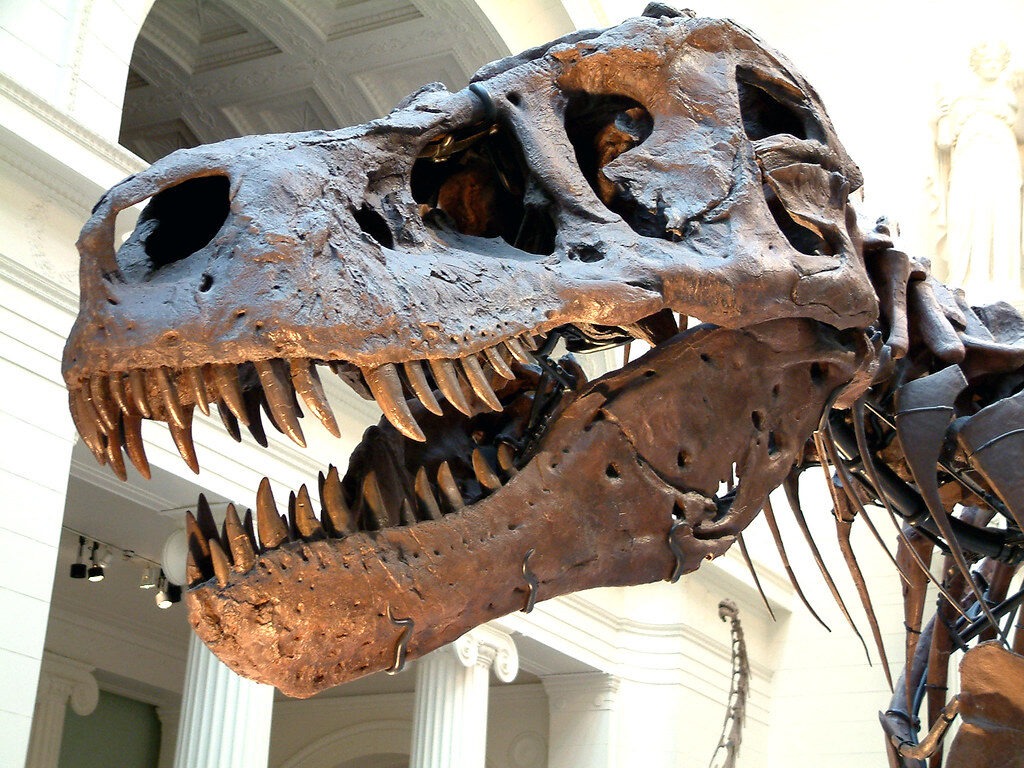
The undisputed apex predator of Hell Creek. This specimen, famously known as “Sue,” is one of the most complete ever found.
The apex predator of Hell Creek requires no introduction. Tyrannosaurus rex was a 40-foot, 8-ton marvel of biological engineering.
Possessing the strongest bite force of any terrestrial animal in history, its thick, banana-shaped teeth were designed not just to slice meat, but to crush and shatter the solid bones of Triceratops and Edmontosaurus.
An adult T. rex was heavily built and likely could not sprint at high speeds. Therefore, it relied on ambush tactics in the dense forests, utilizing its stereoscopic, binocular vision to gauge distance perfectly.
Its massive olfactory bulbs indicate an incredibly acute sense of smell, allowing it to track herds over long distances or locate rotting carcasses from miles away, making it both a fearsome hunter and an efficient scavenger.

Did a smaller, sleeker tyrannosaur hunt alongside T. rex, or are these simply the fossils of highly athletic teenage T. rexes?
One of Hell Creek’s greatest ongoing controversies surrounds Nanotyrannus lancensis. Fossils of this smaller, sleeker, longer-legged tyrannosaur show it was built for speed.
Many paleontologists argue it is a distinct genus that occupied the mid-sized predator niche. However, a large contingent argues these are simply juvenile T. rex specimens, suggesting that as a T. rex grew, it radically changed from a swift pursuit predator into a bulky bone-crusher.
For decades, teeth of small “raptors” (dromaeosaurids) were found in Hell Creek, but no bodies. Finally, Acheroraptor temertyorum was formally described. It is the youngest known member of the dromaeosaur family.
Roughly the size of a coyote, this feathered predator likely hunted small mammals, lizards, and ground-dwelling birds, acting as the forest’s lethal mid-tier carnivore.
Discovered more recently, Dakotaraptor was a massive dromaeosaur, growing over 16 feet long. It was armed with the terrifying, iconic “killing claw” on its foot.
Crucially, fossils of its ulna (arm bone) show distinct quill knobs, providing direct, undeniable evidence that this large, agile predator was heavily feathered, bridging the visual gap between dinosaurs and modern birds of prey.

Artist’s depiction of the bizarre, feathered, beaked oviraptorosaurs, including the towering Anzu wyliei.
Nicknamed the “Chicken from Hell,” Anzu wyliei was a large oviraptorosaur. At 10 feet long, it sported a toothless beak, a tall bony crest on its head, and a body covered in feathers.
Its powerful build and sharp claws suggest it was a formidable omnivore, capable of defending itself while foraging for tough vegetation, eggs, and small animals in the muddy swamps.
Alongside Struthiomimus lived other “ostrich-mimic” dinosaurs like Ornithomimus. Their long, grasping hands and large eyes suggest a highly opportunistic lifestyle.
They darted through the undergrowth, likely snapping up large insects, lizards, and small mammals, while supplementing their diet with fruits and seeds, avoiding the attention of larger theropods through sheer speed.

A census chart revealing that T. rex made up a surprisingly large percentage of the large-bodied population, a rarity for apex predators.
In standard ecosystems, apex predators are exceedingly rare compared to herbivores. However, the “Hell Creek Census” projects consistently show T. rex fossils are surprisingly abundant.
This anomaly might suggest that T. rex had an incredibly high survival rate once reaching adulthood, or that their robust, massive bones were simply much more likely to survive the fossilization process than the fragile hollow bones of smaller carnivores.
The traditional scaly image of dinosaurs is rapidly changing. In Hell Creek, practically all small-to-medium theropods (like Acheroraptor and Anzu) were covered in complex feathers.
These feathers were not just for insulation; they were vital for complex social displays, mating rituals, and brooding eggs, hinting at bird-like behaviors that defined the theropod social structure.
When a multi-ton Triceratops died of old age or disease, a complex hierarchy of scavengers descended. T. rex would take the choice cuts and crush the bones for marrow.
Following them, smaller dromaeosaurs, primitive birds, and massive monitor lizards would strip the remaining flesh, functioning as the vital cleanup crew of the humid floodplain.
Part V: The Broader Ecosystem and The End (Chapters 41 – 50)

Illustration showing the interaction between massive terrestrial dinosaurs and the giant azhdarchid pterosaurs that shared their skies.
While birds were already diverse and abundant, the skies above Hell Creek were still ruled by the final generation of pterosaurs. Fragments indicate the presence of azhdarchids, similar to Quetzalcoatlus.
These were animals the size of small airplanes, capable of soaring over the Western Interior Seaway and stalking the floodplains like giant storks, snatching up baby dinosaurs and amphibians in their massive, toothless beaks.
The rivers were patrolled by massive crocodilians like Borealosuchus and Brachychampsa. Some of these grew large enough to drag small or juvenile dinosaurs into the murky depths.
Sharing these waters were the Champsosaurs—bizarre, crocodile-like reptiles with long, slender snouts designed perfectly for snapping up the abundant fish swimming in the warm deltas.

While non-avian dinosaurs perished, small ground-dwelling birds and amphibians survived the K-Pg extinction in this very landscape.
Turtles were incredibly diverse in Hell Creek, with over a dozen species recognized, ranging from soft-shelled river turtles to large terrestrial tortoises.
The swamps also echoed with the croaks of massive prehistoric frogs and salamanders. Crucially, many of these small, aquatic, and burrowing species managed to survive the impending asteroid impact that wiped out the larger dinosaurs.
The freshwater ecosystems were rich with primitive fish. Fossils of massive sturgeons, paddlefish, and gar are commonly found alongside dinosaur bones.
The presence of these large fish indicates a highly productive aquatic environment, providing a constant food source for crocodilians, pterosaurs, and early diving birds.
Mammals lived in the shadows of the dinosaurs, but they were not just tiny shrews. Didelphodon was a badger-sized metatherian (relative of marsupials) with powerful, bone-crushing jaws.
It was a specialized predator and scavenger, likely capable of preying on small dinosaurs, raiding nests, and crushing thick snail shells, proving mammals were already diversifying before the extinction event.
The most successful mammals of Hell Creek were the multituberculates—rodent-like creatures with specialized teeth for gnawing seeds and nuts from the new flowering plants.
Alongside them scurried early eutherians, the ancestors of all modern placental mammals (including humans). Their small size and ability to burrow would soon become the ultimate survival advantage.

Modern harvester ants constantly bring tiny microfossils (teeth, mammal jaws) to the surface to build their hills, making them invaluable to paleontologists.
Not all paleontology involves massive femurs. The true ecological diversity of Hell Creek is found in “micro-sites”—concentrations of tiny teeth, scales, and claws.
Paleontologists actually utilize modern harvester ants. These ants collect tiny hard objects to armor their hills. By scooping up and sifting modern anthills in Hell Creek, scientists discover the microscopic teeth of the earliest mammals and lizards.
Sixty-six million years ago, a 10-kilometer asteroid struck the Gulf of Mexico. The resulting impact released energy equivalent to billions of atomic bombs.
Within hours, the effects reached Hell Creek. The sky turned into a broiler oven as ejecta rained back through the atmosphere, setting the lush forests ablaze. A massive seismic shockwave liquefied the river deltas.
The initial fires were followed by an “impact winter.” Dust and soot blocked the sun for years. The intricate food web of Hell Creek collapsed entirely. Without sunlight, the plants died, followed by the giant herbivores, and finally, the apex predators like T. rex.
Only animals that could burrow, lived in the water, or required very little food—like small mammals, turtles, crocodilians, and avian dinosaurs (birds)—survived the dark years above the K-Pg boundary.

Today, the area is a harsh, beautiful badland environment, serving as ground zero for understanding the twilight of the dinosaurs.
Today, the swamps are gone. Hell Creek is a rugged, beautiful expanse of semi-arid badlands and prairies. Yet, it remains the most vital ground zero for paleontological research in the world.
Every summer, universities and museums launch expeditions into these scorching hills. With every storm that washes away a layer of dirt, a new bone is exposed, allowing humanity to continue piecing together the magnificent puzzle of the last great dinosaur ecosystem.
Explore our trusted network of partner websites covering directories, encyclopedias, marketplaces, education, and finance.
- This digital encyclopedia is created to document the geological and biological marvels of the Hell Creek Formation, providing accessible paleontological education.
- Embedded multimedia assets are gathered via Bing Search and distributed from the open-source Wikimedia Commons database under various Creative Commons and Public Domain licenses.
- Taxonomic classifications, dinosaur behaviors, and extinction data reflect current consensus within the paleontological academic community.
About the Drafting Team: Atechsur.org Paleontology Experts
The scientific curation board at Atechsur.org is dedicated to presenting intricate earth sciences and evolutionary history through engaging, human-centric narratives, fostering a deeper appreciation for the prehistoric giants that once ruled our planet.
© 2026 – Atechsur.org – Hell Creek Formation Encyclopedia (Chapters 1 – 50)
Paleontology • Mesozoic Era • Updated: March 29, 2026