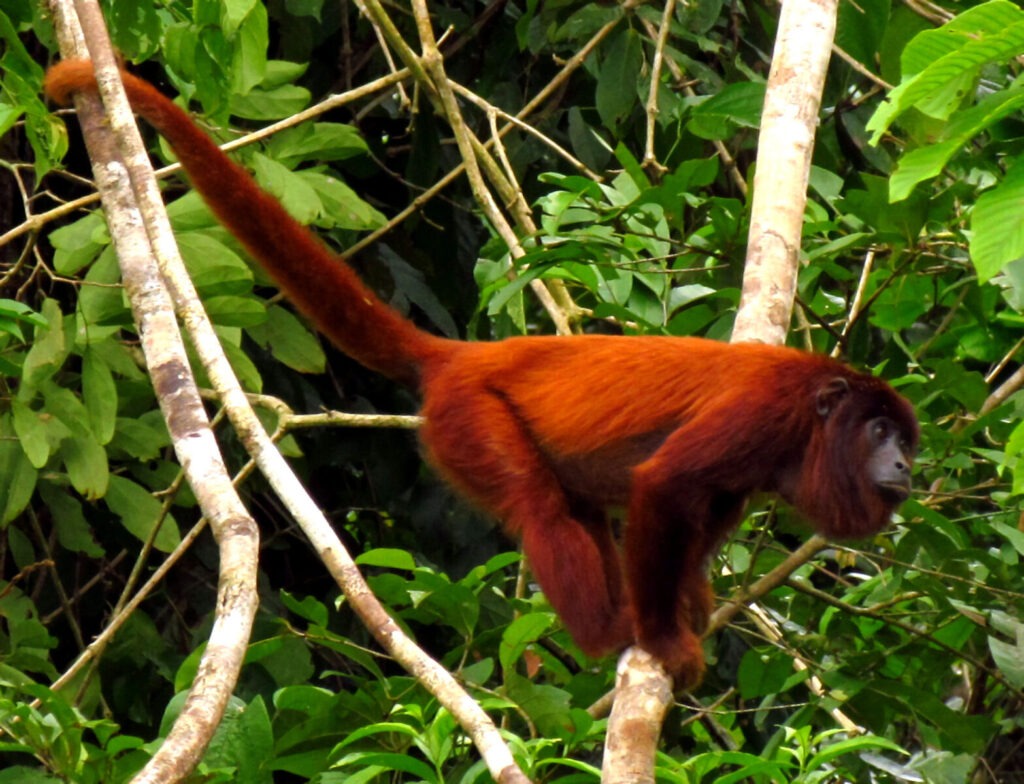
🐒 Howler Monkeys Amazon Rainforest Species List: A Deep Dive into the Loudest Primates
An exhaustive 25-chapter documentation dissecting the biology, acoustic dominance, specialized diet, and conservation status of the Alouatta genus in the Neotropics.
✏️ Written & Curated by the Atechsur.org Primatology Team | Last Updated: April 1, 2026

Welcome to the ultimate guide on the Howler Monkeys Amazon Rainforest Species List. If you have ever been deep in the heart of the jungle at dawn, you know exactly why these creatures are legendary. Their roar can travel for miles, shaking the very canopy you stand under. At atechsur.org, we believe that understanding these magnificent primates is the first step toward appreciating the complex biodiversity of the Amazon basin.
The Amazon is home to a staggering variety of life, but few animals command as much presence as the howler monkey. These primates belong to the genus Alouatta and are famous for their specialized enlarged hyoid bones, which act as a resonator for their vocalizations. In this article, we will explore the different species, their unique behaviors, and why they are vital to the health of the rainforest.
- The Three-Mile Roar: A male howler’s call can travel up to 3 miles (4.8 km) through dense foliage, warning rival troops to stay away.
- Prehensile Power: Their tail is a true fifth limb, featuring a hairless tactile pad at the tip capable of supporting their entire body weight.
- Energy Conservation: Digesting toxic leaves takes immense energy; therefore, howlers spend up to 80% of their day resting, moving very little.
- Trichromatic Vision: Like humans, many howler species have full color vision to help them spot the most nutritious, tender red leaves against a green canopy.
Part I: Anatomy and Adaptation (Chapters 1-8)
 1. Taxonomy and the Atelidae Family
Howler monkeys are among the largest New World monkeys. They belong to the genus Alouatta, comprising 15 currently recognized species. They were first formally classified by the French naturalist Bernard Germain de Lacépède in 1799.
They belong to the family Atelidae, sharing this family tree with spider monkeys and woolly monkeys. Members of Atelidae are the largest monkeys in the Americas and are united by their highly evolved, fully prehensile tails, an adaptation absent in Old World monkeys of Africa and Asia.
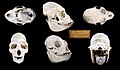 2. Anatomy of the Roar: The Skull and Hyoid

Skull of a red howler monkey (Alouatta seniculus) showing the deep lower jaw needed to house the hyoid bone.
The secret to their incredible volume lies in their specialized throat anatomy. Males, in particular, possess a massively enlarged hyoid bone—a U-shaped bone in the neck that supports the tongue.
In howlers, this bone has evolved into a hollow, bony, balloon-like resonating chamber. When the monkey forces air through its vocal cords, the hyoid bone amplifies the sound exponentially, creating the low-frequency roar. To accommodate this massive bone, their lower jaw (mandible) is exceptionally deep and thick, giving them a distinctively “jowly” appearance.
 3. The Prehensile Tail: A Fifth Limb

Notice the bare, hairless tactile pad on the underside of the tail wrapping the branch.
The howler possesses a true prehensile tail, an evolutionary marvel that functions as a fifth limb. This tail is highly muscular and incredibly strong, often measuring longer than the monkey’s actual body.
Crucially, the underside of the tail’s tip lacks fur and is covered in a bare, highly sensitive tactile pad—much like the palm of a human hand or a fingerprint. This allows the tail to grip branches with immense precision, enabling the heavy monkey to hang entirely upside down to reach tender leaves at the very tips of fragile branches.
 4. Folivory: The Challenge of Eating Leaves

Howlers (like this Alouatta pigra) spend hours slowly chewing tough canopy leaves.
Howler monkeys are the only truly folivorous (leaf-eating) primates in the New World. While leaves are universally abundant in the Amazon, they pose a massive dietary challenge.
Canopy leaves are tough, highly fibrous, low in easily accessible calories, and packed with toxic secondary compounds (like tannins and alkaloids) that trees produce to deter herbivores. To extract nutrients, howlers have large, complex, multi-chambered stomachs and elongated intestines that house specialized bacteria to ferment and slowly break down the cellulose.
 5. Lethargy and Energy Conservation

Digesting toxic leaves requires so much energy that howlers must remain motionless for most of the day.
Because digesting leaves yields so little net energy and takes a massive toll on their metabolism, howler monkeys are famous for their extreme lethargy. In this aspect, their lifestyle is surprisingly similar to the sloths that occupy the same canopy.
A howler monkey troop may spend up to 80% of its day resting or sleeping, draped over thick branches. They rarely engage in the playful, acrobatic swinging or rapid leaps seen in spider monkeys, reserving their limited energy strictly for foraging, grooming, and territorial roaring.
 6. Trichromatic Color Vision
Most New World monkeys exhibit a mix of color vision types, with many males being dichromatic (colorblind to red/green). However, research indicates that howler monkeys have evolved routine trichromatic vision—the same full color spectrum that humans see.
This is believed to be a direct evolutionary result of their strict folivorous diet. Young, tender, highly nutritious leaves (which are easier to digest and have fewer toxins) often have a slight reddish tint, while older, tougher leaves are dark green. The ability to distinguish red from green allows the howler to visually select only the most beneficial foliage without expending energy tasting bad leaves.
 7. Sexual Dimorphism

Males of this species are entirely black, while females remain blonde.
Many species of howler monkeys exhibit profound sexual dimorphism—stark physical differences between males and females. Males are universally larger and possess a much thicker, bearded neck to accommodate their massive hyoid bone.
The most striking visual example is the Black Howler (Alouatta caraya). In this species, adult males are entirely pitch black, while adult females and juveniles of both sexes are a pale blonde or yellowish-buff color.
 8. Quadrupedal Locomotion
Despite their prehensile tail, howlers are not agile brachiators (they don’t swing arm-over-arm like gibbons or spider monkeys). They are slow, deliberate quadrupedal walkers.
They move carefully along the tops of thick branches on all fours, always maintaining a grip with at least two hands/feet and their tail at all times. They rarely leap across gaps, preferring to stretch their bodies across to the next branch, using their tail as an anchor to pull themselves over.
Part II: Social Structure and Behavior (Chapters 9-14)
 9. Troop Dynamics

Howlers live in cohesive social groups, resting in close proximity to reinforce social bonds.
Howlers live in cohesive social groups called troops, typically ranging from 6 to 15 individuals. A troop usually consists of one to three dominant adult males, several females, and their offspring.
Unlike many primate societies where females stay in their birth group for life, in howler troops, both males and females typically emigrate from their birth troop upon reaching sexual maturity. This helps prevent inbreeding but makes establishing a new troop highly competitive.
 10. The Dawn Chorus: Acoustic Defense
For animals that have very little energy to spare, engaging in physical combat over feeding territory is a dangerous and wasteful risk. This is why their roar is so crucial to their survival.
The famous dawn chorus of the howler monkey is essentially an acoustic border patrol. By broadcasting their location and the size/strength of their males every morning, adjacent troops can establish and respect territorial boundaries without ever laying eyes on each other, maintaining harmony in the canopy without wasting calories.
 11. Infanticide and Male Takeovers
While troops avoid each other, internal politics can be violent. When solitary, incoming males attempt to join a new troop, they must often fight the established dominant male for control.
If the new male successfully defeats the resident leader and takes over the troop, he will frequently engage in infanticide, killing the young infants fathered by his predecessor. This brutal reality of nature immediately forces the females back into estrus (heat), allowing the new male to quickly pass on his own genetics.
 12. Reproduction and Maternal Care

A female carrying her infant. The baby clings tightly to the mother’s fur as she navigates the canopy.
Females give birth to a single infant after a gestation period of about six months. For the first few weeks of its life, the infant clings desperately to its mother’s belly.
As the baby grows stronger and heavier, it transitions to riding on her back like a jockey. The mother provides intense, continuous care, nursing the infant and teaching it the complex map of the canopy and which leaves are safe to eat, until it is fully weaned at around one year of age.
 13. Allomothering (Aunt Behavior)
In many howler troops, young infants are of great interest to other females in the group, particularly younger, juvenile females who have not yet had their own babies.
These “aunts” will frequently approach the mother to groom the infant, touch it, and even briefly carry it (a practice known as allomothering). This behavior helps the younger females practice crucial maternal skills they will need later in life, while temporarily relieving the mother of her burden.
 14. Social Grooming (Allogrooming)
Unlike macaques or baboons, which spend hours every day intensely grooming each other to establish social hierarchies, howler monkeys dedicate relatively little time to social grooming (allogrooming).
Because their energy levels are so low due to their folivorous diet, any unnecessary movement is avoided. When grooming does occur, it is usually very brief and focused on areas the monkey cannot reach itself, such as the back of the neck, and serves primarily to reduce tension after a stressful event (like an encounter with a predator).
Part III: Species and Distribution (Chapters 15-20)
 15. The Mantled Howler (A. palliata)

Photographed in the Canal Zone forest of Panama. Notice the golden-brown “mantle” of fur on its sides.
The Mantled Howler is one of the most widely studied and frequently seen species, heavily populated throughout Central America (Costa Rica, Panama) and extending into the northern edges of South America.
They are primarily black but are named for the long, yellowish-brown fringe of hair (the mantle) running along their flanks. Because they inhabit the highly touristed forests of Costa Rica, they are often the first wild primate many eco-tourists ever hear or see.
 16. The Bolivian Red Howler (A. sara)

Photographed at the Serere reserve in Bolivia.
The Bolivian Red Howler is endemic strictly to Bolivia. As the name suggests, it is characterized by its vibrant, brick-red to orange plumage, which helps it blend into the sun-dappled upper canopy of the Amazon basin.
Like many species deep in the Amazon, it is facing increasing pressure from rapid agricultural deforestation, which isolates populations and prevents genetic diversity.
 17. The Brown Howler (A. guariba)

Native to the heavily fragmented Atlantic Forest of southeastern Brazil.
The Brown Howler lives outside the Amazon, primarily inhabiting the Atlantic Forest along the southeastern coast of Brazil.
Because the Atlantic Forest has been decimated by human development (with less than 15% of the original forest remaining), the Brown Howler is heavily threatened. They have also suffered catastrophic population losses in recent years due to outbreaks of Yellow Fever, which is lethal to these primates.
 18. The Red Howler Monkey (A. seniculus)
The Red Howler is perhaps the most iconic species. Their stunning reddish-orange fur makes them stand out against the deep green of the Amazonian leaves. They are widely distributed across the northern parts of South America, including Colombia, Venezuela, and parts of Brazil.
These monkeys are particularly interesting because of their social dynamics. Unlike some other species where only males migrate, both male and female Red Howlers will leave their natal groups to start new ones. This helps maintain genetic diversity within the population.
 19. The Guyanan Red Howler (A. macconnelli)
Native to the Guiana Shield and the northeastern Amazon, the Guyanan Red Howler is a robust primate. They are frequently studied by researchers because they are relatively easy to locate due to their loud morning choruses. They inhabit some of the most pristine parts of the rainforest that remain today.
The Guyanan species is often found in high-canopy trees where they can access the youngest, most nutrient-rich leaves.
 20. The Maranhão Red-handed Howler (A. ululata)
This species is perhaps the most critically endangered on our list. Found in a very limited range in the Brazilian state of Maranhão, they are clinging to survival in the face of massive industrial expansion. Their fur is a mix of black and brown, with the signature red hands.
Conservation groups are working tirelessly to create protected corridors so these monkeys can move between forest patches safely.
Part IV: Threats and Conservation (Chapters 21-25)
 21. Threats from the Ground

Howlers rarely descend to the ground, where they are clumsy and highly vulnerable to big cats.
Howler monkeys almost never willingly descend to the forest floor. They receive all the water they need from the leaves they eat and from drinking water trapped in bromeliads high in the trees.
If forced to cross open ground (usually due to deforestation breaking the canopy), they are slow, awkward, and highly vulnerable to terrestrial predators like Jaguars, Pumas, and, increasingly, packs of feral domestic dogs near human settlements.
 22. Sanctuaries and Rehabilitation

A young howler being cared for at a wildlife sanctuary in Costa Rica after losing its mother.
As human development pushes deeper into the forests, conflict is inevitable. Uninsulated power lines strung through the canopy frequently electrocute adult howlers, often leaving clinging infants orphaned.
Sanctuaries across Central and South America work tirelessly to rescue, rehabilitate, and eventually release these orphans. However, because howlers have highly specialized diets, keeping them alive in captivity requires immense expertise in local botany to ensure they receive the correct, digestible leaves.
 23. The Threat of the Pet Trade

A baby howler rescued by the Jaguar Rescue Centre.
While their booming roars make them less appealing as traditional indoor pets compared to parrots or smaller monkeys, infant howlers are still tragically poached for the illegal wildlife trade, often to be used as photo props for ignorant tourists.
Capturing a baby almost always involves shooting the mother out of the canopy. The stress of captivity and the inability to provide their complex folivorous diet means these poached infants usually die of malnutrition or severe gastrointestinal distress within months.
 24. Conservation Education (Museums)

A howler monkey diorama at the Milwaukee Public Museum, helping educate the public on rainforest ecology.
Public education is vital to stopping the demand for illegal wildlife and raising awareness about deforestation. Natural history museums utilize detailed dioramas to show the public how these animals utilize the canopy, emphasizing that without the trees, the animals cease to exist.
 25. Summary FAQ: The Voice of the Forest
Why do Howler Monkeys howl?
Their incredibly loud roar is an acoustic spacing mechanism. It allows rival troops to establish and maintain territorial boundaries in the dense jungle without resorting to physical, energy-wasting combat.
Are they dangerous to humans?
While they have large canine teeth, they are slow-moving herbivores and naturally avoid humans. They will only become aggressive if directly cornered or if humans attempt to capture their young.
Why are they so lazy?
They aren’t lazy; they are incredibly energy efficient. Digesting the toxic, low-calorie leaves of the canopy takes immense biological effort, forcing them to remain motionless for hours to conserve calories.
Explore our trusted network of partner websites covering directories, encyclopedias, marketplaces, education, and finance.
- This digital encyclopedia is created solely as an educational reference material detailing the ecological behaviors and biology of the howler monkey.
- All included image multimedia content is distributed from the free open-license directory (GNU/Creative Commons Attribution) belonging to the worldwide Wikimedia Commons database and contributing wildlife photographers.
- Ecological statistics and conservation threats discussed are based on scientific consensus within the primatology community.
About the Drafting Team: Atechsur.org Primatology Experts
The scientific biology editorial board of Atechsur.org proactively provides accurate, in-depth scientific reports with a dedication to engaging, humanistic language to foster a deeper understanding of Neotropical primates and rainforest conservation.
© 2026 – Atechsur.org – Complete Howler Monkey Encyclopedia (Chapters 1 – 25)
Alouatta Genus • Neotropical Fauna • Updated: April 1, 2026