
Hell Creek Formation: The Ultimate Encyclopedia of Late Cretaceous Dinosaurs, Fossils & Extinction
A comprehensive 25-chapter guide to the Hell Creek Formation — the world’s most famous Late Cretaceous fossil site spanning Montana, North Dakota, South Dakota, and Wyoming.
✏️ Written & curated by the Atechsur.org Paleontology Team | Last updated: April 23, 2026

The Hell Creek Formation stands as one of the most celebrated Late Cretaceous rock units on Earth. This iconic formation stretches across eastern Hell Creek Montana, western North Dakota, northwestern South Dakota, and northeastern Wyoming in the northern Great Plains of North America.
This in-depth encyclopedia explores every aspect of the Hell Creek Formation — from its geology and stratigraphy to its world-famous Hell Creek dinosaurs (including Tyrannosaurus rex and Triceratops), rich fossil record, and the dramatic Cretaceous–Paleogene (K–Pg) mass extinction. The formation, together with the contemporaneous Lance Formation, documents the final million years of the Mesozoic era and provides critical evidence for the global extinction event triggered by the Chicxulub impact and Deccan Traps volcanism.
📖 Table of Contents – Hell Creek Formation Encyclopedia
- K–Pg Boundary: The top of the Hell Creek Formation contains a thin, iridium-rich clay layer marking the asteroid impact and mass extinction that ended the Cretaceous Period.
- From Swamp to Badlands: During the Maastrichtian, Hell Creek was a humid subtropical floodplain; today these rocks form arid badlands where dinosaur fossils weather out naturally.
- Triceratops Dominance: In many Hell Creek sections, Triceratops represents the most abundant large-bodied dinosaur in detailed fossil censuses.
- Ironstone Concretions: Spherical ironstone “cannonballs” are common and were once mistaken for dinosaur eggs by early fossil collectors in Montana and the Dakotas.
Part I: Geological Foundation of the Hell Creek Formation (Chapters 1–5)
 1. Geographic Extent and Deposition of the Hell Creek Formation

The Hell Creek Formation (blue) and Lance Formation (green) form a continuous latest Cretaceous package across the western interior of North America.
The Hell Creek Formation is a thick sequence of continental sedimentary rocks deposited near the very end of the Cretaceous Period. It crops out extensively across the northern Great Plains, especially in eastern Montana, western North Dakota, northwestern South Dakota, and parts of northeastern Wyoming.
These river-laid sandstones, mudstones, and paleosols accumulated on the western margin of the Great Plains as rivers flowed eastward from the rising Rocky Mountains toward the retreating Western Interior Seaway. Together with the Lance Formation, the Hell Creek Formation preserves one of the most complete records of latest Cretaceous Hell Creek dinosaurs and fossils in North America.
 2. Stratigraphy and the Cretaceous–Paleogene Boundary in Hell Creek

Fox Hills Formation (marine) → Hell Creek Formation (terrestrial) → Fort Union Formation (Paleocene) across the K–Pg boundary.
Stratigraphically, the Hell Creek Formation overlies the marine Fox Hills Formation and is overlain by the Paleocene Fort Union Formation. The lower beds record the transition from shallow marine to fully terrestrial environments as global sea levels fell and the Western Interior Seaway withdrew.
The upper Hell Creek Formation is capped by the Cretaceous–Paleogene boundary clay — a thin, iridium-rich layer containing shocked quartz. This horizon marks the Chicxulub asteroid impact and coincides with Deccan Traps volcanism, directly linking Hell Creek fossils to the global end-Cretaceous mass extinction.
 3. Badlands Erosion and Fossil Exposure in the Hell Creek Formation

Freeze–thaw cycles and summer storms continually expose new Hell Creek dinosaurs and fossils along Hell Creek and other drainages.
Much of the Hell Creek Formation is exposed as rugged badlands. Soft mudstones and sandstones erode rapidly under the harsh climate of the northern Great Plains, allowing paleontologists and fossil collectors to find dinosaur bones in shallow gullies and slopes.
Winter freeze–thaw cycles and intense thunderstorms in Montana, North Dakota, and South Dakota constantly strip away thin layers of rock, bringing Hell Creek fossils to the surface ready for collection.
 4. Reading the Rock Strata of the Hell Creek Formation

Alternating sandstone channels and mudstone floodplain deposits preserve the original Late Cretaceous landscape.
Thick, cross-bedded sand bodies in the Hell Creek Formation represent ancient river channels that migrated across the western interior floodplain. These rivers carried dinosaur carcasses and plant debris downstream and buried them in sand bars.
Overbank mudstones and paleosols record quieter intervals when fine sediment settled on broad floodplains, preserving dinosaur skeletons, plant fossils, and invertebrate shells in low-oxygen conditions.
 5. Surface Weathering and “Popcorn” Textures in Hell Creek

Smectitic clays swell and crack when wet, creating a bumpy surface that helps expose but can also damage shallow Hell Creek fossils.
Many Hell Creek Formation mudstones are rich in smectite clays derived from volcanic ash. These clays expand when wet and contract when dry, producing the characteristic “popcorn” weathering texture seen throughout Hell Creek outcrops.
While this weathering helps expose dinosaur fossils, it can also fracture delicate bones near the surface. Paleontologists must stabilize exposed specimens before the next wet–dry cycle destroys them.
Part II: Flora of the Late Cretaceous Coastal Plain (Chapters 6–10)
 6. Subtropical Coastal Plain Environments of the Hell Creek Formation

Organic-rich shales and low-grade coal layers indicate extensive wetlands that supported abundant plant life and herbivorous dinosaurs.
During the Maastrichtian, the Hell Creek Formation region lay near the western shore of the Western Interior Seaway in a warm, ice-free climate. The coastal plain supported dense forests, riverine woodlands, fern prairies, and peat-forming swamps.
Thick carbonaceous shales and coal seams in the lower Hell Creek and overlying Fort Union Formation record extensive wetlands that later became peat and coal — habitats that sustained large populations of herbivorous Hell Creek dinosaurs.
 7. Paleobotany and the Rise of Angiosperms in Hell Creek

Fossil leaves record a diverse angiosperm flora similar to modern broadleaf forests (Denver Museum of Nature & Science specimen HC179).
By the time the Hell Creek Formation was deposited, flowering plants (angiosperms) had become dominant. Fossil leaves show a variety of dicot taxa, including relatives of modern breadfruit and other broadleaf trees that supported large herds of hadrosaurids and ceratopsids.
 8. Araliaephyllum and Familiar Forest Canopies of Hell Creek

Multi-lobed leaves document that some Hell Creek forests would have looked surprisingly modern.
Many Hell Creek Formation plant fossils belong to families that still exist today, such as the Araliaceae. Leaves of Araliaephyllum preserve detailed venation that helps paleobotanists reconstruct canopy structure and climate.
 9. Ancient Magnolias and Tulip Trees in the Hell Creek Formation

Tulip tree relatives occur in the Hell Creek paleoflora.

Early magnolias were conspicuous in Late Cretaceous forests of the Hell Creek and Lance formations.
Members of the Magnoliaceae, including Magnolia and Liriodendron, are well represented in Hell Creek Formation plant assemblages. These trees bore showy flowers and large seeds that attracted insects, birds, and small mammals — and provided browse for herbivorous dinosaurs.
 10. Aquatic Flora: Nelumbium and Wetland Plants of Hell Creek

Lotus-like aquatic plants flourished in lakes and channels that overlay the Hell Creek beds.
Aquatic plants such as Nelumbium and water ferns occupied ponds, oxbows, and abandoned river channels on the Hell Creek Formation floodplain. Their remains are often found in laminated shales and fine siltstones.
These vegetated water bodies were important habitats for freshwater invertebrates, fish, amphibians, and semi-aquatic reptiles — and supplied water and cover for dinosaurs.
Part III: Dinosaur Fauna of the Hell Creek Formation (Chapters 11–20)
 11. Apex of Late Cretaceous Dinosaur Evolution in Hell Creek

Ceratopsids, hadrosaurids, ankylosaurids, and tyrannosaurids dominated the Maastrichtian landscape of the western interior.
The Hell Creek Formation preserves one of the last non-avian dinosaur communities before their extinction. By this time, sauropods and stegosaurs had disappeared from the region, leaving ceratopsids, hadrosaurids, ankylosaurids, and tyrannosaurids as the dominant large-bodied groups.
This fauna represents the culmination of Late Cretaceous evolutionary trends: heavily armored herbivores, sophisticated chewing mechanisms in hadrosaurids, and extremely specialized apex predators like Tyrannosaurus rex.
 12. Scale of the Giants – Hell Creek Dinosaurs

Fully grown Tyrannosaurus rex exceeded 12 meters in length; its main prey, Triceratops and Edmontosaurus, were similarly massive.
Large dinosaur fossils from the Hell Creek Formation show that fully grown Tyrannosaurus rex could exceed 12 meters in length and weigh several tons. Its main prey species, such as Triceratops and Edmontosaurus, were similarly massive.
Living alongside these giants were smaller theropods, pachycephalosaurs, and ankylosaurs, filling other ecological niches in the complex Hell Creek dinosaur ecosystem.
 13. Dinosaur Diversity Across the Hell Creek Floodplain

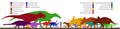
Silhouette chart of the wide range of dinosaur taxa known from the Hell Creek Formation of eastern Montana and adjacent states.
In addition to iconic taxa like Tyrannosaurus and Triceratops, the Hell Creek Formation preserves ornithomimids, pachycephalosaurs, ankylosaurs, small dromaeosaurids, and other dinosaur groups. Many species are known from partial skeletons and isolated elements.
Ongoing fieldwork in northeastern Montana, southeastern Montana, and southwestern North Dakota continues to expand the taxonomic list, demonstrating that Hell Creek dinosaurs were more diverse than once thought.
 14. Hell Creek Dinosaur Census – Abundance Data

Data from the Hell Creek Project summarizing relative abundance of Triceratops, Tyrannosaurus, and other taxa in the fossil record.
The Hell Creek Project, led by the Museum of the Rockies and partner institutions, carried out a large-scale census of dinosaur fossils across sections of the Hell Creek Formation and Lance Formation. Results indicate that Triceratops is the most common large herbivore, while Tyrannosaurus is unexpectedly abundant for an apex predator.
 15. Tyrannosaurus rex – Apex Predator of the Hell Creek Formation

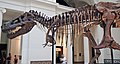
Iconic specimens such as “Sue” and “Stan” were collected from the Hell Creek Formation and Lance Formation of South Dakota and eastern Montana.
The Hell Creek Formation of South Dakota, eastern Montana, and adjacent areas has yielded the most famous Tyrannosaurus rex specimens in the world. Skeletons collected for the American Museum of Natural History, the Museum of the Rockies, and other institutions have become icons of paleontology.
As a taxon, Tyrannosaurus rex combines massive skull strength with keen senses, enabling it to crush bone and hunt large ceratopsids and hadrosaurids in the Hell Creek ecosystem.
 16. Nanotyrannus or Juvenile Tyrannosaurus? The Hell Creek Debate

Small tyrannosaurid skulls from the Hell Creek Formation have sparked debate over whether they represent a separate taxon or growth stages of T. rex.
Several small tyrannosaurid skulls from the Hell Creek Formation and Lance Formation were once assigned to Nanotyrannus lancensis. Some paleontologists argue this represents a distinct, more gracile species.
However, many researchers now interpret these specimens as juvenile T. rex, consistent with a long growth series documented from multiple Hell Creek individuals.
 17. Anzu and the “Chicken from Hell” – Hell Creek Caenagnathids

Large, feathered oviraptorosaurian dinosaurs such as Anzu wyliei lived alongside tyrannosaurids and ceratopsids.
Among the more bird-like dinosaurs of the Hell Creek Formation are caenagnathid oviraptorosaurs, including Anzu wyliei, nicknamed the “Chicken from Hell.” These theropods had toothless beaks, long arms, and likely bore feathers.
Their fossils indicate omnivorous diets and suggest that Late Cretaceous dinosaur faunas included a variety of theropod feeding strategies beyond pure carnivory.
 18. Pterosaurs Above the Hell Creek Floodplain

Fragmentary azhdarchid remains indicate large flying reptiles persisted in western North America until the K–Pg boundary.
Fragmentary remains from the Hell Creek Formation suggest that large azhdarchid pterosaurs, similar to Quetzalcoatlus, lived above the Maastrichtian floodplains. Their bones are fragile and rarely preserved, but available evidence shows pterosaurs persisted right up until the Cretaceous–Paleogene boundary.
 19. Museum Dioramas: Hell Creek Formation Today

A modern badlands diorama with a partially exposed T. rex skeleton explains how fossils emerge from Hell Creek rocks.
Several museums have built detailed dioramas to communicate the geology of the Hell Creek Formation to the public. These exhibits often contrast the dry, eroded badlands of today with the lush floodplain environments of the Late Cretaceous.
 20. Living Hell Creek: 66 Million Years Ago

A companion diorama reconstructs the Hell Creek landscape when Triceratops and Tyrannosaurus rex were still alive.
Companion “living” dioramas place reconstructed dinosaurs within dense magnolia forests, fern undergrowth, and palmetto thickets representative of the Hell Creek Formation paleoflora. These exhibits visualize how plant fossils translate into real ecosystems.
Part IV: Unsung Survivors and the K–Pg Extinction (Chapters 21–25)
 21. Invertebrate Life: Freshwater Mollusks of the Hell Creek Formation

Thick accumulations of bivalve and gastropod shells indicate long-lived freshwater lakes and rivers in the Hell Creek ecosystem.
Beyond dinosaurs, the Hell Creek Formation preserves abundant freshwater mollusks, including unionid clams and various snails. These invertebrates formed an important component of the floodplain food web.
Shell beds formed when storms, floods, or droughts concentrated mollusk remains — providing information about water depth, flow conditions, and habitat stability near the end of the Cretaceous.
 22. Microfossils and Harvester Ant Mounds – Hell Creek

Harvester ants in Harding County build mounds using small clasts, including tiny vertebrate fossils from the Hell Creek beds.
To study tiny vertebrates in the Hell Creek Formation — such as small reptiles, amphibians, and mammals — paleontologists collect microfossils often concentrated in ant hills built from sediment and small pebbles.
By sieving abandoned ant hills, researchers recover a diverse microvertebrate assemblage that complements the larger dinosaur record.
 23. Early Mammals of the Hell Creek Formation
Microfossil localities in the Hell Creek Formation and Lance Formation have produced dozens of mammal taxa, including multituberculates, early marsupials, and basal placental mammals. These animals were typically small, nocturnal, and insectivorous or omnivorous.
Their fossil record across the Cretaceous–Paleogene boundary shows that many mammal groups survived the extinction event and diversified further in the overlying Paleocene Fort Union Formation.
 24. The Chicxulub Impact and the End of the Cretaceous in Hell Creek
At the top of the Hell Creek Formation, the fossil-rich Maastrichtian succession ends abruptly at the Cretaceous–Paleogene boundary layer. This thin horizon records the impact of a roughly 10-kilometer-wide asteroid at Chicxulub on the Yucatán Peninsula.
The impact triggered wildfires, global dust and sulfate aerosols, and a sharp collapse of photosynthesis. In the Hell Creek region and across the northern Great Plains, plant communities, non-avian dinosaurs, and many other organisms disappeared from the fossil record — marking one of the most dramatic mass extinction events in Earth’s history and closing the Mesozoic era.
 25. FAQ: Legacy of the Hell Creek Formation
Where is the Hell Creek Formation located?
The Hell Creek Formation is located in the northern Great Plains of North America, mainly in eastern Montana, western North Dakota, northwestern South Dakota, and northeastern Wyoming. Smaller outcrops also appear in neighboring areas where Late Cretaceous rocks were preserved.
Why is the Hell Creek Formation so important in paleontology?
Hell Creek and the closely related Lance Formation form one of the clearest windows into the last million years of the Cretaceous Period. They yield world-famous dinosaur fossils, well-preserved plant assemblages, and a continuous stratigraphic section through the Cretaceous–Paleogene boundary, making them key reference sections for the end of the Mesozoic era.
What dinosaurs are found in the Hell Creek Formation?
The formation is best known for Hell Creek dinosaurs such as Tyrannosaurus rex, Triceratops, Edmontosaurus, Ankylosaurus, pachycephalosaurs, ornithomimids, small dromaeosaurids, and other theropods. These taxa represent one of the last non-avian dinosaur faunas in North America before the K–Pg extinction.
What kinds of fossils are found in the Hell Creek Formation?
Fossils include dinosaur skeletons, crocodilians, turtles, amphibians, fish, freshwater mollusks, plant remains, microfossils of small mammals and reptiles, and trace fossils such as burrows and coprolites. This broad fossil record allows scientists to reconstruct both the fauna and flora of the latest Cretaceous.
How old is the Hell Creek Formation?
Radiometric ages and biostratigraphic data indicate that the Hell Creek Formation spans roughly 68 to 66 million years ago, during the Maastrichtian stage of the Late Cretaceous, immediately before the global Cretaceous–Paleogene extinction event.
What caused the extinction of the Hell Creek dinosaurs?
Most researchers agree that a combination of the Chicxulub asteroid impact and large-scale volcanism in the Deccan Traps of India drove rapid climate change at the end of the Cretaceous. In the Hell Creek Formation region, these global events caused ecosystem collapse, leading to the extinction of non-avian dinosaurs while some smaller vertebrates survived into the Paleocene.
What was the environment like in Hell Creek during the Late Cretaceous?
During the Maastrichtian, sea levels were falling and the Western Interior Seaway was retreating toward the Gulf of Mexico. The Hell Creek area was a warm, humid, subtropical coastal plain with rivers, floodplains, swamps, and lakes, supporting dense vegetation and abundant vertebrate life.
Can you collect fossils in the Hell Creek Formation?
Fossil collecting regulations vary by land ownership. On U.S. federal and many state lands, vertebrate fossil collecting is restricted to permitted scientific projects. On some private lands in Montana, North Dakota, South Dakota, and Wyoming, owners may allow supervised fossil collecting through commercial or educational digs, but collectors must always obtain explicit permission and follow local laws.
Is the Hell Creek Formation unique to North America?
The Hell Creek Formation itself is restricted to the northern Great Plains of North America, but equivalent Late Cretaceous formations exist on other continents, including units in South America and Asia. Together, these formations help paleontologists compare how dinosaur faunas and ecosystems differed around the world at the end of the Mesozoic era.
Where can I see Hell Creek fossils on display?
Specimens from the Hell Creek Formation and related units are held in major museums such as the Museum of the Rockies, the American Museum of Natural History, the Denver Museum of Nature & Science, and numerous regional museums across Montana, North Dakota, South Dakota, and Wyoming. Many of these institutions display complete dinosaur skeletons and interpretive exhibits about the K–Pg extinction.
Explore our network of partner websites featuring encyclopedias, directories, marketplaces, education portals, and finance resources.
- This digital encyclopedia is intended as educational reference material summarizing the geology, paleontology, and fossil record of the Hell Creek Formation and related units.
- All images are sourced from the public domain or Creative Commons media in the global Wikimedia Commons database, with attribution to the original contributors where required.
- Age estimates, formation correlations (Hell Creek and Lance formations, Fox Hills Formation, Fort Union Formation, Denver Formation, Scollard Formation, Frenchman Formation, Javelina Formation), and extinction timelines are based on current scientific consensus and Geological Society of America publications.
About the Atechsur.org Paleontology Team
The editorial board at Atechsur.org compiles accessible, research-based reports on paleontology, geology, and deep-time ecosystems, with a focus on clarity for students, educators, and science-interested readers.
© 2026 –
Atechsur.org
– Hell Creek Formation Encyclopedia (Chapters 1–25)
Late Cretaceous • Paleontology • Updated: April 23, 2026