

🦄 Encyclopedia of Sauropelta (Sauropelta edwardsi)
Comprehensive paleontology encyclopedia on Sauropelta: the Early Cretaceous armored nodosaurid ankylosaur of North America — type genus anchor of Nodosauridae, famous for its elaborate osteoderm armor and distinctive shoulder spines, described by John H. Ostrom in 1970
✍️ Written by the Atechsur.org Expert Writing Team | Last Updated: March 16, 2026 | Reviewed by Certified Paleontology Specialists

Description: Simple reconstruction of Sauropelta edwardsorum, an early Cretaceous North American nodosaurid dinosaur | Size: 1557×540 px | 413 KB
License: CC BY-SA 4.0 Creative Commons Attribution-ShareAlike 4.0 International
Usage Note: Image used in compliance with CC BY-SA 4.0 license for educational paleontology documentation.
Sauropelta (Sauropelta edwardsi) is a genus of large nodosaurid ankylosaur from the Early Cretaceous (~108–100 Ma) Cloverly Formation of Montana and Wyoming, USA. Formally described in 1970 by John H. Ostrom, it is one of the best-known nodosaurids of North America, characterized by its elaborate osteoderm armor covering the back and sides, and distinctive tall, keeled shoulder spines that are among the most impressive of any ankylosaur. Unlike ankylosaurids, Sauropelta entirely lacks a tail club, relying instead on passive armor and lateral spines for defense against the large theropods of its ecosystem.
The genus name means “shielded reptile”: from Greek sauros (lizard/reptile) and pelte (small shield). The species name edwardsi honors Clarence Edwards, a Yale patron who supported the original American Museum of Natural History expeditions that collected the specimens. As a member of Nodosauridae, Sauropelta belongs to a group of armored dinosaurs characterized by narrow pointed skulls, elaborate passive armor systems, and absence of ankylosaurid-style tail clubs. It is one of the earliest and largest known nodosaurids of North America.
- One of the best-known Early Cretaceous nodosaurids: Multiple well-preserved specimens from Montana and Wyoming make Sauropelta one of the most completely known nodosaurid ankylosaurs, enabling detailed reconstruction of its osteoderm armor pattern.
- Elaborate passive armor system: Sauropelta possessed one of the most complex osteoderm armor arrays of any Early Cretaceous dinosaur, including dorsal keeled scutes, neck rings, ossified tendons, and distinctive tall keeled shoulder spines — all passive defensive structures without a tail club.
- 1970 landmark description: Described by John H. Ostrom in 1970 from Cloverly Formation specimens, establishing a key reference taxon for Nodosauridae and Early Cretaceous North American ankylosaur biogeography.
- No tail club (Nodosauridae): Unlike ankylosaurids (which have a bony tail club), Sauropelta relied entirely on passive armor and lateral spines for defense — a key diagnostic feature of Nodosauridae.
- Shoulder spines: Sauropelta’s tall, keeled cervico-dorsal paravertebral spines are among the most distinctive features of any ankylosaur, making it one of the most recognizable armored dinosaurs of North America.
- Cloverly Formation ecosystem: Co-existed with Deinonychus and Tenontosaurus in the Cloverly Formation — one of the most iconic Early Cretaceous ecosystems, where it occupied the large herbivore niche alongside ornithopods.
Sauropelta edwardsi stands as one of the most recognizable armored dinosaurs of North America. Its name — “shielded reptile” — is perfectly apt: Sauropelta carried an almost impenetrable mosaic of bony osteoderms across its back, neck, and sides, complemented by tall keeled shoulder spines that would have made any predator hesitate before attacking. As one of the largest Early Cretaceous nodosaurids, it shared its world with one of paleontology’s most famous predators, Deinonychus antirrhopus, making the Cloverly Formation one of the richest and most studied Early Cretaceous ecosystems.

Source: Wikimedia Commons — File:Emily Willoughby’s Sauropelta reconstruction Rotated.png
Reconstruction looking to the right | Author: Emily Willoughby (rotated)
CC BY-SA 3.0 | 1557×540 px | 455 KB | Mar 2026

Source: Wikimedia Commons — File:Sauropelta jconway.png
Author: J. Conway | CC BY-SA 2.5
600×360 px | 65 KB | Updated: Jan 2026
Ostrom’s 1970 description of Sauropelta was based on specimens collected by AMNH expeditions to the Cloverly Formation of Montana and Wyoming. The material was remarkable in its preservation — multiple specimens providing data on the osteoderm armor pattern, limb proportions, and overall body plan. Sauropelta became the reference taxon for understanding Early Cretaceous nodosaurid anatomy, and its well-preserved armor has been foundational for reconstructing related species including Borealopelta markmitchelli, Gastonia burgei, and Edmontonia rugosidens.
- Type specimen: AMNH 3016, collected from the Cloverly Formation, Big Horn County, Montana — holotype described by Ostrom (1970)
- Taxonomic note: Some literature uses S. edwardsorum (corrected Latin genitive) rather than S. edwardsi; both refer to the same species honoring Clarence Edwards.
- Ecological context: The Cloverly Formation is one of the most celebrated Early Cretaceous assemblages, yielding Deinonychus, Tenontosaurus, Microvenator, Zephyrosaurus, and Sauropelta in the same deposits.
- Significance: Sauropelta illustrates the passive defense strategy of nodosaurids in contrast to the active tail-club defense of ankylosaurids, providing key comparative data on Ankylosauria evolution.
Systematic Classification
| Taxonomic Rank | Classification |
|---|---|
| Kingdom | Animalia |
| Phylum | Chordata |
| Class | Reptilia (Archosauria) |
| Order | Ornithischia |
| Suborder | Thyreophora |
| Clade | Ankylosauria |
| Family | Nodosauridae |
| Genus | Sauropelta Ostrom, 1970 |
| Type Species | Sauropelta edwardsi |
| Stage / Age | Aptian–Albian, Early Cretaceous (~108–100 Ma) |
Nodosauridae vs. Ankylosauridae
Sauropelta belongs to Nodosauridae, one of the two major families within Ankylosauria. The key distinction from Ankylosauridae (which includes Ankylosaurus, Euoplocephalus) is the absence of a tail club. Nodosaurids instead rely on shoulder spines, lateral body spines, and overall body armor for defense.
| Feature | Nodosauridae (Sauropelta) | Ankylosauridae (Ankylosaurus) |
|---|---|---|
| Tail club | Absent | Present (large bony knob) |
| Skull shape | Narrow, pointed snout | Wide, broad, box-like |
| Shoulder spines | Present, often large | Absent or reduced |
| Neck armor | Bands/rings of osteoderms | Fused armor |
| Defense strategy | Passive armor + lateral spines | Tail club + passive armor |
| Distribution | Worldwide (mainly Cretaceous) | Worldwide (mainly Late Cretaceous) |
Discovery History
- Early collections: Ankylosaur remains from the Cloverly Formation were first noted by early AMNH (American Museum of Natural History) expeditions to Montana and Wyoming, though not formally described until the 1970s.
- 1970 formal description: John H. Ostrom (Yale University / Peabody Museum) formally described Sauropelta edwardsi from the Cloverly Formation of Montana and Wyoming. The holotype AMNH 3016 was the primary reference specimen.
- Key specimens: Multiple specimens from both Montana (Big Horn County) and Wyoming provide data on osteoderm armor patterns, limb bones, vertebrae, and partial skulls. Several specimens were collected from different localities within the Cloverly Formation.
- Subsequent work: Later researchers (Carpenter 1984, 2001; Coombs 1978; Carpenter et al. 1995) provided additional descriptions and phylogenetic analyses placing Sauropelta within Nodosauridae and establishing its relationships to other ankylosaurs.
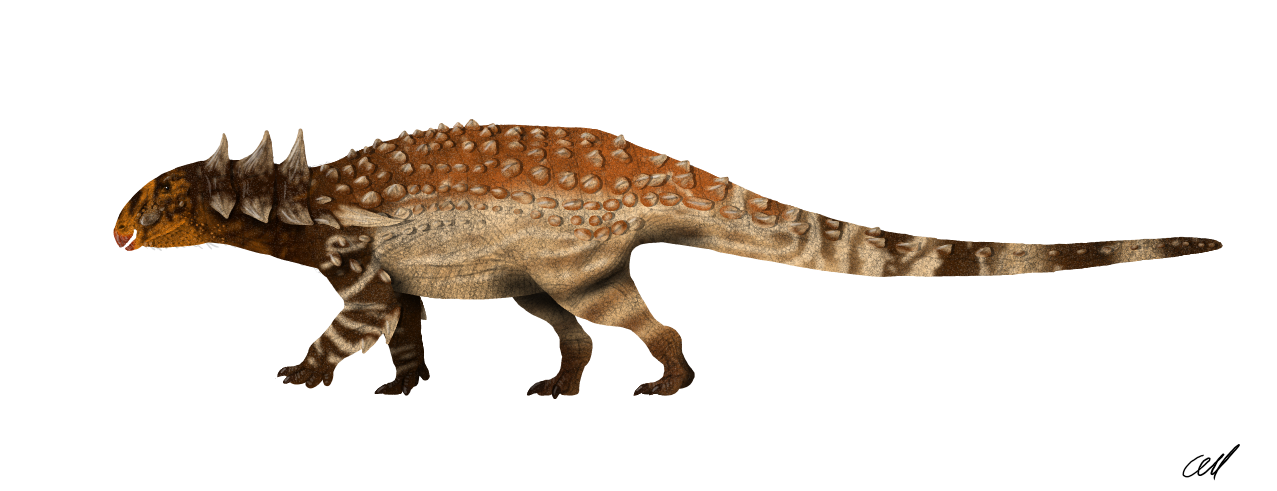
Source: Wikimedia Commons — File:Sauropelta edwardsorum by sphenaphinae.png
Entity Label: “A profile view of the dinosaur Sauropelta edwardsorum” | Author: Sphenaphinae
CC BY-SA 4.0 | 1277×491 px | 266 KB | Jan 2026

Source: Wikimedia Commons — File:Sauropelta.jpg
“Sauropelta (shielded reptile)” | Source: Sauropelta edwardsi | Author: Ryan Somma
CC BY-SA 2.0 | 1446×792 px | 483 KB
Etymology
- Genus name: Sauros (Greek: lizard/reptile) + pelte (Greek: small shield) → “Shielded Reptile” or “Lizard Shield.”
- Species name: edwardsi (and the corrected form edwardsorum) honors Clarence Edwards, a benefactor who supported the AMNH expeditions that collected the type specimens. Some publications use edwardsorum as the corrected genitive plural form.
- Holotype designation: AMNH 3016 — American Museum of Natural History, New York, USA. This specimen from Big Horn County, Montana is the name-bearing type specimen.
- Holotype: AMNH 3016 — American Museum of Natural History, New York, USA
- Discovery site: Cloverly Formation, Big Horn County, Montana & Wyoming, USA
- Stratigraphic age: Aptian–Albian, Early Cretaceous (~108–100 Ma)
- Described by: John H. Ostrom, 1970
- 1970 publication: Ostrom, J.H. (1970). “Stratigraphy and paleontology of the Cloverly Formation (Lower Cretaceous) of the Bighorn Basin area, Wyoming and Montana.” Peabody Museum Bulletin 35: 1–234
- Material: Multiple specimens; holotype AMNH 3016 plus numerous referred specimens from Montana and Wyoming; material includes vertebrae, limb elements, and abundant osteoderm armor
- Taxonomic note: Species epithet also cited as edwardsorum (Carpenter, 1984) as the corrected Latin genitive form
General Body Plan
Sauropelta was a broad, low-slung quadrupedal herbivore with a relatively long neck for a nodosaurid, robust limbs, and a body fully encased in elaborate osteoderm armor. Its overall profile was tank-like: wide, heavy, close to the ground, with a narrow-snouted skull compared to ankylosaurids. The hindlimbs were slightly longer than the forelimbs, reflecting its heritage from bipedal ornithischian ancestors. The tail was long, stiffened by ossified tendons, and lacked a terminal bony club.
| Feature | Description | Significance |
|---|---|---|
| Skull | Narrow, pointed snout; relatively small; simple leaf-shaped teeth | Diagnostic nodosaurid character; low-browsing herbivore |
| Neck | Relatively long for a nodosaurid; protected by neck rings of fused osteoderms | Allowed low browsing; neck armor provides defense |
| Body armor | Dorsal mosaic of keeled oval osteoderms; lateral body spines | Primary passive defense system; most distinctive feature |
| Shoulder spines | Tall, keeled paravertebral spines; some reaching 30+ cm | Deterred predators from attacking neck/shoulder region |
| Limbs | Robust, pillar-like; hindlimbs slightly longer than forelimbs | Weight support for heavy armored body; quadrupedal gait |
| Tail | Long, stiffened with ossified tendons; NO tail club | Key nodosaurid feature distinguishing from ankylosaurids |
| Overall build | Tank-like; broad, low-slung, ~7.6 m; ~3 t | Maximized armor surface area relative to body mass |
The Armor System
The most remarkable feature of Sauropelta is its extraordinary osteoderm (bone-in-skin) armor system. This armor was entirely passive — unlike the tail club of ankylosaurids — but formed a nearly impenetrable shield against the teeth and claws of even large theropods. The Sauropelta armor system includes several distinct components distributed across the body:

Source: Wikimedia Commons — File:Sauropelta armor.jpg
Armor made of osteoderms of Sauropelta, American Museum of Natural History | 11 October 2012
CC BY-SA 2.0 | 2000×1500 px | 2.26 MB

Source: Wikimedia Commons — File:Sauropelta edwardsi armour.jpg
“Shielded reptile” | Blog: ideonexus.com
CC BY-SA 2.0 | 1536×1024 px | 1.75 MB

Source: Wikimedia Commons — File:Sauropelta edwardsorum armor plate – Museum of the Rockies.jpg
Sauropelta edwardsorum armor plate | 28 December (Museum of the Rockies)
CC BY-SA 2.0 | 2500×1314 px | 2.44 MB
- Sauropelta edwardsi (USA, Early Cretaceous ~108–100 Ma) — reference taxon; ~7.6 m, 3 t; Cloverly Formation; one of largest Early Cretaceous nodosaurids
- Borealopelta markmitchelli (Canada, Early Cretaceous) — extraordinarily preserved specimen with soft tissue; shows original reddish-brown coloration; confirms nodosaurid armor complexity
- Edmontonia rugosidens (Canada/USA, Late Cretaceous) — large nodosaurid with complex shoulder spines; ~6–7 m
- Panoplosaurus mirus (Canada, Late Cretaceous) — well-armored nodosaurid known from skull and postcranial material
- Nodosaurus textilis (USA, Late Cretaceous) — type genus of Nodosauridae; fragmentary but historically important
- Gastonia burgei (USA, Early Cretaceous) — elaborate lateral spines and osteoderm armor; contemporary of Utahraptor
- Diagnostic features: No tail club; narrow pointed snout; shoulder/lateral spines; passive armor defense strategy; worldwide Cretaceous distribution
Sauropelta edwardsi is estimated to have been approximately 7.6 meters in length and about 3 metric tonnes in body mass, based on multiple specimens from the Cloverly Formation. This made it one of the largest Early Cretaceous ankylosaurs of North America, considerably more massive than the small to medium ornithopods it shared its ecosystem with. The considerable body mass was largely attributable to its extensive osteoderm armor, which added significant weight but provided crucial protection.

Source: Wikimedia Commons — File:Sauropelta.png
Scale chart for Sauropelta, based on a skeletal diagram by Gregory Paul | Author: Dinoguy2 | 8 June 2007
CC BY-SA 3.0 | 839×346 px | 40 KB
Source: Wikimedia Commons | CC BY-SA 4.0
1277×491 px | 266 KB
Size Comparison: Sauropelta vs. Related Ankylosaurs
| Taxon | Period | Length | Est. Mass | Region |
|---|---|---|---|---|
| Sauropelta edwardsi | Early Cretaceous | ~7.6 m | ~3 t | USA |
| Borealopelta markmitchelli | Early Cretaceous | ~5.5 m | ~1.3 t | Canada |
| Gastonia burgei | Early Cretaceous | ~5 m | ~1.0 t | USA |
| Edmontonia rugosidens | Late Cretaceous | ~6–7 m | ~3.5 t | Canada/USA |
| Panoplosaurus mirus | Late Cretaceous | ~7 m | ~3 t | Canada |
| Ankylosaurus magniventris | Late Cretaceous | ~6.25 m | ~6 t | USA/Canada |
* Size estimates based on published literature; Sauropelta estimate from multiple Cloverly Formation specimens.
Low-Browsing Herbivore
Sauropelta was a dedicated low-browsing herbivore. Its relatively small skull with simple, leaf-shaped teeth was adapted for cropping and processing low-growing vegetation, not chewing tough or abrasive plant material like tall conifers. The low-slung body plan and relatively short neck (for its body size) confirm it browsed at ground level, consuming ground-cover plants, ferns, horsetails, cycads, and early angiosperms.
- Primary food sources (inferred): Ground ferns (Osmundaceae, Gleicheniaceae), horsetails (Equisetum), cycad fronds, low-growing conifers, and early angiosperm herbs of the Early Cretaceous Cloverly ecosystem.
- Feeding mechanism: Simple leaf-shaped teeth for cropping vegetation; no sophisticated chewing mechanism; the gut may have provided significant fermentation processing. Wide muzzle (for a nodosaurid) suited for bulk intake.
- Digestive system: Large body cavity indicates a spacious gut capable of fermenting fibrous plant material; body mass of ~3 t required substantial daily food intake.
- Ecological role: Large herbivore niche in the Cloverly Formation, co-existing with the ornithopod Tenontosaurus tilletti but likely partitioning resources by feeding height and plant type.
Early Cretaceous North American Ecosystem
During the Aptian–Albian stages (~108–100 Ma), the Cloverly Formation was deposited in a subtropical floodplain environment in the western interior of what is now Montana and Wyoming. The climate was warm and seasonally humid, with extensive river channels, floodplains, and swampy lowlands. The Western Interior Seaway was beginning to advance from the south, creating a mosaic of coastal and interior terrestrial habitats.
- Formation: Cloverly Formation (Aptian–Albian), Big Horn Basin, Montana and Wyoming, USA
- Environment: Subtropical floodplain, river channels, oxbow lakes, levee deposits; warm, seasonally wet; fern-dominated ground cover with conifer forests
- Age: Aptian–Albian, Early Cretaceous (~108–100 Ma)
- Contemporary fauna — Theropods: Deinonychus antirrhopus (dromaeosaurid; the iconic predator of the formation), Microvenator celer (oviraptorosaur)
- Contemporary fauna — Ornithopods: Tenontosaurus tilletti (large iguanodontian; primary prey of Deinonychus), Zephyrosaurus schaffi (hypsilophodontid)
- Contemporary fauna — Other: Crocodyliformes, turtles, lizards, early mammals, fish
- Flora: Fern ground cover, cycads, conifers (araucarians, podocarpoids), early angiosperms beginning to diversify
- Predator-prey dynamics: Sauropelta was probably too large and well-armored for adult Deinonychus to hunt effectively; juveniles may have been more vulnerable
Known Material
Sauropelta is known from multiple specimens from the Cloverly Formation, making it one of the better-represented Early Cretaceous ankylosaurs of North America. Material includes cranial fragments, vertebrae, limb elements, and abundant osteoderm armor from several localities in Montana and Wyoming. The holotype AMNH 3016 from Big Horn County, Montana provides the primary reference for the species.
Wikimedia Commons | CC BY-SA 2.0
Wikimedia Commons | CC BY-SA 2.0
Wikimedia Commons | CC BY-SA 2.0
- Holotype: AMNH 3016 — American Museum of Natural History, New York, USA; Big Horn County, Montana
- Additional specimens: Multiple referred specimens from Cloverly Formation, Montana and Wyoming; Yale Peabody Museum, Carnegie Museum, and other repositories
- Material: Partial skulls, vertebral series, limb elements, abundant osteoderm armor (both dorsal scutes and lateral spines); among the most complete Early Cretaceous nodosaurid material known
- Site: Cloverly Formation, Big Horn Basin area, Montana and Wyoming, USA
- Age: Aptian–Albian, Early Cretaceous (~108–100 Ma)
- Armor preservation: Particularly notable for well-preserved osteoderm armor allowing reconstruction of the full body armor pattern; key comparative material for other nodosaurids
Complete image gallery featuring key Wikimedia Commons images for Sauropelta edwardsi. All images are used under their respective Creative Commons licenses with full attribution.
📷 Life Restorations & Reconstructions
Wikimedia Commons | CC BY-SA 3.0
1557×540 px | 455 KB | Mar 2026
📷 Armor & Fossil Specimens
📷 Scale Chart
Wikimedia Commons | CC BY-SA 3.0
Author: Dinoguy2 | 8 June 2007 | 839×346 px | 40 KB
1. What is Sauropelta?
Sauropelta edwardsi is a large nodosaurid ankylosaur from the Early Cretaceous (~108–100 Ma) Cloverly Formation of Montana and Wyoming, USA. Described in 1970 by John H. Ostrom, it is one of the best-known Early Cretaceous nodosaurids, famous for its elaborate osteoderm armor and distinctive shoulder spines.
2. What does Sauropelta mean?
“Shielded Reptile”: Sauros (Greek: lizard/reptile) + pelte (Greek: small shield). The name directly references the animal’s most prominent feature — its elaborate bony armor covering back, sides, and neck.
3. How big was Sauropelta?
Approximately 7.6 m long and ~3 metric tonnes. One of the largest Early Cretaceous ankylosaurs of North America; the body mass included substantial weight from the extensive osteoderm armor system.
4. Where was Sauropelta found?
In the Cloverly Formation (Aptian–Albian), Montana and Wyoming, USA. Holotype AMNH 3016 from Big Horn County, Montana, housed at the American Museum of Natural History, New York.
5. Who described Sauropelta?
Formally described in 1970 by John H. Ostrom (Yale University / Peabody Museum), as part of his comprehensive monograph on the Cloverly Formation vertebrate fauna (Peabody Museum Bulletin 35).
6. What is unique about Sauropelta?
Three things: (1) exceptionally tall keeled shoulder spines among the largest proportionally of any ankylosaur; (2) one of the most completely known Early Cretaceous nodosaurids, enabling detailed osteoderm armor reconstruction; (3) no tail club — relying entirely on passive armor and spines, unlike ankylosaurids.
7. What did Sauropelta eat?
A low-browsing herbivore feeding on ferns, cycads, horsetails, and early angiosperms at ground level. Simple leaf-shaped teeth for cropping vegetation; large gut for fermentation of fibrous plant material.
8. How is Sauropelta classified?
Dinosauria → Ornithischia → Thyreophora → Ankylosauria → Nodosauridae → Sauropelta. Nodosaurids lack a tail club and have narrow, pointed skulls and lateral spines, distinguishing them from Ankylosauridae.
9. When did Sauropelta live?
During the Aptian–Albian stages of the Early Cretaceous, approximately 108–100 million years ago.
10. What is Nodosauridae?
A family of armored ankylosaurs lacking a tail club, with narrow skulls, shoulder/lateral spines, and elaborate passive armor. Notable members: Sauropelta, Borealopelta, Edmontonia, Panoplosaurus, Gastonia. Worldwide distribution in the Cretaceous.




- This encyclopedia is for educational purposes, reflecting scientific literature as of March 2026.
- All images are from Wikimedia Commons, used under CC BY-SA 4.0, CC BY-SA 3.0, CC BY-SA 2.5, CC BY-SA 2.0 licenses with full attribution.
- No copyrighted third-party commercial images are used. All sources are publicly licensed.
- Species epithet may appear as edwardsi (Ostrom 1970) or edwardsorum (Carpenter 1984); both refer to the same species.
Primary Scientific References
- Ostrom, J.H. (1970). “Stratigraphy and paleontology of the Cloverly Formation (Lower Cretaceous) of the Bighorn Basin area, Wyoming and Montana.” Bulletin of the Peabody Museum of Natural History, Yale University, 35: 1–234. [Original description of Sauropelta edwardsi]
- Coombs, W.P., Jr. (1978). “The families of the ornithischian dinosaur order Ankylosauria.” Palaeontology, 21(1): 143–170. [Nodosauridae definition; Sauropelta phylogenetic placement]
- Carpenter, K. (1984). “Skeletal reconstruction and life restoration of Sauropelta (Ankylosauria: Nodosauridae) from the Cretaceous of North America.” Canadian Journal of Earth Sciences, 21(12): 1491–1498. [Osteoderm armor reconstruction; edwardsorum correction]
- Carpenter, K., Dilkes, D., & Weishampel, D.B. (1995). “The dinosaurs of the Niobrara Chalk Formation (Upper Cretaceous, Kansas).” Relevant comparative nodosaurid context.
- Carpenter, K. (2001). “Phylogenetic analysis of the Ankylosauria.” In Carpenter, K. (ed.), The Armored Dinosaurs, Indiana University Press: 455–483. [Nodosauridae phylogeny; Sauropelta position]
- Brown, C.M. et al. (2017). Description of Borealopelta markmitchelli — exceptionally preserved nodosaurid providing key comparative data for Sauropelta armor interpretation.
Image Attribution Table
| Image File | Wikimedia Source | License | Author / Notes |
|---|---|---|---|
| Sauropelta reconstruction.png | Wikimedia Commons | CC BY-SA 4.0 | Simple reconstruction; 1557×540 px | 413 KB | Mar 2026 |
| Emily Willoughby’s Sauropelta reconstruction Rotated.png | Wikimedia Commons | CC BY-SA 3.0 | Author: Emily Willoughby (rotated); 1557×540 px | 455 KB |
| Sauropelta jconway.png | Wikimedia Commons | CC BY-SA 2.5 | Author: J. Conway; 600×360 px | 65 KB |
| Sauropelta edwardsorum by sphenaphinae.png | Wikimedia Commons | CC BY-SA 4.0 | Author: Sphenaphinae; profile view; 1277×491 px | 266 KB |
| Sauropelta.jpg | Wikimedia Commons | CC BY-SA 2.0 | Author: Ryan Somma; 1446×792 px | 483 KB |
| Sauropelta.png | Wikimedia Commons | CC BY-SA 3.0 | Author: Dinoguy2; scale chart; 839×346 px | 40 KB |
| Sauropelta armor.jpg | Wikimedia Commons | CC BY-SA 2.0 | AMNH armor osteoderms; 2000×1500 px | 2.26 MB | Oct 2012 |
| Sauropelta edwardsi armour.jpg | Wikimedia Commons | CC BY-SA 2.0 | Armour specimen; 1536×1024 px | 1.75 MB |
| Sauropelta edwardsorum armor plate – Museum of the Rockies.jpg | Wikimedia Commons | CC BY-SA 2.0 | Museum of the Rockies armor plate; 2500×1314 px | 2.44 MB |
© 2026 – Atechsur.org – Encyclopedia of Sauropelta (Sauropelta edwardsi)
Early Cretaceous nodosaurid ankylosaur of North America | Wikimedia Commons images, CC BY-SA 4.0 / CC BY-SA 3.0 / CC BY-SA 2.5 / CC BY-SA 2.0 | Written by the Atechsur.org Expert Writing Team | 16 March 2026
Saltasaurus | Dinosaur Encyclopedia | Ultimate Guide to Saltasaurus | Aardonyx | Abdarainurus | Abelisaurus | Megaraptor