

🦕 Encyclopedia of Megaraptor (Megaraptor namunhuaiquii)
Comprehensive paleontology encyclopedia on Megaraptor: the Late Cretaceous megaraptoran theropod of Patagonia, Argentina — type genus of Megaraptoridae, famous for its enormous forelimb sickle claw, originally described as a giant raptor by Fernando Novas in 1998
✍️ Written by the Atechsur.org Expert Writing Team | Last Updated: March 16, 2026 | Reviewed by Certified Paleontology Specialists

Description: Illustration of Megaraptor tracking a large sauropod; restored based on megaraptoran hypothesis | Size: 4179×2489 px | 5.82 MB
License: CC BY-SA 4.0 Creative Commons Attribution-ShareAlike 4.0 International
Usage Note: Image used in compliance with CC BY-SA 4.0 license for educational paleontology documentation.
Megaraptor (Megaraptor namunhuaiquii) is a genus of large tetanuran theropod dinosaur from the Late Cretaceous (~90–85 Ma) of Patagonia, Argentina. Formally described in 1998 by Fernando E. Novas, it is the type genus of the family Megaraptoridae and was originally — and controversially — interpreted as a giant dromaeosaurid. Its most defining feature is an enormous sickle-shaped claw (~33 cm) on the first digit of its forelimb, originally mistaken for a pedal (foot) claw similar to that of dromaeosaurids. This misidentification led to its initial classification as the largest known raptor, before subsequent postcranial material revealed its true nature.
The genus name means “large thief”: from Greek mega (large) and Latin raptor (thief). The species name namunhuaiquii is derived from Mapuche words namun (foot) and huaiqui (lance/spear) — meaning “foot lance” — referencing the claw originally thought to be a foot weapon. Megaraptoridae, as now understood, encompasses large theropods from Argentina, Australia, and possibly Japan, making Megaraptor the cornerstone of a Gondwana-wide evolutionary lineage of large-clawed predators.
- Type genus of Megaraptoridae: The namesake and type genus of family Megaraptoridae — a group of large-clawed theropods now known from Argentina, Australia, and Japan, representing a major predator lineage of the Cretaceous Gondwana.
- Iconic misidentified claw: Originally described as a giant pedal (foot) sickle claw ~33 cm long that made Megaraptor appear to be the largest known dromaeosaurid — later shown to be a forelimb (hand) claw, fundamentally changing the animal’s classification.
- 1998 landmark description: Described by Fernando E. Novas in 1998; the paper and the subsequent reclassification of the claw as a hand structure (Calvo et al. 2004) are among the most cited events in Argentine theropod paleontology.
- Phylogenetic controversy: One of the most phylogenetically debated theropods ever described — placed at various times in Dromaeosauridae, Coelurosauria, Tyrannosauroidea, Allosauroidea, and now Megaraptoridae (Tetanurae), with different analyses reaching different conclusions.
- Apex predator of the Portezuelo Formation: As an ~8 m theropod, Megaraptor was likely the dominant large carnivore of its Turonian–Coniacian ecosystem in Neuquén, hunting titanosaur sauropods and large ornithopods.
- Patagonian paleobiogeography: Recovered from the Portezuelo Formation, Neuquén Province — in the heart of the world’s richest Late Cretaceous vertebrate fossil sites, sharing its ecosystem with titanosaurs and diverse small theropods.
Few dinosaurs have generated as much scientific controversy per bone as Megaraptor namunhuaiquii. When Fernando Novas described the animal in 1998 from a partial skeleton including what appeared to be a massive foot claw, the paleontological community believed they were looking at the largest dromaeosaurid ever discovered — a raptor that would have dwarfed even Utahraptor. The creature was envisioned as a devastating predator with a sickle-claw foot weapon of enormous proportions, capable of disemboweling titanosaur sauropods. This vision, however, was built on a fundamental misidentification.

Source: Wikimedia Commons — File:Megaraptor TD.png
Entity Label: “Megaraptor: Large thief, Late Cretaceous, South America” | Author: TotalDino
CC BY 4.0 | 2800×1000 px | 1.39 MB | Feb 2026

Source: Wikimedia Commons — File:MegaraptorNV.jpg
Reconstitution de Megaraptor | Author: Foolp | 21 August 2015
CC BY-SA 4.0 | 800×348 px | 73 KB
In 2004, Calvo, Porfiri, and Kellner reanalyzed the specimen and demonstrated that the famous claw belonged to the first digit of the forelimb (hand), not the foot. This revelation transformed Megaraptor from a giant raptor into something else entirely — a large-armed, large-clawed tetanuran theropod of uncertain phylogenetic affinities, eventually placed in its own family Megaraptoridae. The significance of Megaraptor spans several dimensions:
- Type genus of Megaraptoridae: Establishing a family that now includes Australovenator (Australia), Fukuiraptor (Japan), Murusraptor, Aerosteon (Argentina), and potentially others.
- Phylogenetic debate: Megaraptorans have been placed in Coelurosauria, Tyrannosauroidea, Allosauroidea, and Tetanurae incertae sedis in different analyses, making them one of the most phylogenetically contentious theropod groups.
- Gondwanan biogeography: Distribution across South America, Australia, and Asia suggests a Gondwanan origin with later dispersal.
- Forelimb specialization: Enormous forelimb claws suggest a unique predatory strategy unlike most large theropods.
Systematic Classification
| Taxonomic Rank | Classification |
|---|---|
| Kingdom | Animalia |
| Phylum | Chordata |
| Class | Reptilia (Archosauria) |
| Order | Saurischia |
| Suborder | Theropoda |
| Clade | Tetanurae |
| Family | Megaraptoridae (type genus) |
| Genus | Megaraptor Novas, 1998 |
| Type Species | Megaraptor namunhuaiquii |
| Stage / Age | Turonian–Coniacian, Late Cretaceous (~90–85 Ma) |
Phylogenetic Controversy
The phylogenetic position of Megaraptor is one of the most actively debated topics in theropod paleontology. Over its history, it has been assigned to multiple major groups:
- 1998 (original): Placed as a giant dromaeosaurid by Novas, based on the presumed large pedal sickle claw.
- 2004 (reclassification): Calvo et al. showed the claw was from the forelimb; placement shifted to Tetanurae, affinities unclear.
- 2010s analyses: Several phylogenetic analyses placed megaraptorans within Tyrannosauroidea (basal tyrannosauroids), based on shared skull and forelimb characters.
- Alternative placement: Other analyses placed megaraptorans in Allosauroidea or as basal Coelurosauria.
- Current consensus (2020s): Most analyses recover megaraptorans as a distinct clade within Tetanurae of uncertain exact placement, united in the family Megaraptoridae. Their position relative to Tyrannosauroidea vs. Allosauroidea remains contentious as of 2026.
Discovery History
- Discovery: The holotype partial skeleton (MUCPv 595) was discovered in the Portezuelo Formation, Sierra del Portezuelo, Neuquén Province, Patagonia, northwestern Argentina.
- 1998 formal description: Fernando E. Novas (Museo Argentino de Ciencias Naturales “Bernardino Rivadavia”, Buenos Aires) formally described Megaraptor namunhuaiquii and initially classified it as a large dromaeosaurid theropod based on the apparently large foot claw.
- 2004 claw reinterpretation: Calvo, Porfiri, and Kellner reanalyzed the specimen and demonstrated that the large curved element was actually a manual (hand/forelimb) ungual from the first digit — not a foot claw. This fundamentally changed the animal’s interpretation.
- Subsequent discovery: Additional megaraptoran material from Argentina and the description of related genera (Aerosteon, Murusraptor) and international relatives (Australovenator in Australia, Fukuiraptor in Japan) expanded the family significantly.

Source: Wikimedia Commons — File:Megaraptor namunhuaiquii jmallon.jpg
“Originally described as a massive dromaeosaurid, M. namunhuaiquii is now recognized as having been a megaraptoran.”
GFDL / CC BY-SA | 482×530 px | 74 KB | Updated: Mar 2026
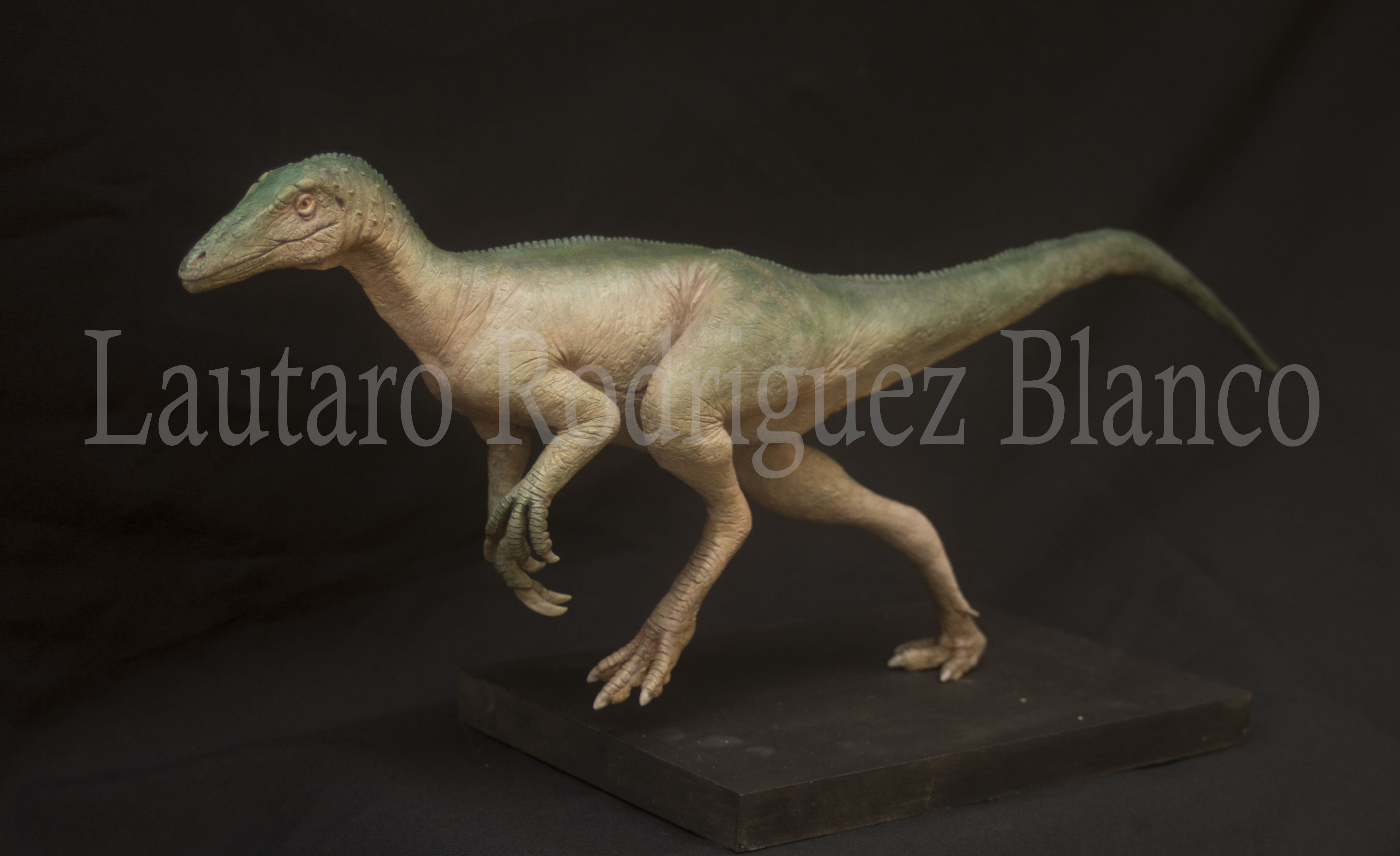
Source: Wikimedia Commons — File:Megaraptor LRB.jpg
Author: Lautaro Rodriguez Blanco | 27 April 2017
CC BY-SA 4.0 | 4955×3029 px | 909 KB
Etymology
- Genus name: Mega (Greek: large/great) + raptor (Latin: thief, plunderer) → “Large Thief” or “Great Plunderer.”
- Species name: namun (Mapuche: foot) + huaiqui (Mapuche: lance, spear) → “Foot Lance” — referencing the enormous claw originally thought to be a pedal weapon.
- Irony of the name: The name namunhuaiquii (“foot lance”) is an ironic artifact of the original misidentification, since the claw turned out to be a forelimb (hand) claw, not a foot claw — yet the name remains valid as the formally published species name.
- Holotype: MUCPv 595 — Museo de la Universidad Nacional del Comahue, Neuquén, Argentina
- Discovery site: Portezuelo Formation, Sierra del Portezuelo, Neuquén Province, Patagonia, Argentina
- Stratigraphic age: Turonian–Coniacian, Late Cretaceous (~90–85 Ma)
- Described by: Fernando E. Novas, 1998
- 1998 publication: Journal of Vertebrate Paleontology 18(1): 4–9
- 2004 claw reinterpretation: Calvo, Porfiri & Kellner; forelimb claw confirmed
- Material: Partial skeleton including fragmentary skull, vertebrae, forelimb elements, hindlimb elements, and the iconic hand claw
General Body Plan
Based on the holotype material and comparisons with related megaraptorans, Megaraptor was a lightly built but large bipedal theropod with notably elongated forelimbs bearing enormous claws, long hindlimbs adapted for running, and a relatively gracile build compared to other large theropods of similar body mass. Unlike abelisaurids (which had vestigial arms) or tyrannosaurids (which had tiny arms), megaraptorans developed extremely large, functional arms — their most distinctive anatomical feature.
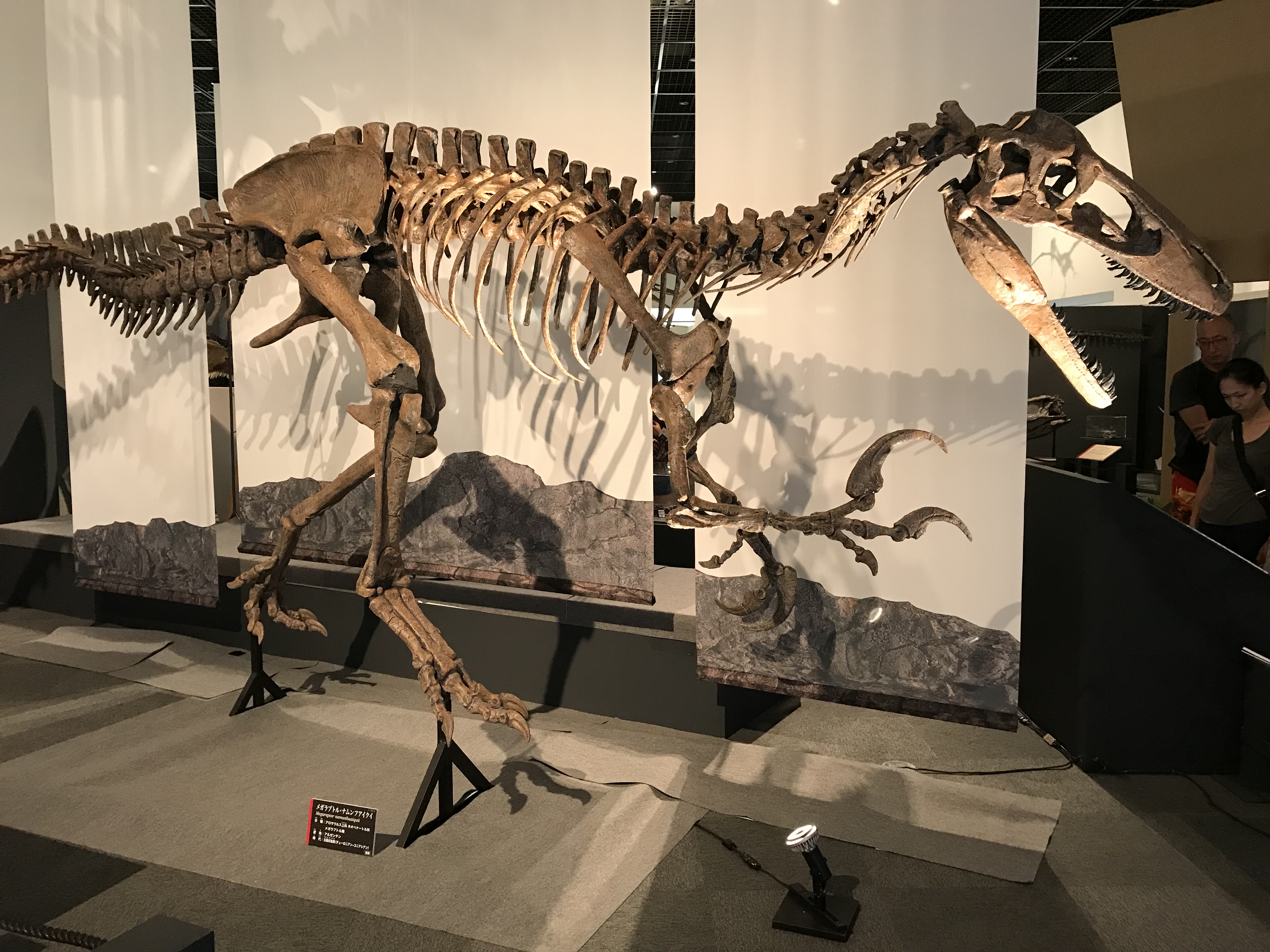
Source: Wikimedia Commons — File:Megaraptor mount.jpg
Megaraptor skeleton | 10 November 2019 | Author: ケラトプスユウタ
CC BY-SA 4.0 | 4032×3024 px | 2.97 MB

Source: Wikimedia Commons — File:Megaraptor whole body skeleton.jpg
Full skeleton display, Dinosaur Expo 2023 | Author: ケケケノケ
CC BY-SA 4.0 | 4032×3024 px | 689 KB
Key Anatomical Characters
| Feature | Description | Significance |
|---|---|---|
| Forelimb | Elongated, functional arms with large manual unguals | Diagnostic megaraptoran character; unique among large theropods |
| Hand claw (Digit I) | Enormous sickle-shaped claw, ~33 cm | Defining megaraptoran feature; originally misidentified as foot claw |
| Hand claws (II & III) | Also large and curved | Multi-claw grasping capability for prey capture |
| Hindlimbs | Long, slender, adapted for cursorial locomotion | Suggests active pursuit predator; does NOT have pedal sickle claws |
| Skull | Only fragmentary skull material known | Long, low skull inferred from megaraptoran relatives |
| Vertebrae | Pneumatized vertebrae with complex internal structure | Weight reduction; possible evidence of air-sac respiratory system |
| Overall build | Relatively gracile for its size; lighter build than typical large theropods | Suggests speed and agility in hunting strategy |
| Feet | Normal theropod feet — NO pedal sickle claw | Confirms original dromaeosaurid interpretation was incorrect |
The Iconic Claw: From Foot to Hand
The story of Megaraptor’s claw is one of the most dramatic reinterpretations in modern vertebrate paleontology. The claw discovered with MUCPv 595 measures approximately 33 cm along the outer curve and is deeply compressed laterally with a sharp, recurved tip — morphology strongly reminiscent of a dromaeosaurid sickle claw. Novas (1998) logically placed it as a pedal element, making Megaraptor a giant raptor. However, when Calvo et al. (2004) examined additional material including forelimb bones, they found the claw was articulated with the first metacarpal of the hand — it was a manual ungual of digit I.

Source: Wikimedia Commons — File:Megaraptor claw cast with scale.JPG
Cast of claw of first digit of Megaraptor namunhuaiquii
CC BY-SA 4.0 | 3048×1604 px | 3.33 MB

Source: Wikimedia Commons — File:Megaraptor claw cast with ruler scale.JPG
Cast of a Megaraptor claw with ruler | Feb 2015
CC BY-SA 4.0 | 3264×2448 px | 2.81 MB

Source: Wikimedia Commons — File:Megaraptor-Kralle.jpg
Megaraptor claw / Megaraptor-Kralle | Author: Haplochromis
CC BY-SA 3.0 | 1443×960 px | 320 KB

Source: Wikimedia Commons — File:Megaraptor hand.jpg
Megaraptor hand fossil | March 2005 | Author: Raffaele Sergi
CC BY 2.0 | 1600×1067 px | 188 KB

Source: Wikimedia Commons — File:Megaraptor bust.png
Juvenile Megaraptor namunhuaiquii, pencil art | Author: Tom Parker | Oct 2015
CC BY-SA 4.0 | 2069×1464 px | 3.31 MB
- Megaraptor namunhuaiquii (Argentina, Late Cretaceous ~90–85 Ma) — type genus; ~8 m, Portezuelo Fm., Neuquén
- Australovenator wintonensis (Australia, Late Cretaceous) — best-known megaraptoran outside South America; ~6 m; confirms Gondwanan distribution
- Fukuiraptor kitadaniensis (Japan, Early Cretaceous) — possibly basal megaraptoran; ~4.2 m; suggests Laurasian extent or early divergence
- Murusraptor barrosaensis (Argentina, Late Cretaceous) — known from good skull material; provides crucial morphological data for Megaraptoridae
- Aerosteon riocoloradensis (Argentina, Late Cretaceous) — associated with evidence of avian-style air-sac respiratory system; ~9 m
- Unresolved phylogeny: Whether Megaraptoridae belongs within Tyrannosauroidea, Allosauroidea, or is a distinct Tetanurae clade remains actively debated as of 2026
Megaraptor namunhuaiquii is estimated to have been approximately 8 meters in length and about 2 metric tonnes in body mass, based on the holotype skeleton and comparison with related megaraptorans. It was notably more lightly built than most large theropods of equivalent length due to its gracile body plan. The holotype MUCPv 595 is considered a subadult or young adult, suggesting even larger individuals may have existed.

Source: Wikimedia Commons — File:Megaraptor namunhuaiquii size chart.png
Author: Megaraptor-The-Allo | CC BY-SA 4.0
3720×1598 px | 414 KB | Oct 2025

Source: Wikimedia Commons — File:Megaraptoridae size chart.png
All known Megaraptoridae members compared | Author: Megaraptor-The-Allo
CC BY-SA 4.0 | 4050×1151 px | 580 KB | Oct 2025
Size Comparison: Megaraptor vs. Related Theropods
| Taxon | Period | Length | Est. Mass | Region |
|---|---|---|---|---|
| Megaraptor namunhuaiquii | Late Cretaceous | ~8 m | ~2 t | Argentina |
| Australovenator wintonensis | Late Cretaceous | ~6 m | ~0.7 t | Australia |
| Aerosteon riocoloradensis | Late Cretaceous | ~8–9 m | ~1.5 t | Argentina |
| Murusraptor barrosaensis | Late Cretaceous | ~6.5 m | ~1.0 t | Argentina |
| Fukuiraptor kitadaniensis | Early Cretaceous | ~4.2 m | ~0.175 t | Japan |
| Abelisaurus comahuensis | Late Cretaceous | ~7–9 m | ~1.5 t | Argentina |
* Size comparisons. Megaraptor estimates are based on holotype MUCPv 595 (possibly subadult) and comparisons with related megaraptorans.

Source: Wikimedia Commons — File:Size of southern predators.png
Giganotosaurus, Abelisaurus, Megaraptor, Majungatholus, Rajasaurus | Author: Ornitholestes
CC BY-SA 3.0 | 2671×1447 px

Source: Wikimedia Commons — File:Megaraptor and Fukuiraptor.jpg
Entity Label: “Megaraptor and Fukuiraptor, the dinosaur expo 2023”
CC BY-SA 4.0 | 4032×3024 px | 2.01 MB
Apex Predator of the Portezuelo Formation
Megaraptor was unquestionably a large carnivore and the likely apex predator of its ecosystem. Its most distinctive hunting adaptation — the enormous forelimb claws — suggests a prey-grasping strategy fundamentally different from the jaw-dominated approach of tyrannosaurids or abelisaurids. With long, powerful arms bearing large curved claws on all three digits, megaraptorans may have used their forelimbs to restrain and slash large prey animals, holding them immobile while using the jaws for killing bites.
- Primary prey (inferred): Large titanosaur sauropods (likely juveniles and subadults), large ornithopods, and other large vertebrates of the Portezuelo Formation — the titanosaurs Cathartesaura, Limaysaurus, and rebbachisaurids occupied the same ecosystem.
- Hunting strategy: The enlarged forelimb with powerful hand claws suggests megaraptorans may have functioned like large eagles or hawks scaled to enormous size — using forelimbs to pin and immobilize prey while delivering killing bites.
- Prey interaction: Unlike tyrannosaurids (primarily jaw hunters with vestigial arms) or abelisaurids (jaw hunters with vestigial arms), megaraptorans invested heavily in forelimb weaponry, suggesting a genuinely different predation style.
- Ecological role: As an ~8 m predator, Megaraptor occupied the apex carnivore niche in the Portezuelo Formation, potentially sharing the ecosystem with the larger carcharodontosaurid Neovenator-related forms and smaller theropods.
Late Cretaceous Patagonian Ecosystem
During the Turonian–Coniacian stages (~90–85 Ma), the Portezuelo Formation of Neuquén was a rich, highly productive terrestrial ecosystem. The environment was characterized by well-developed floodplains, river channel deposits, and warm, humid subtropical conditions. The Neuquén Basin at this time was one of the most biodiverse continental ecosystems known from the Late Cretaceous of South America.
- Environment: Floodplain, river channel, and lacustrine deposits; warm, humid subtropical Late Cretaceous conditions
- Formation: Portezuelo Formation (Sierra del Portezuelo), Río Neuquén Subgroup, Neuquén Group
- Age: Turonian–Coniacian, Late Cretaceous (~90–85 Ma)
- Contemporary fauna — Theropods: Unenlagia comahuiensis (dromaeosaurid), Patagonykus puertai (alvarezsaurid), Neuquenraptor argentinus (dromaeosaurid)
- Contemporary fauna — Sauropods: Limaysaurus tessonei, Cathartesaura anaerobica, Malarguesaurus florenciae (titanosaurs/rebbachisaurids)
- Contemporary fauna — Other: Crocodyliforms, turtles, lizards, fish, diverse invertebrates
- Climate: Warm subtropical; well-watered lowland floodplains in the Neuquén Basin; no ice caps; sea level higher than present
- Paleogeography: South America in the Turonian; partially isolated Gondwanan landmass with intermittent connections; widespread abelisaurids and megaraptorans dominate the large theropod niche
Known Material
The fossil record of Megaraptor is based on the holotype MUCPv 595 and a referred specimen MUCPv 341 (a large tibia). The holotype includes fragmentary cranial material, cervical and dorsal vertebrae, partial forelimb including the iconic hand claw, and partial hindlimb material. Considered by some to represent a subadult individual. Additional isolated theropod material from the Portezuelo Formation has been tentatively associated with Megaraptor but not formally referred.
Wikimedia Commons | CC BY-SA 4.0
Wikimedia Commons | CC BY-SA 4.0
Wikimedia Commons | CC BY 2.0
- Holotype: MUCPv 595 — Museo de la Universidad Nacional del Comahue, Neuquén, Argentina
- Referred specimen: MUCPv 341 — large tibia (provisionally referred)
- Material: Partial skeleton: fragmentary skull, cervical and dorsal vertebrae, partial forelimb (including the famous manual ungual Digit I), and partial hindlimb elements
- Ontogenetic status: Holotype possibly subadult or young adult, based on bone fusion patterns
- Site: Portezuelo Formation (Sierra del Portezuelo), Neuquén Province, Patagonia, northwestern Argentina
- Age: Turonian–Coniacian, Late Cretaceous (~90–85 Ma)
- Claw: The famous curved claw (MUCPv 595) is ~33 cm along outer curve; confirmed as first digit manual ungual
Complete image gallery featuring key Wikimedia Commons images for Megaraptor namunhuaiquii. All images are used under their respective Creative Commons licenses with full attribution.
📷 Life Restorations & Reconstructions
📷 Skeleton Mounts & Museum Specimens
📷 Claw & Forelimb Specimens
1. What is Megaraptor?
Megaraptor namunhuaiquii is a large tetanuran theropod dinosaur from the Late Cretaceous (~90–85 Ma) of Patagonia, Argentina. Described in 1998 by Fernando Novas, it is the type genus of family Megaraptoridae and is famous for an enormous sickle-shaped forelimb claw (~33 cm), originally misidentified as a foot claw.
2. What does Megaraptor mean?
“Large Thief / Foot-Lance”: Mega (Greek: large) + raptor (Latin: thief); species name namunhuaiquii = Mapuche “foot lance” (namun = foot, huaiqui = lance), ironically referencing a claw that turned out to be a forelimb element, not a foot weapon.
3. How big was Megaraptor?
Approximately 8 m long and ~2 metric tonnes. The holotype MUCPv 595 may represent a subadult. The first-digit forelimb claw measures approximately 33 cm along the outer curve — an enormous weapon for prey capture.
4. Where was Megaraptor found?
In the Portezuelo Formation (Turonian–Coniacian), Sierra del Portezuelo, Neuquén Province, Patagonia, northwestern Argentina. Holotype MUCPv 595 is housed at Museo de la Universidad Nacional del Comahue, Neuquén.
5. Who described Megaraptor?
Formally described in 1998 by Fernando E. Novas (Journal of Vertebrate Paleontology 18(1): 4–9). The critical claw reinterpretation was by Calvo, Porfiri & Kellner (2004), who demonstrated the famous claw is a forelimb element.
6. What is unusual about Megaraptor?
Three things: (1) its enormous forelimb claw was originally described as a foot claw, causing a major misclassification; (2) its phylogenetic placement is one of the most debated in theropod paleontology (placed variously in Dromaeosauridae, Coelurosauria, Tyrannosauroidea, Allosauroidea, Tetanurae); (3) it represents a genuinely distinctive predation strategy based on large forelimb weaponry rather than jaw-dominated hunting.
7. What did Megaraptor eat?
As an apex carnivore, Megaraptor hunted titanosaur sauropods, large ornithopods, and other vertebrates of the Portezuelo Formation. Its enormous forelimb claws likely served as grappling and slashing weapons to subdue large prey, complementing jaw-based killing.
8. How is Megaraptor classified?
Currently: Dinosauria → Saurischia → Theropoda → Tetanurae → Megaraptoridae → Megaraptor. It is the type genus of Megaraptoridae. Placement within Tetanurae is most accepted; debate between Tyrannosauroidea and Allosauroidea affinities continues.
9. When did Megaraptor live?
During the Turonian–Coniacian stages of the Late Cretaceous, approximately 90–85 million years ago.
10. What is Megaraptoridae?
A family of large theropods with elongated arms and enormous hand claws, including Megaraptor (Argentina), Australovenator (Australia), Fukuiraptor (Japan), Murusraptor and Aerosteon (Argentina). Their Gondwana-wide distribution reflects vicariance from a common ancestor before continental breakup.


- This encyclopedia is for educational purposes, reflecting scientific literature as of March 2026.
- All images are from Wikimedia Commons, used under CC BY-SA 4.0, CC BY 4.0, CC BY-SA 3.0, CC BY 2.0, GFDL or Public Domain licenses with full attribution.
- No copyrighted third-party commercial images are used. All sources are publicly licensed.
- Phylogenetic placement of Megaraptor within Tetanurae/Megaraptoridae is subject to ongoing debate and may be revised as new specimens are described.
Primary Scientific References
- Novas, F.E. (1998). “Megaraptor namunhuaiquii gen. et sp. nov., a large-clawed, Late Cretaceous theropod from Patagonia.” Journal of Vertebrate Paleontology, 18(1): 4–9.
- Calvo, J.O., Porfiri, J.D., & Kellner, A.W.A. (2004). “On a new maniraptoran dinosaur (Theropoda) from the Upper Cretaceous of Neuquén, Patagonia, Argentina.” Reinterpretation of the Megaraptor claw as a manual ungual.
- Smith, N.D., Makovicky, P.J., Pol, D., Hammer, W.R., & Currie, P.J. (2007). Phylogenetic analyses recovering megaraptorans within Tetanurae.
- Benson, R.B.J., Carrano, M.T., & Brusatte, S.L. (2010). “A new clade of archaic large-bodied predatory dinosaurs (Theropoda: Allosauroidea) that survived to the latest Mesozoic.” Relevant to megaraptoran phylogenetic debates.
- Porfiri, J.D., Novas, F.E., Calvo, J.O., Agnolin, F.L., Ezcurra, M.D., & Cerda, I.A. (2014). “Juvenile specimen of Megaraptor (Dinosauria, Theropoda) sheds light about tyrannosauroid radiation.” New specimens and phylogenetic analysis.
- Canale, J.I. et al. (multiple years). Analyses of Megaraptoridae phylogeny and Gondwanan theropod biogeography.
Image Attribution Table
| Image File | Wikimedia Source | License | Author / Notes |
|---|---|---|---|
| Megaraptor namunhuaiquii.jpg | Wikimedia Commons | CC BY-SA 4.0 | Life illustration tracking sauropod; 4179×2489 px | 5.82 MB |
| Megaraptor TD.png | Wikimedia Commons | CC BY 4.0 | Author: TotalDino; 2800×1000 px | 1.39 MB | Feb 2026 |
| MegaraptorNV.jpg | Wikimedia Commons | CC BY-SA 4.0 | Author: Foolp; 800×348 px | 73 KB |
| Megaraptor LRB.jpg | Wikimedia Commons | CC BY-SA 4.0 | Author: Lautaro Rodriguez Blanco; 4955×3029 px |
| Megaraptor namunhuaiquii jmallon.jpg | Wikimedia Commons | GFDL/CC BY-SA | Sketch restoration by jmallon; 482×530 px |
| Megaraptor bust.png | Wikimedia Commons | CC BY-SA 4.0 | Juvenile head bust, Author: Tom Parker; 2069×1464 px |
| Megaraptor mount.jpg | Wikimedia Commons | CC BY-SA 4.0 | Skeleton mount museum; 4032×3024 px | 2.97 MB |
| Megaraptor whole body skeleton.jpg | Wikimedia Commons | CC BY-SA 4.0 | Full skeleton Dinosaur Expo 2023; 4032×3024 px |
| Megaraptor and Fukuiraptor.jpg | Wikimedia Commons | CC BY-SA 4.0 | Models Dinosaur Expo 2023; 4032×3024 px |
| Megaraptor claw cast with scale.JPG | Wikimedia Commons | CC BY-SA 4.0 | Claw cast digit I; 3048×1604 px | 3.33 MB |
| Megaraptor claw cast with ruler scale.JPG | Wikimedia Commons | CC BY-SA 4.0 | Claw cast with ruler; 3264×2448 px | 2015 |
| Megaraptor-Kralle.jpg | Wikimedia Commons | CC BY-SA 3.0 | Author: Haplochromis; museum claw; 1443×960 px |
| Megaraptor hand.jpg | Wikimedia Commons | CC BY 2.0 | Hand fossil, Author: Raffaele Sergi; 1600×1067 px |
| Megaraptor namunhuaiquii size chart.png | Wikimedia Commons | CC BY-SA 4.0 | Author: Megaraptor-The-Allo; 3720×1598 px |
| Megaraptoridae size chart.png | Wikimedia Commons | CC BY-SA 4.0 | Author: Megaraptor-The-Allo; family comparison; 4050×1151 px |
| Size of southern predators.png | Wikimedia Commons | CC BY-SA 3.0 | Author: Ornitholestes; size comparison; 2671×1447 px |
© 2026 – Atechsur.org – Encyclopedia of Megaraptor (Megaraptor namunhuaiquii)
Late Cretaceous megaraptoran theropod of Argentina | Wikimedia Commons images, CC BY-SA 4.0 / CC BY 4.0 / CC BY-SA 3.0 / CC BY 2.0 | Written by the Atechsur.org Expert Writing Team | 16 March 2026
Abelisaurus | Saltasaurus | Ultimate Guide to Saltasaurus | Dinosaur Encyclopedia | Aardonyx | Abdarainurus