
Table of Contents
🦕
Chubutisaurus insignis — The “Chubut Lizard” of Cretaceous Patagonia
A Complete Visual Encyclopedia: Discovery & Excavation (1961–1975) | Classification History | Physical Description & Osteology | Paleoecology of the Cerro Barcino Formation | Fossil Material & Life Restorations | Size Comparisons | Related Titanosauriforms — with Primary Scientific References, Full-Size Images, Copyright Licenses, and GPS Locations
📑 Table of Contents
🦴 Taxonomic Classification
| Kingdom | Animalia |
| Phylum | Chordata |
| Clade | Dinosauria |
| Order | Saurischia |
| Suborder | Sauropodomorpha |
| Clade | Neosauropoda |
| Clade | Titanosauriformes |
| Clade | Somphospondyli |
| Genus | Chubutisaurus del Corro, 1975 |
| Species | C. insignis |
| Holotype | MACN 18222 |
| Age | Cenomanian (~100–98 Ma) |
| Formation | Bayo Overo Member, Cerro Barcino Fm. |
| Location | Chubut Province, Patagonia, Argentina |
| Length | 18–23 m (59–75 ft) |
| Weight | ~12 tonnes (13 short tons) |
| Diet | Herbivorous |
📖 Introduction
Chubutisaurus (meaning “Chubut lizard”) is a genus of somphospondylan sauropod dinosaur from the Late Cretaceous (Cenomanian stage, ~100–98 million years ago) of the Cerro Barcino Formation, Chubut Province, central Patagonia, Argentina. The type and only species, C. insignis, was described by paleontologist Guillermo del Corro in 1975. Estimated at 18–23 meters (59–75 ft) long and 12 tonnes in weight, it represents one of the most basal somphospondylians — making it a crucial taxon for understanding the early evolution of Titanosauriformes, the clade that would go on to produce the largest land animals in Earth’s history.
The significance of Chubutisaurus lies not only in its size but in its phylogenetic position. A comprehensive 2011 study by Carballido et al., published in the Journal of Vertebrate Paleontology, resolved it as the most basal member of Somphospondyli — the sister group to all other somphospondylians, including the enormously successful Titanosauria. This placement means that Chubutisaurus preserves a snapshot of the ancestral body plan from which tens of thousands of titanosaur species would later diversify across every major landmass during the final 40 million years of the Mesozoic Era. Despite being known from a single incomplete and disarticulated skeleton, it has been the subject of repeated study for over half a century.

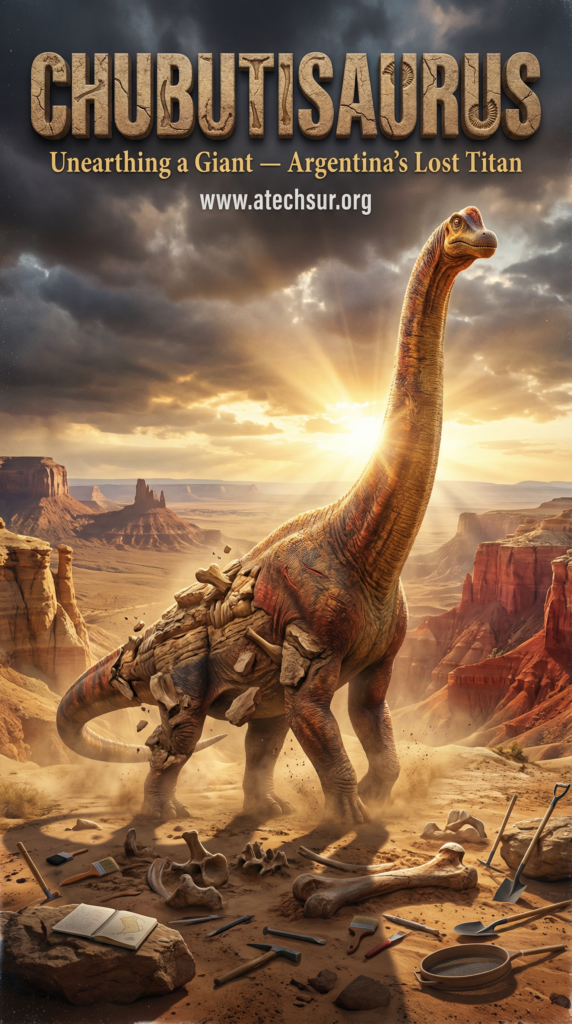
🎨 Chubutisaurus insignis — Life Restoration in Its Late Cretaceous Patagonian Habitat
📄 License: per Wikimedia uploader (2015) | Resolution: 6200 × 3200 px (4.12 MB) | Wikimedia Commons
🔍 Discovery & History
Finding by Mr. Martínez (1961)
Fossils of Chubutisaurus were first discovered in 1961 by Mr. Martínez, a local farmer (sometimes described as a rancher) near the village of El Escorial in Chubut Province, central Patagonia. Martínez noticed large bones eroding out of the rocky hillside on his property but did not know their significance. After his death, his widow informed agronomical engineer Julio Fernández Duque of their existence. Duque recognized the potential scientific importance and contacted Guillermo del Corro, a paleontologist at the Museo Argentino de Ciencias Naturales “Bernardino Rivadavia” (MACN) in Buenos Aires.
Excavation by del Corro (1965)
Starting in February 1965, Duque and del Corro spent 30 days excavating the site near Cerro Barcino and Cerro Winches in the arid scrublands of central Patagonia. The bones were preserved in extremely hard rock — so resistant that the team was forced to use dynamite to extract them, an unfortunately common practice in mid-20th-century paleontology that inevitably damaged some specimens. Despite these difficulties, a substantial quantity of fossil material was recovered. All bones appeared to belong to a single individual sauropod, with the notable exception of five theropod teeth — which del Corro would separately name Megalosaurus inexpectatus in 1966 (now considered a nomen dubium). The collected material was cataloged at the MACN under specimen number MACN 18222. Two fragmentary limb bones were later donated to the Museo Provincial de Ciencias Naturales y Oceanografía in the 1970s.
Formal Description (1975)
Del Corro formally described the remains in 1975 in the proceedings of the I Congreso Argentino de Paleontología y Bioestratigrafía, naming them Chubutisaurus insignis. The generic name derives from Chubut (the province where the fossils were found) and the Greek sauros (“lizard”), a standard suffix for dinosaur names. The specific name insignis comes from the Latin for “remarkable” or “notable”, reflecting the impressive size of the bones. Del Corro originally placed the animal in its own family, “Chubutisauridae” — a classification that did not survive subsequent phylogenetic analyses. Critically, del Corro did not describe or correctly identify many of the elements in his original publication, leading to decades of confusion about the animal’s true anatomy.
Redescriptions (1993–2011)
In 1993, paleontologist Leonardo Salgado published a redescription of Chubutisaurus, reinterpreting several skeletal elements that del Corro had misidentified. However, the most comprehensive study came in 2011, when José Luis Carballido, Oliver W.M. Rauhut, Diego Pol, and Leonardo Salgado published a detailed osteological study in the Journal of Vertebrate Paleontology. The team returned to the original quarry and recovered new materials that they regarded as part of the same specimen (MACN 18222). Additional undescribed elements originally collected by del Corro were also studied for the first time. This work resulted in a more extensive diagnosis and, most importantly, a phylogenetic analysis that resolved Chubutisaurus as the most basal somphospondylian — more primitive than any titanosaur.
1961
Mr. Martínez, a local farmer, discovers fossilized bones near El Escorial, Chubut Province.
February 1965
Julio Fernández Duque and Guillermo del Corro spend 30 days excavating the site using dynamite. Material cataloged as MACN 18222.
1966
Del Corro names five associated theropod teeth Megalosaurus inexpectatus (now nomen dubium).
1975
Del Corro formally describes the sauropod as Chubutisaurus insignis, placing it in its own family “Chubutisauridae.”
1993
Leonardo Salgado redescribes Chubutisaurus, correcting several element identifications.
2002–2004
Wilson (2002) and Upchurch et al. (2004) classify it as a basal titanosaur.
2011
Carballido, Rauhut, Pol & Salgado publish comprehensive osteology; resolve Chubutisaurus as the most basal somphospondylian.
🧬 Classification
Chubutisaurus‘s phylogenetic placement has shifted significantly over time, reflecting both the fragmentary nature of the holotype and the rapidly evolving understanding of sauropod systematics. The 2011 analysis by Carballido et al. is considered the most rigorous treatment to date, resolving it as the sister taxon to all other Somphospondyli — more primitive than Titanosauria proper. This means Chubutisaurus branched off before the evolution of the distinctive titanosaurian features such as procoelous caudal vertebrae and wide-gauge trackways.
| Study / Year | Classification | Key Rationale |
|---|---|---|
| del Corro, 1975 | Own family “Chubutisauridae” | Novel and fragmentary material; no phylogenetic framework |
| Wilson, 2002; Upchurch et al., 2004 | Basal Titanosauria | Shared derived characters with titanosaurs (e.g., opisthocoelous dorsals) |
| Carballido et al., 2011 | Most basal Somphospondyli | Comprehensive osteology; sister to all other somphospondylians |
| NHM (current listing) | Titanosauriformes, Titanosauria | Alternative phylogenetic placement following some analyses |
⚠️ Key Insight: The 2011 analysis by Carballido et al. is particularly significant because it places Chubutisaurus outside Titanosauria proper, as the sister group to all other somphospondylians. This means it preserves the ancestral morphology of the clade from which all titanosaurs — including the colossal Argentinosaurus, Patagotitan, and Dreadnoughtus — ultimately evolved.
📐 Physical Description
Size & Build
Chubutisaurus was a large sauropod dinosaur. In 2010, paleontologist Gregory S. Paul estimated a body length of 18 meters (59 ft) and a mass of approximately 12 tonnes (13 short tons). In 2012, Thomas Holtz provided a higher estimate of 23 meters (75 ft). These differences reflect the difficulty of estimating size from incomplete remains — the holotype lacks a skull, neck vertebrae, and much of the tail. As a somphospondylan, Chubutisaurus would have had the characteristic columnar limbs, long neck, small head, and barrel-shaped torso typical of large sauropods. Its diet was exclusively herbivorous, feeding on conifers, ferns, and other mid-Cretaceous vegetation.
| Parameter | Detail |
|---|---|
| Length | 18 m (Paul, 2010) to 23 m (Holtz, 2012) |
| Weight | ~12 tonnes (13 short tons) |
| Diet | Herbivorous |
| Period | Cenomanian, ~100–98 Ma |
| Formation | Bayo Overo Member, Cerro Barcino Formation |
| Location | Chubut Province, central Patagonia, Argentina |
| Holotype | MACN 18222 — partial disarticulated skeleton |
Distinctive Osteological Features
The holotype (MACN 18222) consists of a partial disarticulated skeleton including: fragments of dorsal (back) vertebrae, a sacral vertebra, eleven caudal (tail) centra, a left femur, tibia, humerus, ulna, radius, four metacarpals, and various appendicular fragments. A distinctive autapomorphic (uniquely diagnostic) feature of Chubutisaurus is the presence of internal laminae within the dorsal vertebral pleurocoels — bony partitions inside the air-filled cavities of the back vertebrae — a structure not observed in any other sauropod. The 2011 study also identified a large rhomboidal fossa ventrally enclosed by both postzygapophyses of the posterior dorsal vertebrae, and noted that Chubutisaurus had a more robust radius than the related North American genus Venenosaurus. Additional material recovered from the original quarry by Carballido’s team (designated MPEF-PV 1129) allowed more precise identification of vertebral positions.
📐 Size Comparison Charts

📐 Chubutisaurus insignis Size Comparison (Human Scale)

📐 Wintonotitan wattsi Size Chart — Uses Chubutisaurus as Reference
🦴 Fossil Evidence
The known fossil material of Chubutisaurus insignis comes from two collection efforts: the original 1965 excavation by del Corro (MACN 18222) and additional material recovered during return fieldwork by Carballido’s team (MPEF-PV 1129). All fossils derive from the Bayo Overo Member of the Cerro Barcino Formation, part of the Chubut Group. The formation is dated to the Cenomanian age (~100–98 Ma) based on invertebrate biostratigraphy. The rock matrix was an extremely hard sandstone, which both preserved the fossils well and made extraction exceptionally difficult — hence the use of dynamite in 1965.

🦴 Chubutisaurus insignis — Fossil Illustration (Dorsal Vertebra / Limb Elements)

🦴 Chubutisaurus — Incomplete Dorsal Vertebra
📋 Image Source Table — Fossil Material
| Image Description & Caption | Source Link & License |
|---|---|
| Fossil illustration — dorsal vertebra / limb elements. Photo by Ghedoghedo (2014). | Wikimedia Commons (JPG, 623 KB) License: CC BY-SA 4.0 |
| Incomplete dorsal vertebra. Photo by Augustios Paleo (2025). | Wikimedia Commons (JPG, 149 KB) License: per uploader |
🌿 Paleoecology
Chubutisaurus inhabited what is now central Patagonia during the early Late Cretaceous (Cenomanian, ~100–98 Ma), when the region was a vegetated floodplain environment with seasonal rivers, shallow lakes, and abundant coniferous forests. The climate was significantly warmer than today, with no permanent ice caps at the poles, and Patagonia lay at a more temperate latitude. The Cerro Barcino Formation has yielded a diverse fossil assemblage indicating a complex mid-Cretaceous ecosystem.
The five theropod teeth found alongside the Chubutisaurus holotype were named Megalosaurus inexpectatus by del Corro in 1966 — now considered a nomen dubium (a name of doubtful validity) because isolated teeth cannot be reliably assigned to a specific theropod genus. These teeth do, however, indicate that large predatory dinosaurs coexisted with Chubutisaurus at the same locality. The contemporary large theropod Tyrannotitan chubutensis — a massive carcharodontosaurid described by Novas et al. in 2005 from the same Cerro Barcino Formation — is estimated at 11.6 meters (38 ft) long and 6–7.4 tonnes. Tyrannotitan is often depicted as a predator of Chubutisaurus in paleoart, and the ecological relationship between these two giant dinosaurs is considered analogous to the predator–prey dynamics between carcharodontosaurids and titanosaurs documented across Gondwana during the mid-Cretaceous.

🎨 Tyrannotitan chubutensis Feeding on Chubutisaurus insignis — Paleoecological Reconstruction
📄 License per uploader (2011) | Wikimedia Commons | Resolution: 1464 × 1231 px (833 KB) | Based on skeletal diagrams
🎨 Life Restorations (Paleoart)
Paleoart depicting Chubutisaurus typically shows a large, robustly built sauropod with columnar limbs, a long neck, a relatively small head, and a long, tapering tail. Because the skull is unknown, artists typically reconstruct it based on closely related somphospondylians. The body plan is generally depicted as less derived than true titanosaurs — with a narrower torso and slightly less wide-gauge stance. The most dramatic paleoart scenes show the predator–prey interaction between Chubutisaurus and the massive carcharodontosaurid Tyrannotitan chubutensis, visualizing the ecological dynamics of the Cenomanian Patagonian ecosystem.
📋 Image Source Table — Life Restorations & Paleoart
| Image Description & Caption | Source Link & License |
|---|---|
| Life restoration — Chubutisaurus in natural habitat (2015). Hero image, 6200 × 3200 px, 4.12 MB. | Wikimedia Commons (JPG, 4.12 MB) License: per uploader |
| Tyrannotitan feeding on Chubutisaurus (2011). 1464 × 1231 px, 833 KB. | Wikimedia Commons (JPG, 833 KB) License: per uploader |
📚 Primary Scientific References
- del Corro, G. (1975). “Un nuevo saurópodo del Cretácico Superior, Chubutisaurus insignis gen. et sp. nov. (Saurischia–Chubutisauridae nov.).” Actas del I Congreso Argentino de Paleontología y Bioestratigrafía, Tucumán, 2: 229–240. — Original description of Chubutisaurus insignis.
- Carballido, J.L.; Rauhut, O.W.M.; Pol, D. & Salgado, L. (2011). “Osteology and phylogenetic relationships of Chubutisaurus insignis del Corro, 1975 (Dinosauria: Neosauropoda) from the ‘middle’ Cretaceous of central Patagonia, Argentina.” Journal of Vertebrate Paleontology, 31(1): 93–110. doi:10.1080/02724634.2011.539651 — Comprehensive osteology; resolved Chubutisaurus as the most basal somphospondylian.
- Salgado, L. (1993). “Comments on Chubutisaurus insignis del Corro (Saurischia, Sauropoda).” Ameghiniana, 30(3): 265–270. — Redescription correcting del Corro’s element identifications.
- Wilson, J.A. (2002). “Sauropod dinosaur phylogeny: critique and cladistic analysis.” Zoological Journal of the Linnean Society, 136(2): 217–276. — Phylogenetic framework placing Chubutisaurus as a basal titanosaur.
- Upchurch, P.; Barrett, P.M. & Dodson, P. (2004). “Sauropoda.” In: Weishampel, D.B.; Dodson, P. & Osmólska, H. (eds.), The Dinosauria (2nd edition). University of California Press, pp. 259–322. — Standard classification reference.
- Paul, G.S. (2010). The Princeton Field Guide to Dinosaurs. Princeton University Press. ISBN 978-0-691-13720-9. — Length estimate of 18 m.
- Holtz, T.R. (2012). “Dinosaurs: The Most Complete, Up-to-Date Encyclopedia for Dinosaur Lovers of All Ages.” Random House. — Length estimate of 23 m.
- Novas, F.E.; de Valais, S.; Vickers-Rich, P. & Rich, T. (2005). “A large Cretaceous theropod from Patagonia, Argentina, and the evolution of carcharodontosaurids.” Naturwissenschaften, 92(5): 226–230. — Description of Tyrannotitan chubutensis, the likely predator of Chubutisaurus.
- del Corro, G. (1966). “Un nuevo dinosaurio carnívoro del Chubut (Argentina): Megalosaurus inexpectatus.” Comunicaciones del Museo Argentino de Ciencias Naturales “B. Rivadavia”, 1(1): 1–4. — Naming of theropod teeth found with Chubutisaurus.
- Bonaparte, J.F. & Gasparini, Z. (1979). “Los saurópodos de los grupos Neuquén y Chubut.” VII Congreso Geológico Argentino, 2: 393–406. — Early comparative study of Patagonian sauropods including Chubutisaurus.
- Poropat, S.F. (2018). “The ‘Chubut lizard’: Chubutisaurus insignis.” Blog article with detailed synthesis. stephenporopat.weebly.com — Accessible overview of collection history and classification.
- Gomez, K.L. et al. (2024). “Unraveling sauropod diversity in the Portezuelo Formation of Patagonia.” PeerJ, 12: e17592. — Recent analysis of sauropod diversity with implications for Chubutisaurus relationships.