

🦄 Encyclopedia of Abrictosaurus (Abrictosaurus consors)
Comprehensive paleontology encyclopedia on Abrictosaurus: the Early Jurassic heterodontosaurid ornithischian dinosaur of South Africa — known for its possible sexual dimorphism in caniniform teeth, Upper Elliot Formation, described by James A. Hopson in 1975
✍️ Written by the Atechsur.org Expert Writing Team | Last Updated: March 16, 2026 | Reviewed by Certified Paleontology Specialists

Description: Life restoration of Abrictosaurus, an Early Jurassic heterodontosaurid dinosaur from South Africa | Size: 1500×977 px | 1,002 KB
Author: LadyofHats (Mariana Ruiz Villarreal) | License: Public Domain Released into the public domain by the author
Usage Note: Image is in the public domain; free for educational and commercial use without restriction.
Abrictosaurus (Abrictosaurus consors) is a genus of small heterodontosaurid ornithischian dinosaur from the Early Jurassic (~199–190 Ma) Upper Elliot Formation of South Africa. Formally described in 1975 by James A. Hopson, it is one of the most scientifically significant members of Heterodontosauridae, a family of early ornithischians characterized by three distinct tooth types (heterodont dentition). Abrictosaurus is particularly notable for the possible absence of caniniform (fang-like) teeth in some specimens, which Hopson and others interpreted as evidence of sexual dimorphism in non-avian dinosaurs — one of the earliest such proposals in vertebrate paleontology.
The genus name means “wide-awake lizard”: from Greek abriktos (awake/not sleeping) + sauros (lizard/reptile). The species name consors means “companion” or “mate” in Latin, reflecting its proposed sexual pairing with tusk-bearing individuals. Abrictosaurus belongs to the basal ornithischian radiation of the southern supercontinent Gondwana, and its occurrence in the Upper Elliot Formation alongside Heterodontosaurus tucki and Lycorhinus angustidens makes the Elliot Formation one of the world’s richest Early Jurassic heterodontosaurid assemblages.
- Possible sexual dimorphism: Abrictosaurus is central to the debate on sexual dimorphism in non-avian dinosaurs — Hopson (1975) proposed that specimens lacking caniniform teeth (NHMUK RU B54) represent females, while tusk-bearing individuals represent males, making this one of the earliest proposals of tooth-based sexual dimorphism in dinosaurs.
- Heterodont dentition: Like all Heterodontosauridae, Abrictosaurus had three distinct tooth types: incisiform front teeth for cropping, large caniniform fangs (in presumed males), and tall cheek teeth (molariforms) for shredding plant material — a highly advanced dental system for an Early Jurassic ornithischian.
- 1975 description by Hopson: Described by James A. Hopson in 1975 from material previously assigned to Lycorhinus consors (Gow, 1975), establishing a new genus based on the lack of caniniforms in the type specimen NHMUK RU B54.
- Upper Elliot Formation assemblage: Co-occurs with Heterodontosaurus tucki and Lycorhinus angustidens in the Upper Elliot Formation — one of the world’s richest Early Jurassic dinosaur assemblages, providing critical data on Gondwanan early ornithischian diversity.
- Small bipedal ornithischian: At ~1.2 m and ~10 kg, Abrictosaurus was a small, agile bipedal dinosaur, representative of the basal ornithischian radiation that gave rise to all later ornithischian diversity including stegosaurs, ankylosaurs, and hadrosaurs.
- Gondwanan biogeography: As a South African heterodontosaurid, Abrictosaurus contributes crucial data on Early Jurassic Gondwanan paleobiogeography, demonstrating the widespread radiation of early ornithischians across the southern supercontinent before it fully fragmented.
Abrictosaurus consors represents one of paleontology’s most intriguing small dinosaurs. Its scientific importance far outweighs its modest size: as a heterodontosaurid, it belonged to a family of early ornithischians that displayed a remarkably sophisticated dental system — three functionally distinct tooth types — that most dinosaurs never evolved. The Upper Elliot Formation where it was found, in what is now the Eastern Cape of South Africa and neighboring Lesotho, has yielded some of the most important Early Jurassic vertebrate material on Earth.
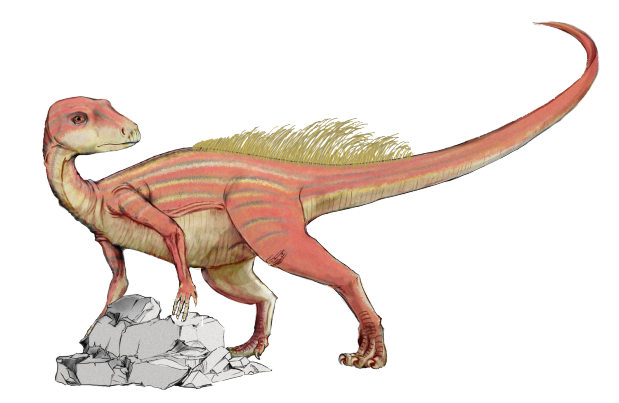
Source: Wikimedia Commons — File:Abrictosaurus dinosaur-removebg-preview.png
Description: Abrictosaurus with transparent background | Source: derived from File:Abrictosaurus dinosaur.png | 26 May 2020
Public Domain | 619×403 px | 204 KB

Source: Wikimedia Commons — File:Abrictosaurus BnW.jpg
Description: Black and white version of the Abrictosaurus | Date: 5 July 2006 | Based on own illustration
Public Domain | 1000×651 px | 135 KB
The key debate surrounding Abrictosaurus is whether the absence of caniniform teeth in specimen NHMUK RU B54 represents sexual dimorphism (females lacking fangs), ontogenetic variation (young individuals lacking fangs), or genuine generic distinctness from Heterodontosaurus. Hopson (1975) argued for sexual dimorphism, and while this interpretation has been challenged by Norman et al. (2011) and others, it remains one of the most cited examples in discussions of dinosaur sexual dimorphism. The Upper Elliot Formation assemblage provides a unique window into Early Jurassic Gondwana, showing diverse heterodontosaurids occupying similar ecological niches in a warm, semi-arid landscape.
- Key specimen: NHMUK RU B54 — Natural History Museum, London (formerly British Museum of Natural History); partial skull in left lateral view, Upper Elliot Formation, South Africa
- Taxonomic note: Originally described as Lycorhinus consors by Gow (1975); immediately re-classified as Abrictosaurus consors by Hopson (1975) in the same year based on the toothless caniniform alveolus.
- Ecological context: The Upper Elliot Formation preserves a diverse Early Jurassic fauna, including Heterodontosaurus tucki, Lycorhinus angustidens, Massospondylus carinatus (large sauropodomorph), and various cynodonts and early mammals.
- Significance: Abrictosaurus provides critical data on basal ornithischian diversity, sexual dimorphism, and the Early Jurassic biogeography of Gondwana.
Systematic Classification
| Taxonomic Rank | Classification |
|---|---|
| Kingdom | Animalia |
| Phylum | Chordata |
| Class | Reptilia (Archosauria) |
| Order | Ornithischia |
| Family | Heterodontosauridae |
| Genus | Abrictosaurus Hopson, 1975 |
| Type Species | Abrictosaurus consors |
| Original combination | Lycorhinus consors Gow, 1975 |
| Stage / Age | Hettangian–Pliensbachian, Early Jurassic (~199–190 Ma) |

Source: Wikimedia Commons — File:Heterodontosauridae evolution.jpg
Showing: heterodontosaurids including Abrictosaurus and Heterodontosaurus in phylogenetic context
CC BY 4.0 | 1512×1595 px | 540 KB | Feb 2026

Source: Wikimedia Commons — File:Sereno 2012 heterodontosauridae cladogram.jpg
Phylogenetic analysis showing Abrictosaurus within Heterodontosauridae (Sereno, 2012)
CC BY 4.0 | 756×510 px | 123 KB
Heterodontosauridae vs. Other Early Ornithischians
| Feature | Heterodontosauridae (Abrictosaurus) | Other Basal Ornithischians |
|---|---|---|
| Tooth types | 3 types: incisiform, caniniform, molariform | Usually 1–2 types |
| Caniniforms | Present (variable; absent in some) | Absent |
| Posture | Bipedal (small body) | Variable |
| Distribution | Worldwide (Triassic–Cretaceous) | Variable by clade |
| Body size | Small (1–2 m typically) | Variable |
| Key South African genera | Abrictosaurus, Heterodontosaurus, Lycorhinus | Massospondylus (sauropodomorph) |
Discovery History
- Fossil collections: Specimens later assigned to Abrictosaurus were collected from the Upper Elliot Formation (Stormberg Group) of South Africa during paleontological surveys of the Karoo Basin.
- 1975 dual description: In 1975, C.E. Gow described the specimen NHMUK RU B54 as Lycorhinus consors. In the same year, James A. Hopson (University of Chicago) independently recognized this specimen as representing a new genus — Abrictosaurus consors — based on the lack of large caniniform teeth, which he interpreted as indicating a female Heterodontosaurus-like animal.
- Key specimen: NHMUK RU B54 (Natural History Museum, London) — a partial skull in left lateral view from the Upper Elliot Formation of South Africa, representing the type specimen.
- Subsequent work: Sereno (1991, 2012), Norman et al. (2011), Butler et al. (2008), and Knoll et al. have provided additional phylogenetic analyses and reinterpretations of Abrictosaurus’s position within Heterodontosauridae and the significance of its tooth morphology.

Source: Wikimedia Commons — File:Abrictosaurus.jpg
Description: Partial skull of Abrictosaurus consors in left lateral view (NHMUK RU B54) | 2012 | Source: Sereno PC (2012) Taxonomy, morphology, masticatory function and phylogeny of heterodontosaurid dinosaurs
CC BY 2.5 | 1479×1095 px | 783 KB

Source: Wikimedia Commons — File:Abrictosaurus skull diagram.jpg
Skull of Abrictosaurus consors from the Lower Jurassic Upper Elliot Formation of South Africa; skull reconstruction
CC BY 4.0 | 1512×986 px | 264 KB
Etymology
- Genus name: Abriktos (Greek: αβρικτος, meaning “awake” / “not sleeping”) + sauros (Greek: lizard/reptile) → “Wide-Awake Lizard”. Named by Hopson (1975) partly in contrast to Lycorhinus (wolf snout), implying the animal is alert rather than fierce.
- Species name: Consors (Latin: companion/mate/partner) — alluding to Hopson’s proposal that this toothless-caniniform specimen represents the female “mate” of the tusk-bearing male Heterodontosaurus tucki.
- Key specimen: NHMUK RU B54 — Natural History Museum, London, United Kingdom. Partial skull in left lateral view; the name-bearing type specimen of the genus.
- Type specimen: NHMUK RU B54 — Natural History Museum, London (NHMUK)
- Discovery site: Upper Elliot Formation (Stormberg Group), Eastern Cape / Lesotho border region, South Africa
- Stratigraphic age: Hettangian–Pliensbachian, Early Jurassic (~199–190 Ma)
- Described by: James A. Hopson, 1975 (University of Chicago)
- Original combination: Lycorhinus consors Gow, 1975 — simultaneously re-assigned to Abrictosaurus consors by Hopson, 1975
- Material: Type specimen NHMUK RU B54 (partial skull); additional referred material from Upper Elliot Formation localities in South Africa and Lesotho
- Repository: Natural History Museum, London (NHMUK), United Kingdom
General Body Plan
Abrictosaurus was a small, lightly built bipedal ornithischian with long hindlimbs adapted for agile, cursorial locomotion, short forelimbs with grasping hands, and a relatively large skull bearing the characteristic heterodont dentition of the family. The overall body plan was typical of basal ornithischians — a compact, agile body designed for quick movement rather than bulk herbivory. Its long tail served as a counterbalance to the front-heavy skull.
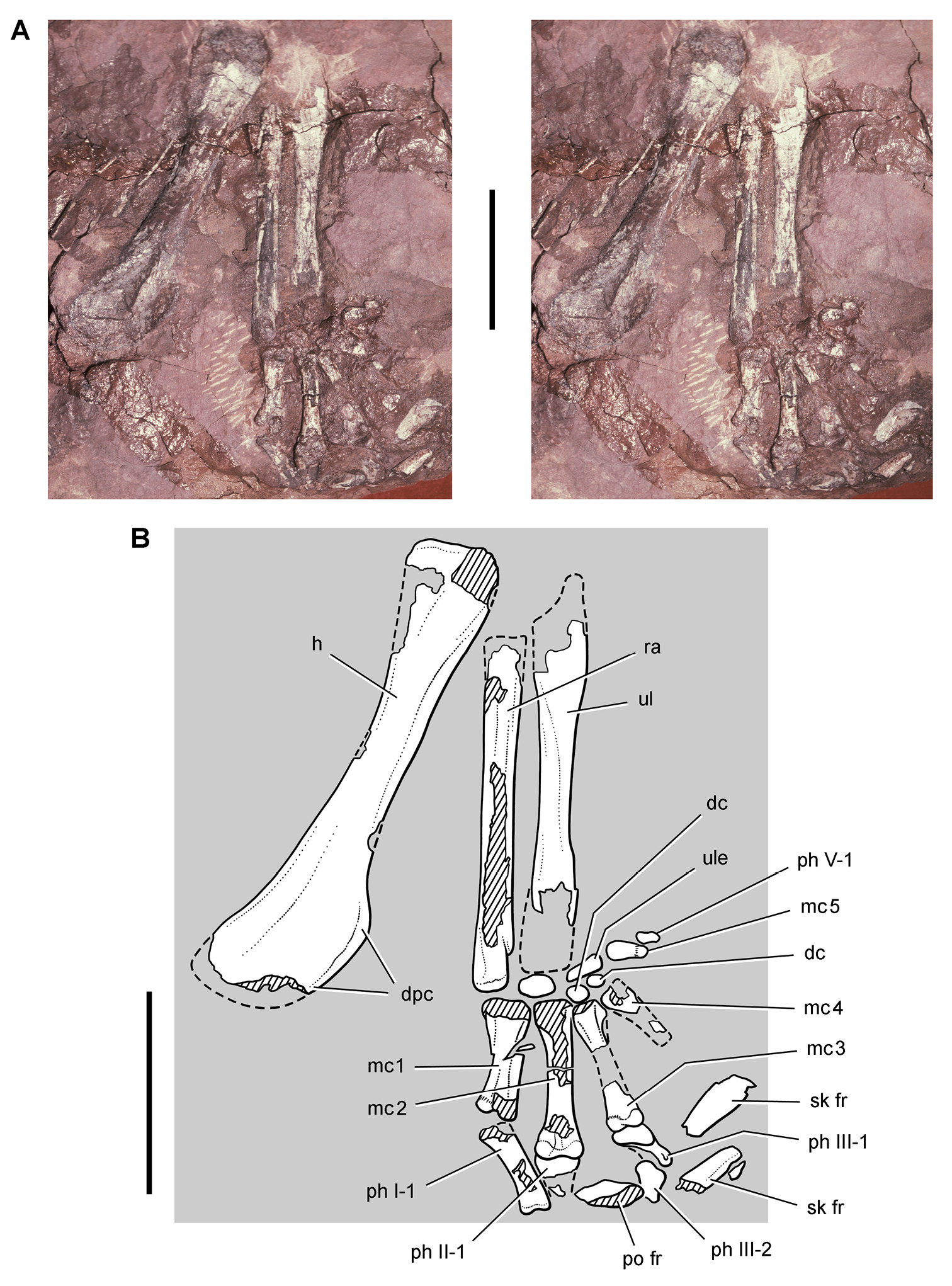
Source: Wikimedia Commons — File:Forelimb of Abrictosaurus.jpg
Forelimb of Abrictosaurus consors from the Lower Jurassic Upper Elliot Formation of South Africa; stereopair
CC BY 4.0 | 1512×2042 px | 1.54 MB
Source: Wikimedia Commons | Public Domain | Author: LadyofHats
1500×977 px | 1,002 KB
| Feature | Description | Significance |
|---|---|---|
| Skull | Relatively large; narrow snout; heterodont dentition; possible absent caniniforms in some specimens | Central to sexual dimorphism debate; diagnostic heterodontosaurid feature |
| Teeth | Incisiforms + (possible) caniniforms + molariforms; NHMUK RU B54 lacks large caniniforms | Key evidence for proposed sexual dimorphism; heterodont dentition |
| Forelimbs | Short; 5-fingered hands with grasping capability; well-preserved in fossil material | Possible food manipulation; manus anatomy well-documented |
| Hindlimbs | Long and slender; well-developed for bipedal locomotion | Cursorial lifestyle; agile locomotion in open Gondwanan environments |
| Tail | Long; stiffened by ossified tendons in some heterodontosaurids | Counterbalance; bipedal posture stability |
| Body size | ~1.2 m; ~10 kg; lightly built | Small ornithischian; comparable to Heterodontosaurus tucki |
The Caniniform Dimorphism Debate
The most scientifically debated aspect of Abrictosaurus is the absence of large caniniform teeth in the type specimen NHMUK RU B54. In Heterodontosaurus tucki and other heterodontosaurids, large, tusk-like caniniform teeth are a prominent feature of the skull. Hopson (1975) proposed that Abrictosaurus simply represents the female morph of the same — or closely related — species, with females lacking the large tusks seen in males.
Source: Wikimedia Commons | CC BY 2.5
Partial skull showing the absence of caniniform (fang) teeth | Sereno (2012)

Source: Wikimedia Commons — File:Heterodontosaur snouts.jpg
Snouts of the heterodontosaurs Heterodontosaurus, Abrictosaurus, and Tianyulong | 2010 | Source: qilong.wordpress
CC BY-SA 3.0 | 3273×729 px | 596 KB | Mar 2026
- Hopson (1975) proposal: Proposed that specimens lacking caniniforms (e.g., NHMUK RU B54) represent females of the heterodontosaurid species, with males bearing the large tusk-like caniniforms seen in Heterodontosaurus tucki. This was one of the first proposals of dental sexual dimorphism in non-avian dinosaurs.
- Argument for dimorphism: The absence of caniniforms in some specimens, with all other skull features being similar, parallels sexual dimorphism seen in modern mammals (e.g., pigs, deer, narwhals) where tusks/horns are male-only features used in display or combat.
- Alternative: ontogenetic variation: Norman et al. (2011) and other researchers proposed that the lack of caniniforms may reflect juvenile age rather than sex, with younger animals lacking the fully developed tusks seen in mature adults.
- Alternative: distinct genus: Some researchers maintain that the morphological differences between Abrictosaurus and Heterodontosaurus are sufficient for generic separation, regardless of the caniniform question.
- Current consensus: The debate remains unresolved. Modern phylogenetic analyses (Sereno 2012; Butler et al. 2008) generally accept Abrictosaurus as a valid genus within Heterodontosauridae, closely related to but distinct from Heterodontosaurus.
- Broader significance: The Abrictosaurus dimorphism debate has been highly influential in discussions of sexual dimorphism across all non-avian dinosaurs, making it one of the most cited cases in the literature.
Abrictosaurus consors is estimated to have been approximately 1.2 meters in length and about 10 kilograms in body mass, based on comparisons with the closely related and better-known Heterodontosaurus tucki and on the proportions of the type specimen NHMUK RU B54. This made it a small but agile bipedal ornithischian, typical of early heterodontosaurids that occupied the small-herbivore niche in Early Jurassic ecosystems.

Scale diagram for Rhynchoraptor, Heterodontosaurus, Abrictosaurus, Manidens, Fruitadens, and Tianyulong | Author: PaleoGeek | 15 April 2018
CC BY-SA 4.0 | 1240×638 px | 103 KB
Size Comparison: Abrictosaurus vs. Other Heterodontosaurids
| Taxon | Period | Length | Est. Mass | Region |
|---|---|---|---|---|
| Abrictosaurus consors | Early Jurassic | ~1.2 m | ~10 kg | South Africa |
| Heterodontosaurus tucki | Early Jurassic | ~1.2 m | ~10 kg | South Africa |
| Lycorhinus angustidens | Early Jurassic | ~1.2 m | ~10 kg | South Africa |
| Fruitadens haagarorum | Late Jurassic | ~0.75 m | ~0.5 kg | USA |
| Tianyulong confuciusi | Late Jurassic | ~0.7 m | ~0.5 kg | China |
| Manidens condorensis | Middle Jurassic | ~0.6 m | ~0.3 kg | Argentina |
* Size estimates based on published literature; Abrictosaurus estimate derived from comparison with Heterodontosaurus tucki and type specimen proportions.
Heterodont Feeding Strategy
Abrictosaurus was primarily a herbivore, but the heterodont dentition of its family suggests a more varied diet than most dinosaurs. The three distinct tooth types of heterodontosaurids — incisiform front teeth for cropping, caniniform fangs (possibly for digging up roots or intraspecific competition), and molariform cheek teeth for shredding plant material — represent one of the most sophisticated dental systems of any Early Jurassic dinosaur. Some researchers have proposed that the large caniniforms were used for root digging (geophage/tuber digging) rather than pure herbivory, which would make heterodontosaurids facultative omnivores.
- Primary food sources (inferred): Ground ferns, horsetails, cycad fronds, early seed plants (gymnosperms), and possibly tubers, roots, and invertebrates in the semi-arid Early Jurassic landscape of South Africa.
- Tooth function: Incisiforms for cropping; molariforms for shredding fibrous plant material; caniniforms (in tusked individuals) possibly used for root digging, bark stripping, or social display/combat.
- Possible omnivory: The powerful jaws and heterodont dentition may have allowed occasional consumption of insects, eggs, or other invertebrates, supporting a facultatively omnivorous diet.
- Feeding posture: Small bipedal body plan with grasping forelimbs suggests the animal could reach ground-level and low-height vegetation; possibly used forelimbs to manipulate food items.
Early Jurassic South African Ecosystem
The Upper Elliot Formation was deposited during the Hettangian–Pliensbachian stages (~199–190 Ma) in what is now the Eastern Cape of South Africa and neighboring Lesotho. The paleoenvironment was a semi-arid to seasonally wet floodplain at a mid-southern paleolatitude on the Gondwana supercontinent, with extensive river systems, ephemeral lakes, and a seasonally stressed vegetation dominated by gymnosperms and ferns.

Source: Wikimedia Commons — File:Heterodontosaurid localities.jpg
Locality map for South Africa and Lesotho; Nosi = Abrictosaurus consors; Mlamli, Tushielaw, Tyinindini = Heterodontosaurus tucki; Bamboeskloof = Lycorhinus
CC BY 4.0 | 1348×804 px | 396 KB | Aug 2025

Source: Wikimedia Commons — File:Heterodontosauridae biogeography.jpg
Worldwide distribution showing Abrictosaurus, Lycorhinus, Heterodontosaurus (Africa) + Asia, Europe, Americas
CC BY 4.0 | 1512×1037 px | 382 KB | Nov 2025
- Formation: Upper Elliot Formation (Hettangian–Pliensbachian), Stormberg Group, Eastern Cape, South Africa & Lesotho
- Environment: Semi-arid to seasonally wet floodplain; river channels, overbank deposits; warm climate with seasonal aridity; Gondwana supercontinent, mid-southern paleolatitude
- Age: Hettangian–Pliensbachian, Early Jurassic (~199–190 Ma)
- Contemporary heterodontosaurids: Heterodontosaurus tucki (with prominent caniniforms; presumed males or distinct species), Lycorhinus angustidens
- Contemporary sauropodomorphs: Massospondylus carinatus (very abundant; large prosauropod); Aardonyx celestae; Arcusaurus pereirabdalorum
- Contemporary fauna: Cynodonts, tritylodontids (mammal-like therapsids), early mammals, crocodyliformes, lepidosaurs
- Flora: Gymnosperms (conifers, cycads, bennettitaleans), ferns (Dicroidium-type), horsetails; no angiosperms yet
- Ecological niche: Small-herbivore (possibly omnivore) niche; agile bipedal forager; prey for larger carnivorous archosaurs and cynodonts
Known Material
Abrictosaurus is known from fragmentary material from the Upper Elliot Formation of South Africa and possibly Lesotho. The type specimen NHMUK RU B54 — a partial skull in left lateral view housed at the Natural History Museum, London — is the primary basis for the genus. Additional referred postcranial material from the Upper Elliot Formation has been tentatively assigned to Abrictosaurus based on size and locality.
Wikimedia Commons | CC BY 2.5 | Sereno (2012)
Wikimedia Commons | CC BY 4.0
Wikimedia Commons | CC BY 4.0
- Type specimen: NHMUK RU B54 — Natural History Museum, London (NHMUK), United Kingdom; partial skull in left lateral view
- Additional material: Referred postcranial elements from Upper Elliot Formation localities in South Africa; forelimb material described from stereopair photographs
- Site: Upper Elliot Formation (Stormberg Group), Eastern Cape, South Africa (specifically Nosi locality) and Lesotho
- Age: Hettangian–Pliensbachian, Early Jurassic (~199–190 Ma)
- Skull preservation: Partial left lateral skull (NHMUK RU B54); lacking prominent caniniforms; key specimen for sexual dimorphism debate; published in detail by Sereno (2012)
- Forelimb: Forelimb of Abrictosaurus consors published with stereopair photograph from Upper Elliot Formation (Wikimedia Commons, CC BY 4.0)
Complete image gallery featuring all Wikimedia Commons images for Abrictosaurus consors and related Heterodontosauridae. All images used under respective Creative Commons or Public Domain licenses with full attribution.
📷 Life Restorations
📷 Fossil Specimens
📷 Heterodontosauridae Family Context
Wikimedia Commons | CC BY-SA 3.0
3273×729 px | 596 KB | Mar 2026
Wikimedia Commons | CC BY 4.0
1512×1595 px | 540 KB | Feb 2026
📷 Biogeography & Localities
Wikimedia Commons | CC BY 4.0
1348×804 px | 396 KB | Aug 2025
📷 Size Comparison
Wikimedia Commons | CC BY-SA 4.0
Author: PaleoGeek | 15 April 2018 | 1240×638 px | 103 KB

Wikimedia Commons | CC BY 4.0
756×792 px | 272 KB | Nov 2020
1. What is Abrictosaurus?
Abrictosaurus consors is a genus of small heterodontosaurid ornithischian dinosaur from the Early Jurassic (~199–190 Ma) Upper Elliot Formation of South Africa. Described in 1975 by James A. Hopson, it is notable for the possible absence of caniniform (fang-like) teeth in some specimens, which has been interpreted as sexual dimorphism.
2. What does Abrictosaurus mean?
“Wide-Awake Lizard”: Abriktos (Greek: awake/not sleeping) + sauros (Greek: lizard/reptile). The species name consors means “companion/mate” in Latin, reflecting Hopson’s proposed sexual pairing interpretation.
3. How big was Abrictosaurus?
Approximately 1.2 m long and ~10 kg. A small, agile bipedal ornithischian comparable in size to the related Heterodontosaurus tucki from the same formation.
4. Where was Abrictosaurus found?
In the Upper Elliot Formation (Hettangian–Pliensbachian, Early Jurassic), South Africa (and possibly Lesotho). Type specimen NHMUK RU B54 is housed at the Natural History Museum, London.
5. Who described Abrictosaurus?
Formally described in 1975 by James A. Hopson (University of Chicago), who re-classified material originally described as Lycorhinus consors by C.E. Gow (1975) in the same year.
6. Did Abrictosaurus have fangs?
The type specimen NHMUK RU B54 lacks large caniniform (fang-like) teeth. Hopson (1975) proposed this represents a female individual lacking the tusks seen in males. This interpretation remains debated — alternatives include ontogenetic variation or genuine generic distinctness.
7. What is Heterodontosauridae?
A family of early ornithischian dinosaurs from the Triassic–Cretaceous, characterized by three distinct tooth types (heterodont dentition): incisiforms, caniniforms, and molariforms. Worldwide distribution; small bipedal herbivores/omnivores. Includes Abrictosaurus, Heterodontosaurus, Fruitadens, Tianyulong, and Manidens.
8. What did Abrictosaurus eat?
Primarily a herbivore feeding on ferns, cycads, and gymnosperms; the heterodont dentition suggests possible facultative omnivory (insects, roots, tubers). Molariform teeth for shredding plant material; incisiforms for cropping.
9. When did Abrictosaurus live?
During the Hettangian–Pliensbachian stages of the Early Jurassic, approximately 199–190 million years ago.
10. Why is Abrictosaurus scientifically important?
Three reasons: (1) key evidence for sexual dimorphism in non-avian dinosaurs; (2) critical for understanding Early Jurassic Gondwanan heterodontosaurid diversity; (3) well-preserved skull material fundamental to heterodontosaurid phylogenetics.




- This encyclopedia is for educational purposes, reflecting scientific literature as of March 2026.
- Primary life restoration images (LadyofHats) are in the Public Domain — free for any use without restriction.
- Fossil specimen and family images from Wikimedia Commons, used under CC BY 4.0, CC BY 2.5, CC BY-SA 4.0, CC BY-SA 3.0 licenses with full attribution.
- No copyrighted third-party commercial images are used. All sources are publicly licensed.
Primary Scientific References
- Hopson, J.A. (1975). “On the generic separation of the ornithischian dinosaurs Lycorhinus and Heterodontosaurus from the Stormberg Series (Upper Triassic) of South Africa.” South African Journal of Science, 71(10): 302–305. [Original description of Abrictosaurus consors]
- Gow, C.E. (1975). “The morphology and relationships of Youngina capensis Broom and Prolacerta broomi Parrington.” Palaeontologia Africana, 18: 89–131. [Original description as Lycorhinus consors]
- Sereno, P.C. (1991). “Lesothosaurus, ‘fabrosaurids,’ and the early evolution of Ornithischia.” Journal of Vertebrate Paleontology, 11(2): 168–197. [Heterodontosauridae phylogeny]
- Butler, R.J., Upchurch, P., & Norman, D.B. (2008). “The phylogeny of the ornithischian dinosaurs.” Journal of Systematic Palaeontology, 6(1): 1–40. [Abrictosaurus within Heterodontosauridae]
- Sereno, P.C. (2012). “Taxonomy, morphology, masticatory function and phylogeny of heterodontosaurid dinosaurs.” ZooKeys, 226: 1–225. [Comprehensive Heterodontosauridae review; skull of Abrictosaurus consors NHMUK RU B54]
- Norman, D.B., Crompton, A.W., Butler, R.J., Porro, L.B., & Charig, A.J. (2011). “The Lower Jurassic ornithischian dinosaur Heterodontosaurus tucki Crompton & Charig, 1962: cranial anatomy, functional morphology, taxonomy, and relationships.” Zoological Journal of the Linnean Society, 163(1): 182–276. [Detailed skull comparison relevant to Abrictosaurus]
Image Attribution Table
| Image File | Wikimedia Source | License | Author / Notes |
|---|---|---|---|
| Abrictosaurus dinosaur.png | Wikimedia Commons | Public Domain | Author: LadyofHats (Mariana Ruiz Villarreal); 1500×977 px | 1,002 KB |
| Abrictosaurus dinosaur-removebg-preview.png | Wikimedia Commons | Public Domain | Derived from above; transparent background; 619×403 px | 204 KB |
| Abrictosaurus BnW.jpg | Wikimedia Commons | Public Domain | Black & white version; 1000×651 px | 135 KB | 5 Jul 2006 |
| Abrictosaurus.jpg | Wikimedia Commons | CC BY 2.5 | Partial skull NHMUK RU B54; Source: Sereno (2012); 1479×1095 px | 783 KB |
| Abrictosaurus skull diagram.jpg | Wikimedia Commons | CC BY 4.0 | Skull diagram Upper Elliot Formation; 1512×986 px | 264 KB |
| Forelimb of Abrictosaurus.jpg | Wikimedia Commons | CC BY 4.0 | Forelimb stereopair Upper Elliot Formation; 1512×2042 px | 1.54 MB |
| Heterodontosaur snouts.jpg | Wikimedia Commons | CC BY-SA 3.0 | Snouts of Heterodontosaurus, Abrictosaurus, Tianyulong; 3273×729 px | 596 KB |
| Heterodontosauridae evolution.jpg | Wikimedia Commons | CC BY 4.0 | Heterodontosauridae evolution cladogram; 1512×1595 px | 540 KB | Feb 2026 |
| Sereno 2012 heterodontosauridae cladogram.jpg | Wikimedia Commons | CC BY 4.0 | Sereno (2012) phylogenetic analysis; 756×510 px | 123 KB |
| Heterodontosauridae Size Comparison by PaleoGeek.svg | Wikimedia Commons | CC BY-SA 4.0 | Author: PaleoGeek; 1240×638 px | 103 KB | 15 Apr 2018 |
| Heterodontosauridae biogeography.jpg | Wikimedia Commons | CC BY 4.0 | Worldwide biogeography map; 1512×1037 px | 382 KB | Nov 2025 |
| Heterodontosaurid localities.jpg | Wikimedia Commons | CC BY 4.0 | SA & Lesotho locality map; 1348×804 px | 396 KB | Aug 2025 |
| Heterodontosauridae localities europe and africa.jpg | Wikimedia Commons | CC BY 4.0 | Europe & Africa localities; 756×792 px | 272 KB | Nov 2020 |
© 2026 – Atechsur.org – Encyclopedia of Abrictosaurus (Abrictosaurus consors)
Early Jurassic heterodontosaurid ornithischian of South Africa | Wikimedia Commons images, Public Domain & CC BY 4.0 / CC BY 2.5 / CC BY-SA 4.0 / CC BY-SA 3.0 | Written by the Atechsur.org Expert Writing Team | 16 March 2026
Saltasaurus | Dinosaur Encyclopedia | Ultimate Guide to Saltasaurus | Aardonyx | Abdarainurus | Abelisaurus | Megaraptor | Sauropelta