

Table of Contents
🦖
Megaraptor namunhuaiquii — The “Large Thief” of Late Cretaceous Patagonia
A Complete Visual Encyclopedia: Discovery & Naming (1996–1998) | Classification Controversy | Fossil Evidence — Claws, Hands, Skeletal Mounts | Life Restorations & Paleoart | Size Charts | Paleoecology of the Portezuelo Formation | Related Megaraptoridae — Australovenator, Fukuiraptor, Maip, Phuwiangvenator, Vayuraptor | Modern Art & Sculpture — with Primary Scientific References, Full-Size Images, Copyright Licenses, and GPS Locations
🦴 Taxonomic Classification
| Kingdom | Animalia |
| Phylum | Chordata |
| Clade | Dinosauria |
| Order | Saurischia |
| Suborder | Theropoda |
| Clade | Megaraptora |
| Family | Megaraptoridae |
| Genus | Megaraptor Novas, 1998 |
| Species | M. namunhuaiquii |
| Holotype | MCF-PVPH 79 |
| Age | Turonian–Coniacian (~90–88 Ma) |
| Formation | Portezuelo Formation |
| Location | Neuquén Province, Patagonia, Argentina |
| Length | ~8 m (26 ft) |
| Weight | ~1 tonne (2,200 lb) |
📖 Introduction
Megaraptor (meaning “large thief”, from Greek megas = large + Latin raptor = thief) is a genus of large theropod dinosaur and the type genus of the clade Megaraptora and family Megaraptoridae. Its fossils were discovered in the Portezuelo Formation of northwestern Patagonia, Argentina, dating to the Turonian–Coniacian stages of the Late Cretaceous, roughly 90–88 million years ago. Only one species, M. namunhuaiquii, has been formally named, known from seven partial or fragmentary skeletons, with only two including skull elements. No complete skeleton has yet been found; the animal’s anatomy has been painstakingly reconstructed from multiple incomplete specimens over nearly three decades of fieldwork and study.
Megaraptora is among the most mysterious of predominantly Gondwanan Cretaceous non-avian theropod groups. Members of this clade are characterized by elongate skulls with low-crowned teeth, extensively pneumatized bones, and — most strikingly — powerfully developed forelimbs equipped with hypertrophied unguals (enlarged claws) on the first and second digits. Although the stratigraphically oldest and earliest-diverging representatives come from Asia (Thailand, Japan) and Australia, megaraptorans are particularly abundant in South America, especially in the Late Cretaceous of Patagonia. A 2025 study published in Nature Communications by Ibiricu et al. described a new latest Cretaceous megaraptorid from the Lago Colhué Huapi Formation of central Patagonia, further illuminating the group’s evolutionary history and establishing that Megaraptoridae persisted until the very end of the Cretaceous — possibly into the late Maastrichtian, roughly 66 million years ago.
🔍 Discovery & Naming (1996–1998)
The type specimen was discovered in 1996 by Argentine paleontologist Fernando E. Novas, working with a National Geographic Society-backed field crew, in the Portezuelo Formation (formerly called the Río Neuquén Formation) near the town of Plaza Huincul, Neuquén Province, in northwestern Patagonia. The holotype (MCF-PVPH 79) consisted of a fragmentary assemblage of limb bones: an ulna (forearm bone), several manual phalanges (finger bones), a partial metatarsal, and — most spectacularly — a massive 35 cm (14 in) sickle-shaped claw. The specimen is housed at the Museo Carmen Funes in Plaza Huincul, Argentina.
Novas formally described and named the animal in 1998 in the Journal of Vertebrate Paleontology as Megaraptor namunhuaiquii. The genus name combines Greek megas (“large”) and Latin raptor (“thief”). The species name, namunhuaiquii, derives from the Mapuche language — the indigenous language of the Mapuche people of southern Argentina and Chile — meaning “foot lance” (namun = foot, huaiquii = lance), referring to what Novas believed was a raptorial foot claw analogous to the killing claws of dromaeosaurid “raptor” dinosaurs like Deinonychus and Velociraptor. The name proved somewhat ironic: by 2002, new discoveries would show the giant claw came not from the foot but from the hand.
⚔️ Classification Controversy
Megaraptor‘s classification has been one of the most debated topics in theropod paleontology. Since its description in 1998, the animal has been successively hypothesized to be a giant dromaeosaurid, a basal tetanuran, a spinosaurid relative, a carcharodontosaurian allosauroid, and — most recently — a coelurosaur potentially related to tyrannosauroids. This remarkable instability reflects the difficulty of classifying theropods from fragmentary remains and the unusual mosaic of primitive and derived characters exhibited by megaraptorans.
| Period | Hypothesized Classification | Key Evidence |
|---|---|---|
| 1998 | Giant dromaeosaurid (raptor) | Large claw interpreted as a foot claw; shape similar to Deinonychus |
| 2002–2004 | Basal tetanuran / spinosaurid relative | New specimens by Calvo et al. at Lago Barreales showed claw was on the hand, not foot |
| 2008–2010 | Allosauroid (related to Neovenator) | Australian relatives (Australovenator) discovered; carcharodontosaurian affinities |
| 2014–present | Coelurosaur / basal tyrannosauroid | Juvenile skull description by Porfiri et al.; possible tyrannosaur relative |
| 2025 | Megaraptoridae within Coelurosauria (debated) | Ibiricu et al. 2025 (Nature Communications) — new latest Cretaceous megaraptorid; position still controversial |
The 2002 discovery of new material by Juan Calvo and colleagues at Lago Barreales, Neuquén Province, was the pivotal turning point. The new specimens crucially revealed that Megaraptor‘s giant claw belonged to the first digit of the hand, not the second toe of the foot — completely overturning the dromaeosaurid hypothesis. A 2025 biogeographic study by Morrison et al. published in Nature Communications further argues that megaraptorans may have had a cosmopolitan distribution prior to the splitting of Laurasia and Gondwana, and that gigantism evolved multiple times in both tyrannosauroids and megaraptorans, possibly driven by Late Cretaceous climatic shifts.
📐 Physical Description
Size & Build
Megaraptor is estimated to have measured approximately 8 meters (26 ft) in length and weighed around 1 tonne (2,200 lb). Its skull, known primarily from a juvenile specimen, was long, low, and slender, though in adults it was likely deeper and more robust, with smaller eye sockets and more robust frontal bones. Similar to tyrannosaurs, it had small, serrated teeth in a pneumatized skull. Its postcranial skeleton was highly pneumatized (air-filled), a feature that extended deep into the caudal vertebrae in derived megaraptorans. The overall body plan — a lightly built, long-legged predator with massive arms — is strikingly different from both the bulky, small-armed tyrannosaurs of the Northern Hemisphere and the equally massive but blunt-clawed carcharodontosaurs.

📐 Megaraptor namunhuaiquii Size Comparison (Human Scale)

📐 Megaraptoridae Family Size Comparison (Multiple Genera)
🗡️ The Iconic Giant Claw
The most distinguishing feature of Megaraptor was the massive sickle-like ungual claw on the first digit (pollex) of each hand, measuring approximately 35 cm (14 in) along its outer curve. This is one of the largest hand claws known among theropod dinosaurs. Each hand’s remaining fingers bore smaller but still formidable claws, and the entire forelimb was powerfully muscled — 3D tomography studies of the forelimb bones have revealed large muscle insertion sites indicating raptorial capability. The hand structure was initially misidentified by Novas (1998) as a foot — an understandable error, since the claw closely resembles the pedal unguals of dromaeosaurids. It was Calvo et al. (2004) who demonstrated, through articulated manus material, that this was a manual (hand) claw, a discovery that fundamentally redirected Megaraptor research.
🦴 Fossil Evidence
Claw Fossils & Casts

🦴 Megaraptor Hand Claw (Ungual) Fossil

🦴 Cast of First-Digit Claw — With Ruler for Scale

🦴 Claw Cast — Alternative Angle with Scale
✋ Hand Fossils

✋ Articulated Megaraptor Hand Fossil — The specimen that proved the giant claw was manual (hand), not pedal (foot)
📄 License: CC BY-SA 3.0 | Wikimedia Commons | Discovery by Calvo et al. at Lago Barreales revolutionized Megaraptor classification
🏛️ Skeletal Mounts & Museum Displays
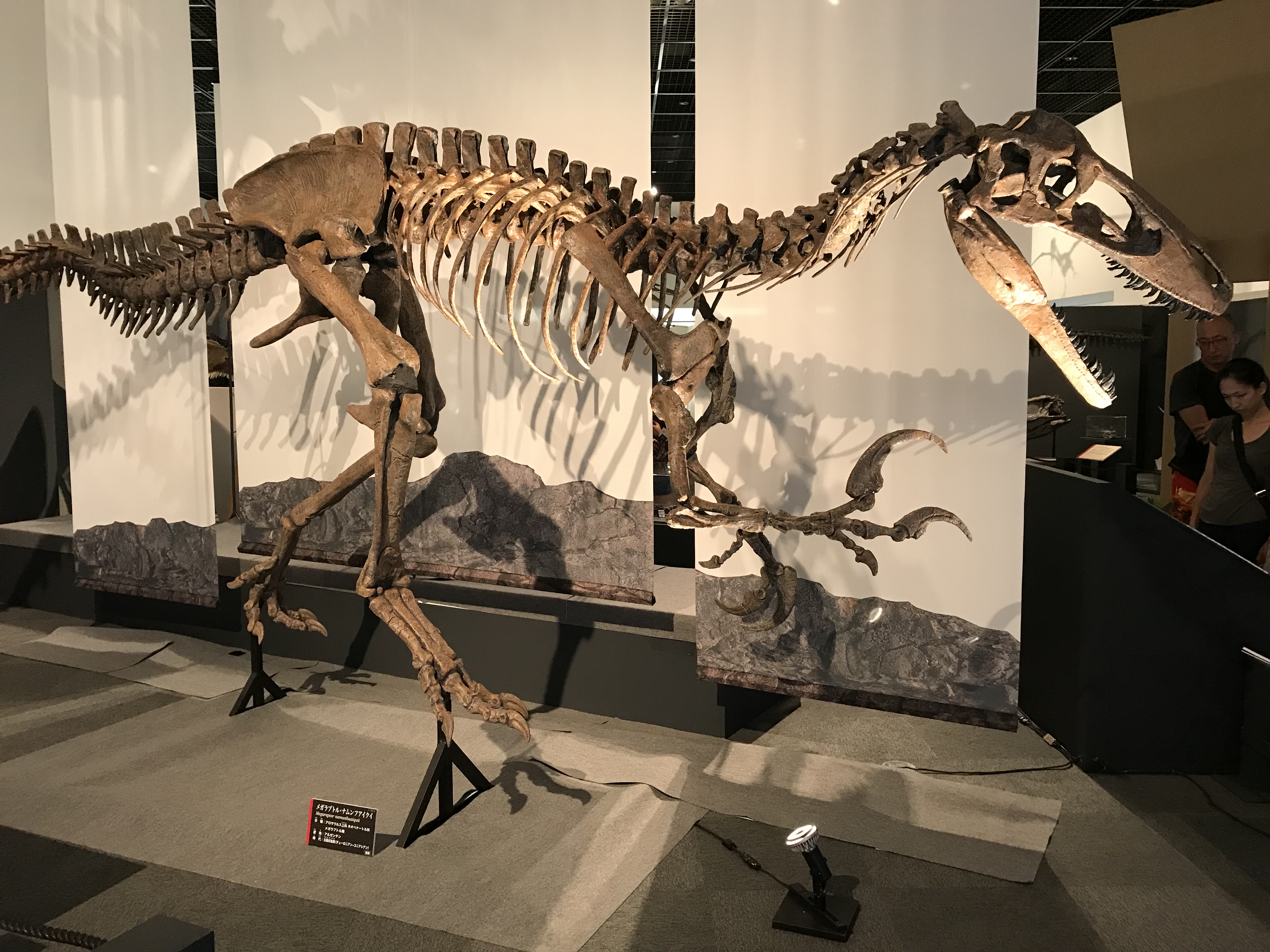
🏛️ Megaraptor Skeletal Mount — Complete Reconstruction

🏛️ Megaraptor Whole Body Skeleton — Dinosaur Expo 2023, Japan

🏛️ Megaraptor Skeletal Display (Photo: Kabacchi)

🏛️ Megaraptor and Fukuiraptor Displayed Together — Dinosaur Expo 2023, Japan
📄 License per uploader | Two megaraptorans from different continents (South America & Asia) side by side | 📍 Tokyo, Japan
📋 Image Source Table — Fossil Evidence & Museum Displays
| Image Description & Caption | Source Link & License |
|---|---|
| Megaraptor hand claw (ungual) — ~35 cm fossil | Wikimedia (JPG) | CC BY-SA 3.0 |
| Claw cast with scale — ruler for size reference | Wikimedia (JPG) | CC BY-SA 3.0 |
| Claw cast, alternate angle — with ruler | Wikimedia (JPG) | CC BY-SA 3.0 |
| Articulated hand fossil — manual elements | Wikimedia (JPG) | CC BY-SA 3.0 |
| Skeletal mount — complete reconstruction | Wikimedia (JPG) | CC BY-SA 3.0 |
| Whole body skeleton — Dinosaur Expo 2023 | Wikimedia (JPG) | License per uploader |
| Museum display — Photo by Kabacchi | Wikimedia (JPG) | CC BY 2.0 |
| Megaraptor & Fukuiraptor together — Dino Expo 2023 | Wikimedia (JPG) | License per uploader |
| Size chart — human scale | Wikimedia (PNG) | CC BY-SA 4.0 |
| Megaraptoridae family size chart | Wikimedia (PNG) | CC BY-SA 4.0 |
🌿 Paleoecology
Megaraptor lived during the Turonian–Coniacian stages (~93–86 Ma) in what is now northwestern Patagonia, Argentina. The Portezuelo Formation preserves a snapshot of a diverse, well-watered Late Cretaceous ecosystem that included titanosaurid sauropods (massive long-necked herbivores), iguanodontian ornithopods, the small dromaeosaurid Unenlagia, fish, pterosaurs, turtles, crocodiles, and a variety of invertebrates. The climate was warm and semi-arid to seasonal, with broad fluvial plains and scattered lakes. Megaraptor was likely an apex or near-apex predator in this environment, possibly hunting sauropod calves, smaller ornithopods, and other mid-sized prey. Its massive forelimb claws may have served as the primary killing weapons — a fundamentally different predatory strategy from the bite-focused approach of tyrannosaurs and carcharodontosaurs.
Following the Cenomanian–Turonian extinction of the carcharodontosaurids in the Southern Hemisphere, megaraptorans appear to have expanded into the ecological niche of top predators in South America. Successive species — from Megaraptor (~90 Ma) through Tratayenia (~85 Ma), Aerosteon (~84 Ma), and ultimately Maip macrothorax (~70 Ma) — show a progressive increase in body size, culminating in animals approaching 10 meters (33 ft) in length. This trend of megaraptoran gigantism parallels the independently-evolved gigantism of tyrannosauroids in the Northern Hemisphere.
🎨 Life Restorations (Paleoart)
Paleoart — the artistic reconstruction of prehistoric life — has played a crucial role in shaping public understanding of Megaraptor. Early restorations (1998–2002) depicted it as a giant dromaeosaurid with an oversized foot claw, inspired by Jurassic Park-era depictions of raptors. After the 2002 reclassification, artists began depicting Megaraptor as a more robustly-built predator with massive arms and hand claws held forward, closer to the posture of a bear or therizinosaurid. Modern restorations typically show a lightly built, long-legged theropod with a relatively small head, long neck, and enormous three-fingered hands dominated by the first-digit claw. Whether Megaraptor bore feathers or filamentous integument remains unknown, though as a possible coelurosaur, some degree of feathering is plausible.

🎨 Megaraptor namunhuaiquii Tracking a Large Sauropod — Life Restoration
📄 License per uploader | Wikimedia Commons | Depicts the apex predator in its Patagonian habitat

🎨 Classic Life Restoration by J. Mallon

🎨 Side Profile Reconstruction by Foolp
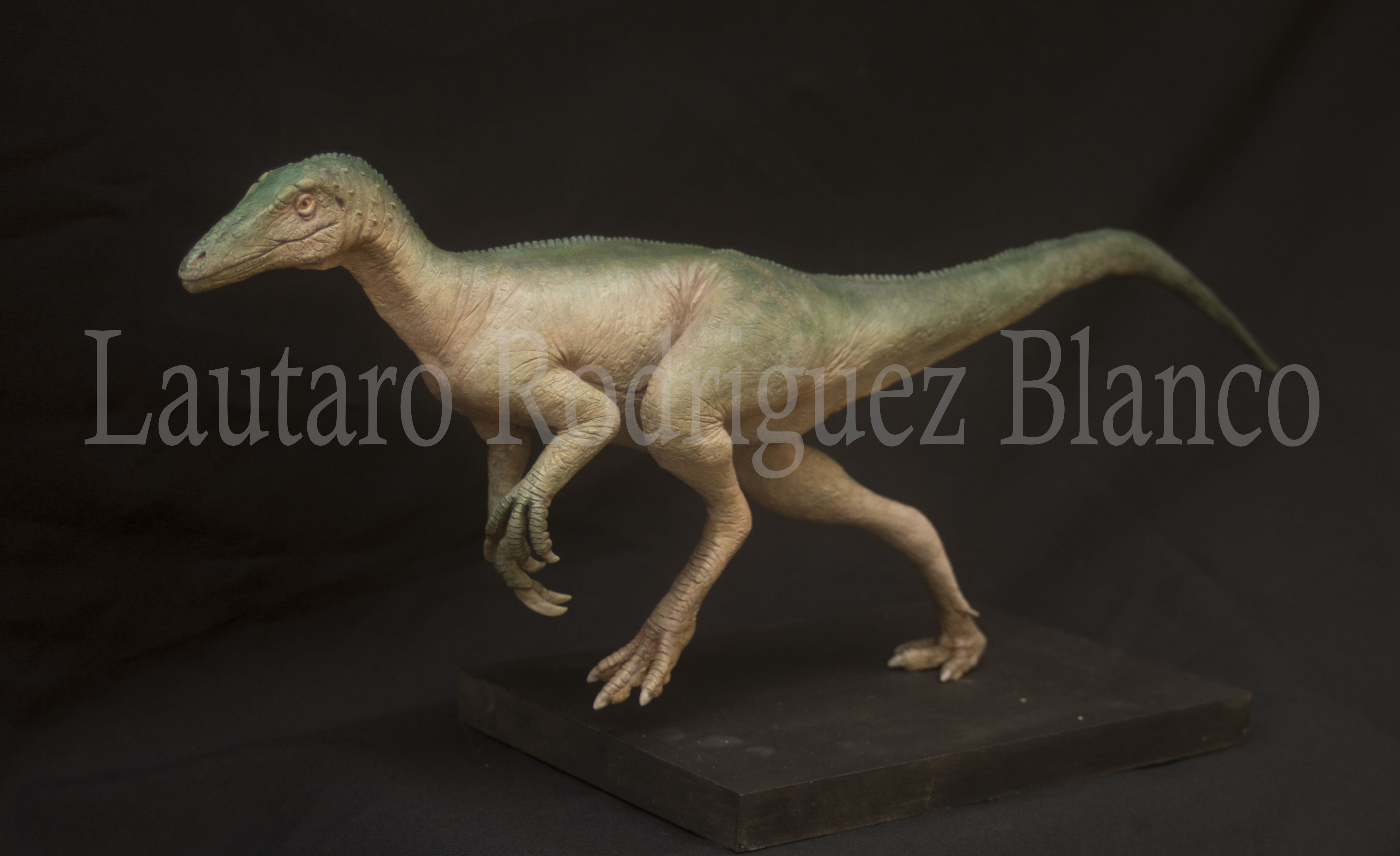
🎨 Reconstruction by Lautaro Rodriguez Blanco

✏️ Juvenile Megaraptor Bust — Pencil Drawing by Tom Parker (2015)

🎨 Megaraptor Illustration by Arcovenator (2012)

🎨 “Large Thief” — by TotalDino
📋 Image Source Table — Life Restorations (Paleoart)
| Image Description & Caption | Source Link & License |
|---|---|
| Megaraptor tracking sauropod | Wikimedia (JPG) | License per uploader |
| J. Mallon classic restoration | Wikimedia (JPG) | CC BY-SA 4.0 |
| Side profile by Foolp | Wikimedia (JPG) | CC BY-SA 4.0 |
| Lautaro Rodriguez Blanco | Wikimedia (JPG) | CC BY-SA 4.0 |
| Tom Parker pencil bust (2015) | Wikimedia (PNG) | CC BY-SA 4.0 |
| Arcovenator illustration (2012) | Wikimedia (PNG) | CC BY-SA 3.0 |
| TotalDino “Large Thief” | Wikimedia (PNG) | CC BY-SA 4.0 |
🎭 Modern Art & Sculpture
Megaraptor has inspired modern artists and sculptors worldwide. One notable example is the aluminium foil sculpture by Tekòlótl — an intricate miniature recreation of the animal crafted entirely from household aluminium foil, demonstrating the dinosaur’s enduring appeal in popular culture and artisanal crafts.

🎭 Megaraptor Aluminium Foil Sculpture by Tekòlótl
📄 License per uploader | Wikimedia Commons | Handcrafted from household aluminium foil
📋 Image Source Table — Modern Art
| Image Description & Caption | Source Link & License |
|---|---|
| Aluminium foil sculpture by Tekòlótl | Wikimedia (JPG) | License per uploader |
🌍 Related Megaraptoridae
The clade Megaraptora includes several related genera from Gondwanan and Laurasian continents. The earliest diverging members come from Asia (Thailand and Japan) and Australia, while the most derived forms — the Megaraptoridae proper — are concentrated in South America. A 2025 biogeographic analysis by Morrison et al. suggests that the ancestral megaraptoran lineage may have been cosmopolitan, present across both supercontinents before they fully separated. As carcharodontosaurids went extinct in the Southern Hemisphere during the mid-Cretaceous, megaraptorans filled the vacant apex-predator niche, growing progressively larger through the Santonian, Campanian, and Maastrichtian stages.
🦖 Australovenator wintonensis (Australia, ~95 Ma)
Australovenator wintonensis, nicknamed “Banjo”, was described in 2009 by Hocknull et al. from the Winton Formation of Queensland, Australia. It is one of the most complete Australian theropods ever discovered. Australovenator is estimated at 5–6 meters in length and shares the enlarged hand claws characteristic of megaraptorans. Its discovery was pivotal in establishing the Gondwanan distribution of the clade and was initially used to argue for an allosauroid affinity for Megaraptora.

🦖 Australovenator wintonensis Skeletal Reconstruction
📄 CC BY-SA 3.0 | Wikimedia Commons | 📍 Winton, Queensland, Australia (−22.3917, 143.0529)
🦖 Fukuiraptor kitadaniensis (Japan, ~120 Ma)
Fukuiraptor kitadaniensis was described in 2000 by Azuma & Currie from the Kitadani Formation in Fukui Prefecture, Japan. At approximately 4.2 meters (14 ft), it represents one of the earliest and most basal megaraptorans — predating the South American radiation by ~30 million years. Its discovery in Asia was critical in establishing the Asian origin hypothesis for the clade. A life-size statue of Fukuiraptor greets visitors at Fukui Station, reflecting the species’ status as a regional icon.

🗿 Fukuiraptor Statue at Fukui Station

🏛️ Skeletal Mount — Okayama (Angle 1)

🏛️ Skeletal Mount — Okayama (Angle 2)

🏛️ Fukuiraptor kitadaniensis Skeletal Display

✋ Fukuiraptor Hands — Manual Unguals Close-Up

🗿 Fukuiraptor Statue in Front of Fukui Station, Japan
📄 CC BY-SA 3.0 | 📍 Fukui Station, Fukui Prefecture, Japan (36.0614, 136.2230)
🦖 Maip macrothorax (Patagonia, ~70 Ma)
Maip macrothorax was described in 2022 by Aranciaga Rolando et al. from the Chorrillo Formation of Santa Cruz Province, southern Patagonia. At an estimated 9–10 meters (30–33 ft) and up to 5 tonnes, it may be the largest megaraptorid ever discovered. The generic name “Maip” references a malicious being in Aonikenk mythology described as the “shadow of death” that “kills with cold wind.” The species name macrothorax refers to its enormous thoracic cavity. Maip lived during the Maastrichtian stage (~70 Ma), making it one of the last megaraptorans before the end-Cretaceous mass extinction.

🎨 Maip macrothorax 3D Reconstruction by Santiago Miner
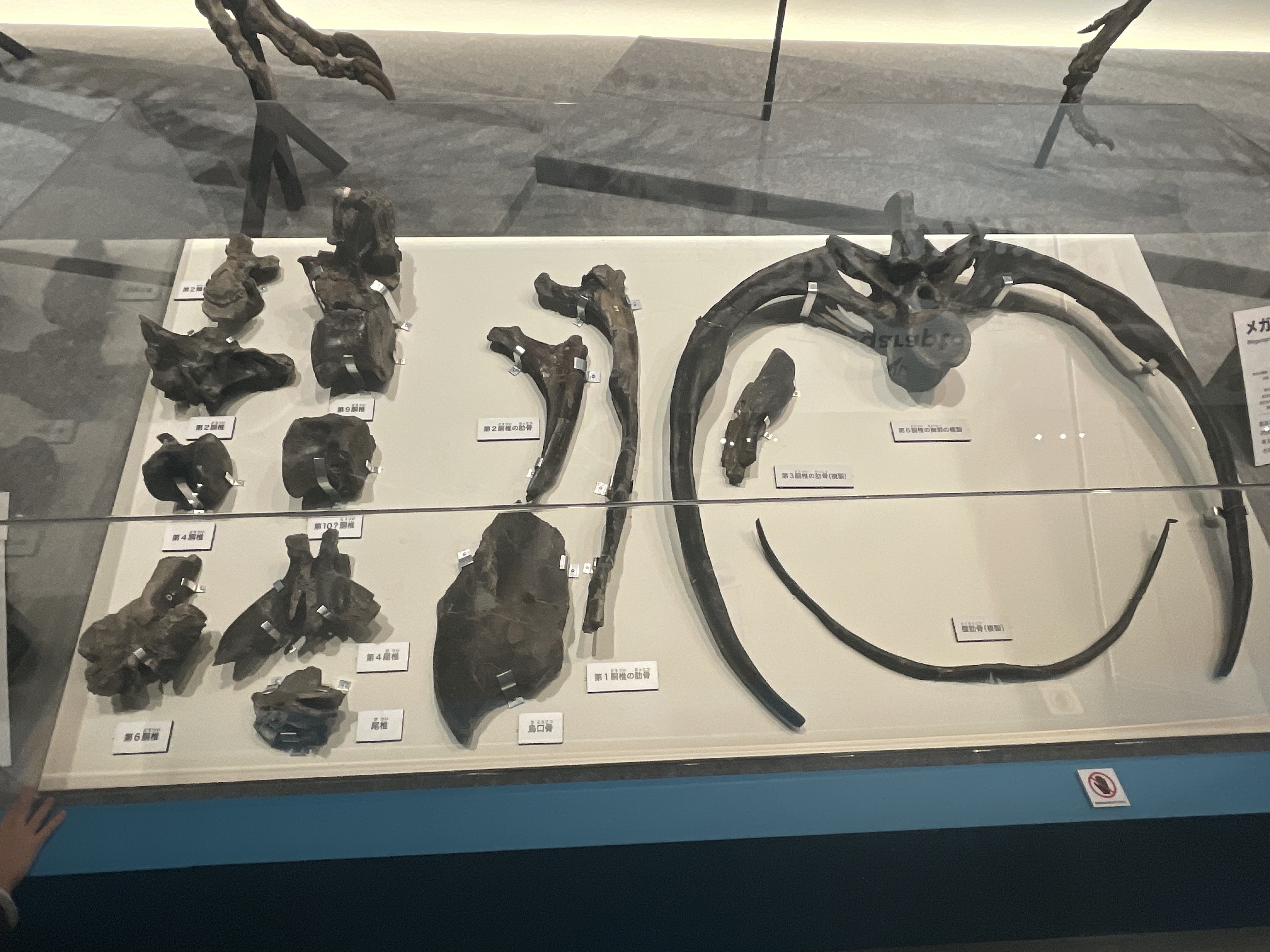
🦴 Maip Holotype Specimen (MPM 21545) — Dinosaur Expo 2023
🦖 Phuwiangvenator yaemniyomi (Thailand, ~130 Ma)
Phuwiangvenator yaemniyomi was described from the Sao Khua Formation of Nakhon Ratchasima Province (formerly attributed to Phu Wiang), Thailand, dating to the Early Cretaceous (~130 Ma, Barremian). It is one of the oldest known megaraptorans globally, supporting the hypothesis that the clade originated in Asia before dispersing to Australia and South America via Gondwanan land bridges.

🦴 Phuwiangvenator — Pedal Elements
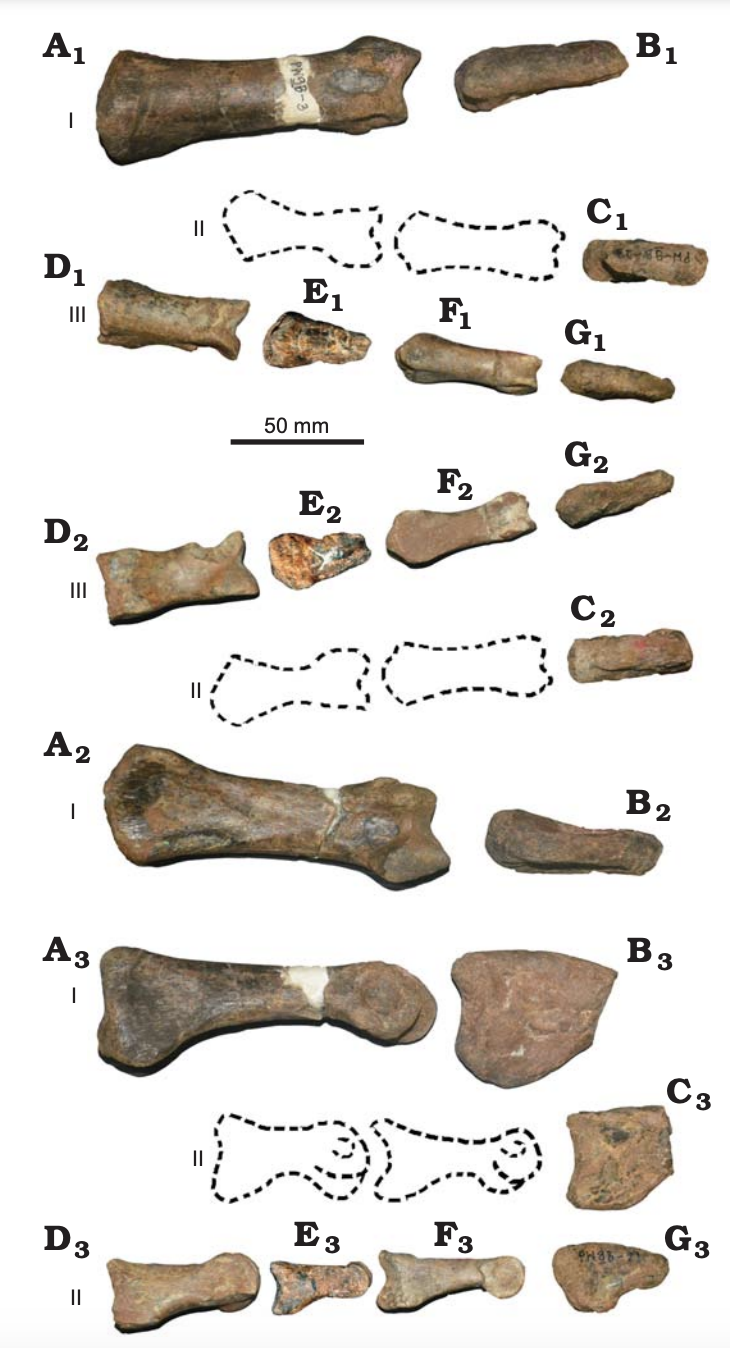
✋ Phuwiangvenator — Manual Elements

🦴 Phuwiangvenator — Metatarsals
🦖 Vayuraptor nongbualamphuensis (Thailand, ~130 Ma)
Vayuraptor nongbualamphuensis was also described from Thailand (~130 Ma, Barremian), from the Sao Khua Formation. The name derives from “Vayu”, the Hindu god of wind, and “raptor” (thief). Known primarily from a left tibia with associated astragalocalcaneum, it represents another basal megaraptoran that supports the Southeast Asian origin of the clade.

🦴 Vayuraptor nongbualamphuensis — Left Tibia with Associated Astragalocalcaneum
📄 CC BY 4.0 | Scientific illustration | 📍 Nong Bua Lamphu Province, Thailand (17.2083, 102.4261)
📋 Image Source Table — Related Megaraptoridae
| Image Description & Caption | Source Link & License |
|---|---|
| Australovenator skeletal reconstruction | Wikimedia (JPG) | CC BY-SA 3.0 |
| Fukuiraptor statue — Fukui Station | Wikimedia (JPG) | CC BY-SA 3.0 |
| Fukuiraptor skeletal mount — Okayama (1) | Wikimedia (JPG) | CC BY-SA 3.0 |
| Fukuiraptor skeletal mount — Okayama (2) | Wikimedia (JPG) | CC BY-SA 3.0 |
| Fukuiraptor kitadaniensis skeletal display | Wikimedia (JPG) | CC BY-SA 3.0 |
| Fukuiraptor hands — manual unguals | Wikimedia (JPG) | CC BY-SA 3.0 |
| Fukuiraptor statue — front of Fukui Station | Wikimedia (JPG) | CC BY-SA 3.0 |
| Maip macrothorax 3D reconstruction | Wikimedia (JPG) | CC BY-SA 4.0 |
| Maip holotype — Dino Expo 2023 | Wikimedia (JPG) | License per uploader |
| Phuwiangvenator feet bones | Wikimedia (PNG) | CC BY 4.0 |
| Phuwiangvenator hand bones | Wikimedia (PNG) | CC BY 4.0 |
| Phuwiangvenator metatarsals | Wikimedia (PNG) | CC BY 4.0 |
| Vayuraptor left tibia | Wikimedia (PNG) | CC BY 4.0 |
📚 Primary Scientific References
- Novas, F.E. (1998). “Megaraptor namunhuaiquii, gen. et sp. nov., a large-clawed, Late Cretaceous theropod from Patagonia.” Journal of Vertebrate Paleontology, 18(1): 4–9. doi:10.1080/02724634.1998.10011030 — Original description of Megaraptor.
- Calvo, J.O.; Porfiri, J.D.; Veralli, C.; Novas, F.E. & Poblete, F. (2004). “Phylogenetic status of Megaraptor namunhuaiquii Novas based on a new specimen from Neuquén, Patagonia, Argentina.” Ameghiniana, 41(4): 565–575. — Demonstrated the giant claw was manual, not pedal.
- Porfiri, J.D.; Novas, F.E.; Calvo, J.O.; Agnolín, F.L.; Ezcurra, M.D. & Cerda, I.A. (2014). “Juvenile specimen of Megaraptor (Dinosauria, Theropoda) sheds light about tyrannosauroid radiation.” Cretaceous Research, 51: 35–55. — Juvenile skull description; coelurosaur/tyrannosauroid hypothesis.
- Ibiricu, L.M. et al. (2025). “Latest Cretaceous megaraptorid theropod dinosaur sheds light on the radiation of the clade across southern South America.” Nature Communications, 16: 4873. doi:10.1038/s41467-025-63793-5 — New genus from Lago Colhué Huapi Formation; latest Cretaceous megaraptorid.
- Morrison, C.; Scherer, C.; O’Callaghan, K.; Layton, R.; Boisvert, C.; Rolando, A.; Durrant, M.; Salas, P.; Allain, R. & Gascoigne, E. (2025). “Gondwanan Origins and Evolution of Megaraptoran Dinosaurs.” Nature Communications. — Biogeographic analysis of Megaraptora and Tyrannosauroidea; cosmopolitan origin hypothesis.
- Aranciaga Rolando, A.M.; Motta, M.J.; Agnolín, F.L.; Manabe, M.; Tsuihiji, T. & Novas, F.E. (2022). “A large Megaraptoridae (Theropoda: Coelurosauria) from Upper Cretaceous (Maastrichtian) of Patagonia, Argentina.” Scientific Reports, 12: 6318. — Description of Maip macrothorax.
- Hocknull, S.A. et al. (2009). “New mid-Cretaceous (latest Albian) dinosaurs from Winton, Queensland, Australia.” PLoS ONE, 4(7): e6190. — Description of Australovenator wintonensis.
- Azuma, Y. & Currie, P.J. (2000). “A new carnosaur (Dinosauria: Theropoda) from the Lower Cretaceous of Japan.” Canadian Journal of Earth Sciences, 37(12): 1735–1753. — Original description of Fukuiraptor kitadaniensis.
- Samathi, A.; Chanthasit, P. & Sander, P.M. (2019). “Two new basal coelurosaurian theropod dinosaurs from the Lower Cretaceous Sao Khua Formation of Thailand.” Acta Palaeontologica Polonica, 64(2): 239–260. — Description of Phuwiangvenator and Vayuraptor.
- Porfiri, J.D.; Calvo, J.O.; dos Santos, D. & Juárez Valieri, R.D. (2018). “A new megaraptoran theropod dinosaur from the Upper Cretaceous of Patagonia, Argentina: Tratayenia rosalesi, gen. et sp. nov.” Cretaceous Research, 83: 1–13. — Expands megaraptorid diversity in Patagonia.
- Benson, R.B.J.; Carrano, M.T. & Brusatte, S.L. (2010). “A new clade of archaic large-bodied predatory dinosaurs (Theropoda: Allosauroidea) that survived to the latest Mesozoic.” Naturwissenschaften, 97: 71–78. — Allosauroid hypothesis for Megaraptora.
- Poropat, S.F. (2018). “A tale of three specimens: two decades of change for Megaraptor.” Blog article with detailed overview. stephenporopat.weebly.com — Accessible summary of classification history.